Superconductivity in the Hubbard model with next-nearest-neighbor hopping
76No. 57 in all physics · No. 7 in Condensed Matter Physics
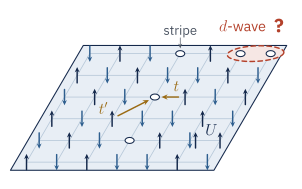
For the square-lattice $t-t'-U$ Hubbard model with $t'/t \sim -0.2\ \text{to}\ -0.3$ and $U/t = 8$, determine the ground-state phase diagram versus hole and electron doping in the thermodynamic limit: presence, magnitude and symmetry of the superconducting order parameter and its coexistence with partially filled stripes or Neel order. An answer is a phase diagram with extrapolated order parameters and an estimate of $T_c/t$.
What would settle it
Thermodynamic-limit extrapolations from DMRG on wide cylinders, AFQMC and tensor networks that agree on the phase boundaries and order-parameter magnitudes.
Status in the literature
Unverified note: it names recent work and was partly written without a live literature search; it awaits a check by an editor.
DMRG and AFQMC (2024) found d-wave order coexisting with partially filled stripes on the hole-doped side and with Neel order on the electron-doped side.
No solutions, ideas or subproblems yet.
See also
- Related Maximum $T_c$ from purely repulsive electron interactions
- Related What interaction binds electrons into pairs in the cuprates?
- Related Does the pure square-lattice Hubbard model superconduct at moderate doping?
Details, signature and history
- Kind
- Well-posed question
- Answer
- Classification
- Topic review
- M. Qin, T. Schaefer, S. Andergassen, P. Corboz, E. Gull, The Hubbard model: a computational perspective, Annual Review of Condensed Matter Physics, 2022. Link
- Record
- Revision 1 · imported from the seed collection · compiled by AI, not yet reviewed by an editor
Proof
- Fingerprint
- 2a1f5e43304b…
- Public log
- Entry 1,027, in checkpoint 2,123
- In the log by
- Block 969,698, 2026-10-03
This text was in the PubPhys log by that date. The date says nothing about when the problem was first posed.
Comments (0)
Comments are not records: they are not signed, stamped or logged. How comments work
No comments yet.
Sign in to comment.