This browser is older than PubPhys supports. Every page can be read, but signing in to contribute, voting and signing need Safari 15.4, Chrome or Edge 99, Firefox 97 or newer. Browsers
All problems
1,762 problems
Starting order drafted by AI. Votes change it. How ranking works
-
AI-generated illustration
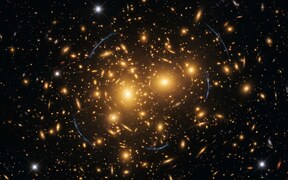
What is dark matter made of?
Open 93Determine the microscopic identity (mass, spin, non-gravitational couplings, production mechanism) of the non-baryonic component with $\Omega_c h^{2} = 0.120 \pm 0.001$ inferred from the CMB in LCDM. An answer is a candidate confirmed by a reproducible non-gravitational signal (direct, indirect or collider detection, or a compact-object census) whose abundance accounts for $\Omega_c$.
-
AI-generated illustration
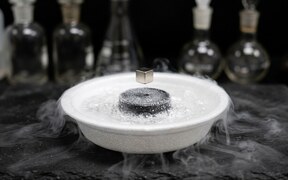
Determine whether any thermodynamically stable or long-lived metastable material has $T_c \ge 300\ \mathrm{K}$ at ambient pressure. The ambient-pressure record is 151 K in pressure-quenched HgBa2Ca2Cu3O8+d (2026). An answer is a reproduced zero-resistance and Meissner measurement above 300 K at 1 bar, or a proof that a defined class of realistic materials cannot exceed a stated $T_c$ below 300 K.
-
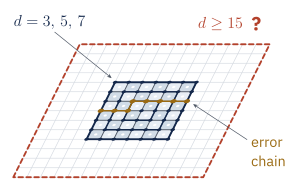
For surface-code memories on superconducting hardware, the logical error per cycle is modeled as $\epsilon_L(d) \sim A \Lambda^{-(d+1)/2}$ with code distance $d$; Google Quantum AI (Nature 638, 920, 2025, arXiv:2408.13687) reported $\Lambda$ of about 2.1 up to $d = 7$. Determine whether this law holds to $d \ge 15 \text{ and } \epsilon_L \le 10^{-10}$ per cycle, or whether correlated, leakage or drift events produce a floor; the answer is the measured $\epsilon_L(d)$ curve or a validated model of its floor.
-
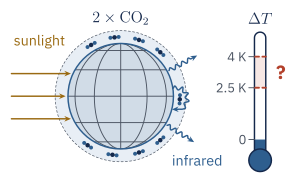
What is Earth's equilibrium climate sensitivity?
Partially resolved 88Equilibrium climate sensitivity (ECS) is the equilibrium global-mean surface air temperature change for doubled $\mathrm{CO_2}$ (forcing about $4\mathrm{e}3\,\mathrm{erg}/(\mathrm{s}\,\mathrm{cm}^{2})$). The 2020 multi-evidence assessment gives a 66 percent range of about $2.6\ \text{to}\ 3.9\,\mathrm{K}$ and the 2021 IPCC assessment a likely range of $2.5\ \text{to}\ 4\,\mathrm{K}$. An answer is a 66 percent range narrower than $1\,\mathrm{K}$ consistent with process, historical and paleoclimate evidence.
-
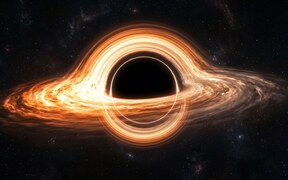
AI-generated illustration
For a named candidate completion of $3+1$ gravity coupled to the Standard Model (string theory, asymptotic safety, loop quantum gravity, causal dynamical triangulations, Horava gravity or another), derive a low-energy observable, at energies far below $E_P=\sqrt{\hbar c^5/G}$, approximately $1.2 \times 10^{19}$ GeV ($2 \times 10^{16}$ erg), whose predicted deviation from general relativity plus the Standard Model is computed with stated uncertainty and is within reach of current or planned measurements. An answer is a falsifiable prediction with a stated magnitude that distinguishes the candidate from the alternatives.
-
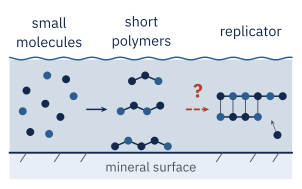
Identify a sequence of chemically and geologically plausible steps, with rates under stated early-Earth conditions (temperature, pH, mineral surfaces, wet-dry cycles), that takes a mixture of small prebiotic molecules to a population of informational polymers that replicate with heritable variation and undergo Darwinian selection. A complete answer specifies each step and demonstrates the chain in the laboratory or in a quantitative model with measured rate constants.
-
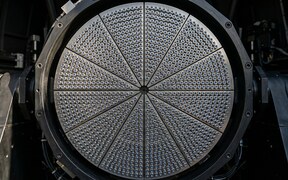
AI-generated illustration
Is the dark energy density constant in time?
Contested 86In the parametrization $w(a) = w0 + wa (1 - a)$, with w the pressure-to-density ratio and a the scale factor, determine whether $(w0, wa) = (-1, 0)$ is excluded at $5\sigma$ by baryon acoustic oscillations, CMB and type Ia supernovae. DESI DR2 BAO plus CMB plus DES-Dovekie supernovae give $w0 = -0.803 \pm 0.054, wa = -0.72 \pm 0.21$. Answer yes or no at $5\sigma$ with datasets whose systematics are independently validated.
-
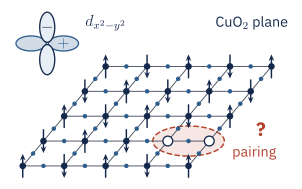
Identify the dominant pairing interaction behind $d_{(x^{2}-y^{2})}$ superconductivity in hole-doped $\mathrm{CuO_2}$ planes (candidates: antiferromagnetic superexchange $J \sim 0.13\ \mathrm{eV}$ and spin fluctuations, charge-transfer fluctuations, phonons, or a combination). An answer is a microscopic mechanism that predicts $T_c(p)$ and the gap magnitude across cuprate families within a factor of order one and passes material-specific tests (isotope effect, pressure dependence, family dependence of $T_c,\mathrm{max}$).
-
AI-generated illustration
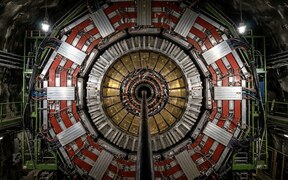
In the SM with a cutoff $\Lambda$, the top loop gives $\delta m_h^{2} \sim -(3 y_t^{2}/(8 \pi^{2})) \Lambda^{2}$, so $m_h = 125\,\mathrm{GeV}$ with $\Lambda \sim M_{\mathrm{Pl}} \sim 1.2 \times 10^{19}\,\mathrm{GeV}$ requires cancellation to about 1 part in $10^{33}$. An answer is a mechanism (symmetry, compositeness, dynamics or selection) that yields $v = 246\,\mathrm{GeV}$ with at most mild tuning and is consistent with all LHC data.
-
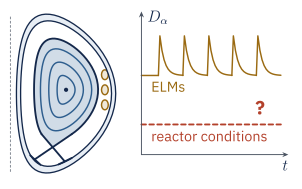
Candidate regimes are QH-mode (edge harmonic oscillation), I-mode, EDA H-mode, small or grassy ELM regimes (quasi-continuous exhaust) and negative-triangularity L-mode edges. Determine whether at least one achieves $H_{98}$ near 1, no type-I ELMs and a detached divertor simultaneously at reactor-relevant $n_{e}/n_{G}$ of about 0.8 or more, low external torque, high separatrix density and pedestal collisionality as low as ITER $Q = 10$. An answer is a demonstrated discharge meeting all conditions on one device, or a validated stability analysis showing that each regime's access window excludes them.
-
AI-generated illustration
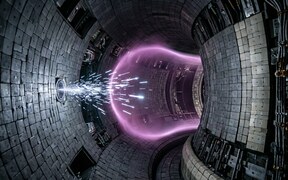
In ITER disruptions mitigated by shattered pellet injection (SPI, fragmented $\mathrm{D_2}$ and Ne pellets), a small runaway seed from hot-tail generation, tritium beta decay and Compton scattering of gamma rays from the activated wall is amplified by avalanche multiplication. Compute the final runaway current versus injected D and Ne quantities, including losses through stochastic magnetic fields during the thermal quench and runaway-driven kinetic instabilities, and determine whether any injection scheme keeps the runaway current below the wall-tolerable level.
-
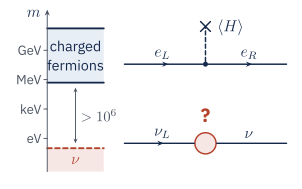
Identify the origin of $m_{\nu} < \sim 0.1\ \mathrm{eV}$: Dirac Yukawas with $y \sim 10^{-12}$ plus right-handed neutrinos, the type I, II or III seesaw ($m_{\nu} \sim y^2 v^2 / M$), or radiative and low-scale mechanisms. An answer is the mechanism together with its scale, confirmed by a signature such as lepton number violation or heavy neutral leptons.
-
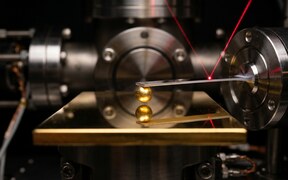
AI-generated illustration
The observed dark energy density is $\rho_{\Lambda} \sim 6 \times 10^{-30}\ \mathrm{g}/\mathrm{cm}^{3}$, i.e. $\rho_{\Lambda}^{1/4} \sim 2.3 \times 10^{-3}\ \mathrm{eV}$ in natural units, while Standard Model contributions (electroweak symmetry breaking ~ $(100\ \mathrm{GeV})^{4}$, QCD ~ $(0.2\ \mathrm{GeV})^{4}$) exceed it by $\sim 10^{55}$ and $\sim 10^{44}$, and a Planck-scale cutoff by $\sim 10^{123}$ (often quoted as $10^{120}$, using the reduced Planck mass). Find a mechanism that yields the observed value without tuning to that precision, or show that environmental selection in a multiverse is the only consistent explanation.
-
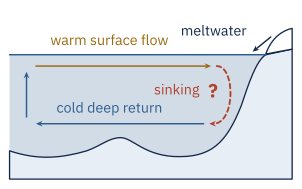
Determine whether the present AMOC (about $17\,\mathrm{Sv}$ at $26.5\,\mathrm{N}$, $1\,\mathrm{Sv} = 10^{12}\,\mathrm{cm}^3/\mathrm{s}$) is bistable and, if so, the critical North Atlantic freshwater flux or global warming level at which the strong state disappears, including the timescale of the transition. An answer is a threshold value with uncertainty from models whose salt-advection feedback and mean salinity biases are constrained by observations.
-
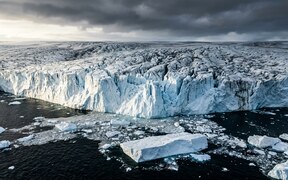
AI-generated illustration
Is West Antarctic retreat already irreversible?
Contested 84For the Amundsen Sea sector (Thwaites and Pine Island glaciers), determine whether grounding lines have passed a marine ice-sheet instability threshold such that retreat continues under present or even reduced ocean forcing, accounting for bedrock uplift, ice-shelf buttressing and basal friction laws. An answer is a yes or no with the committed sea-level contribution (Amundsen Sea sector potential about 120 cm, whole West Antarctic ice sheet about 330 cm) and its timescale.
-
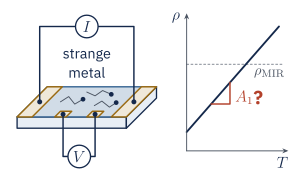
Explain $\rho(T) = \rho_0 + A_1 T$ persisting from T well below the Fermi temperature up to and beyond the Mott-Ioffe-Regel limit without saturation, near quantum critical points in cuprates ($p \sim p*$), $\mathrm{YbRh_2Si_2}$ and other materials. An answer is a controlled theory of a metal without long-lived quasiparticles in two or three dimensions that yields T-linear resistivity with the measured slope $A_1$ and its doping or field dependence.
-
AI-generated illustration
For systems of 100 to 1000 atoms (molecular crystal lattice energies, host-guest binding, molecules adsorbed on metal or oxide surfaces), devise an electronic-structure method with computational cost scaling at most as $O(N^3)$ in system size $N$ that delivers interaction or reaction energies within $1\,\mathrm{kcal}/\mathrm{mol}$ of the exact Born-Oppenheimer value with a computed, verifiable error estimate. An answer is the method with benchmark evidence against converged references, or a complexity argument showing the target is unattainable for a stated class of methods.
-
Does the QCD axion exist?
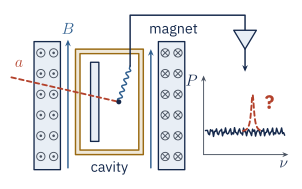
Open 84Determine whether a pseudoscalar a with $m_a \sim 5.7\ \mathrm{micro-eV}\ (10^{12}\ \mathrm{GeV}/f_a)$ and photon coupling $g_{agamma}$ inside the QCD axion band (KSVZ to DFSZ and beyond) exists, for $f_a\ \text{between}\ \sim 10^{8}\ \text{and}\ \sim 10^{17}\ \mathrm{GeV}$. An answer is a detection with $m_a$ and $g_{agamma}$ consistent with the QCD mass-decay constant relation, or exclusion of the band over the full range.
-
AI-generated illustration
Explain $\eta_B = n_B/n_\gamma \sim 6.1 \times 10^{-10}$ (CMB and BBN) satisfying the Sakharov conditions, given that SM CP violation and the SM crossover fail by many orders of magnitude. An answer is a mechanism (thermal or resonant leptogenesis, electroweak baryogenesis, Affleck-Dine, or others) with an independent experimental confirmation.
-
How strongly do low marine clouds amplify warming?
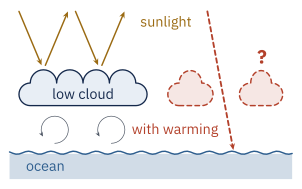
Partially resolved 83Determine the global low-cloud feedback parameter (stratocumulus and trade cumulus over the subtropical oceans) in $\mathrm{erg}/(\mathrm{s}\,\mathrm{cm}^{2}\,\mathrm{K})$; current assessments center near $+2 \times 10^{2}\,\mathrm{erg}/(\mathrm{s}\,\mathrm{cm}^{2}\,\mathrm{K})$ with large uncertainty. An answer is a value with uncertainty below about $10^{2}\,\mathrm{erg}/(\mathrm{s}\,\mathrm{cm}^{2}\,\mathrm{K})$ supported by large-eddy simulations and observed cloud-controlling-factor relations.
-
AI-generated illustration
Establish or refute an inflationary epoch by a signature that alternatives cannot reproduce, such as a nearly scale-invariant primordial tensor spectrum with tilt $n_t = -r/8$ (single-field consistency relation); refutation requires a demonstration that a non-inflationary model reproduces all CMB and large-scale-structure data including any detected tensor modes. For r below $\sim 0.01$ the consistency relation cannot be measured, and a yes answer then requires a detected tensor spectrum with amplitude and scale dependence that non-inflationary models are shown unable to produce.
-
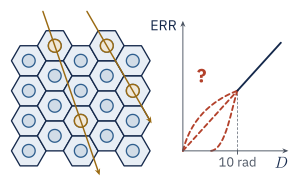
Does risk stay linear below 10 rad?
Contested 83Determine the shape of the dose-response relation for solid-cancer incidence below 10 rad ($1\,\mathrm{rad}=100\,\mathrm{erg}/\mathrm{g}$) of low-linear-energy-transfer radiation: linear without threshold, linear-quadratic, threshold, or non-monotonic. The answer must handle dose-measurement error, confounding and reverse causation at effect sizes of about 5 percent excess relative risk per 10 rad (ERR about 0.5 per 100 rad), falling to about 0.5 percent at 1 rad. An answer is a shape with confidence intervals excluding the alternatives.
-
AI-generated illustration
Determine whether lepton number is violated by Majorana neutrino masses via neutrinoless double beta decay, with half-life T_1/2 $\sim 10^{26}$ to $10^{28}$ yr for $m_{bb} \sim 10\ \text{to}\ 50\ \mathrm{meV}$. KamLAND-Zen (2024) gives T_1/2(Xe-136) > $3.8 \times 10^{26}$ yr, $m_{bb} < \sim 28\ \text{to}\ 122\ \mathrm{meV}$ (spread from nuclear matrix elements).
-
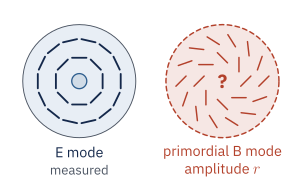
Measure the tensor-to-scalar ratio r at pivot $k = 0.05\ \mathrm{Mpc}^{-1}$, which fixes the inflation energy scale $V^{(1/4)} \sim 1.04 \times 10^{16}\ \mathrm{GeV}\ (r / 0.01)^{(1/4)}$. Current bound $r < 0.036$ (95 percent, BICEP/Keck 2021), $r < 0.038$ with ACT DR6. An answer is a detection or a bound $r < 0.001$ after delensing and foreground separation.
-
AI-generated illustration
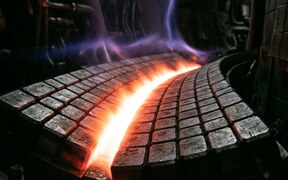
A multi-machine regression gives an inter-ELM heat flux width $\lambda_{q}$ inversely proportional to the outboard-midplane poloidal field, extrapolating to about $0.1\,\mathrm{cm}$ for ITER, while gyrokinetic XGC simulations predict about $0.5\,\mathrm{cm}$. Determine $\lambda_{q}$ for the ITER $Q = 10$ baseline to within 30 percent and identify the mechanism (magnetic drifts versus edge turbulence) that sets it.
-
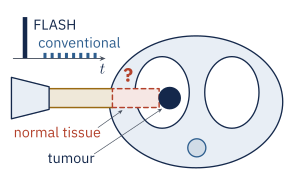
Determine whether single-fraction doses of 800 to 3000 rad delivered at mean dose rates above 4000 rad/s produce measurably lower normal-tissue toxicity in humans than the same dose at conventional dose rates of 1 to 10 rad/s, at matched tumour control, for at least one tissue and endpoint. An answer is yes or no with an estimated dose-modifying factor and confidence interval.
-
AI-generated illustration
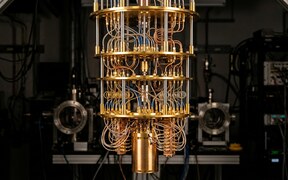
Fix a size-indexed chemical family, for example iron-sulfur clusters with $N_{\mathrm{Fe}} = 2, 4, 8, ...$ iron centers and active spaces of N orbitals growing linearly with $N_{\mathrm{Fe}}$, or linear transition-metal chains of length N. For ground-state energy to chemical accuracy ($1.6\,\mathrm{mHa}$), compare the scaling with N of the best classical cost (DMRG, coupled cluster, selected CI, quantum Monte Carlo) with that of quantum phase estimation including the cost of preparing a state with sufficient ground-state overlap; decide whether the ratio grows exponentially in N. Lee et al. (arXiv:2208.02199, Nature Communications 2023) found no evidence of a generic exponential advantage.
-
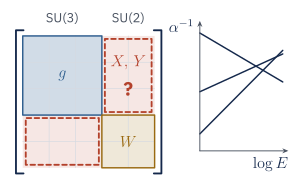
Determine whether SU(3) x SU(2) x U(1) embeds in a simple group ($\mathrm{SU}(5), \mathrm{SO}(10), \mathrm{E6}$) broken near $M_{\mathrm{GUT}} \sim 10^{15}\ \text{to}\ 10^{16}\,\mathrm{GeV}$. In the SM the three couplings do not meet at a point; in the MSSM they meet at $\sim 2 \times 10^{16}\,\mathrm{GeV}$. An answer is an observation of a unification-specific effect such as proton decay with a branching pattern fixed by the group.
-
AI-generated illustration
What causes the Hubble tension?
Contested 81Write $H0 = h x 3.24 \times 10^{-18}\ \mathrm{s}^{-1}$. The SH0ES Cepheid plus type Ia supernova ladder gives $h = 0.730 \pm 0.010$, while Planck CMB in LCDM gives $h = 0.674 \pm 0.005$. Identify whether the discrepancy comes from distance-ladder systematics, from physics before recombination that shrinks the sound horizon, or from late-time physics, with a model that fits all data at least as well as LCDM.
-
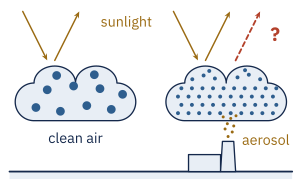
The industrial-era total aerosol effective radiative forcing has a 68 percent range of about $-1.6 \times 10^{3} \text{ to } -0.65 \times 10^{3}\,\mathrm{erg}/(\mathrm{s}\,\mathrm{cm}^2)$ (Bellouin and coauthors, Reviews of Geophysics 2020, https://doi.org/10.1029/2019RG000660), dominated by aerosol-cloud interactions (droplet number, liquid-water-path and cloud-fraction adjustments). Determine this forcing with a 68 percent range narrower than about $4 \times 10^{2}\,\mathrm{erg}/(\mathrm{s}\,\mathrm{cm}^2)$. An answer is a value supported by process-level observations of cloud adjustments and consistent with the historical and interhemispheric temperature record.