Interferometric proof of non-Abelian braiding statistics
74No. 80 in all physics · No. 10 in Condensed Matter Physics
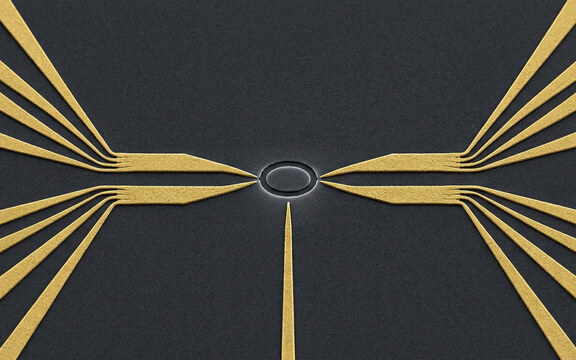
In a Fabry-Perot interferometer at $\nu = 5/2$ (GaAs) or at even-denominator states in bilayer graphene, demonstrate the even-odd effect: Aharonov-Bohm oscillations of $e/4$ quasiparticles vanish when the enclosed number of $e/4$ quasiparticles is odd and reappear, with phase shifts given by Ising braiding, when it is even. An answer is reproducible data in independent devices that exclude Coulomb-dominated and Abelian explanations.
What would settle it
Independent control of enclosed flux and quasiparticle number showing the parity-dependent suppression with the predicted phase, replicated by a second group.
Status in the literature
Unverified note: it names recent work and was partly written without a live literature search; it awaits a check by an editor.
Bilayer-graphene interferometers (2024-2026; e.g., arXiv:2603.11162) report selective braiding consistent with non-Abelian anyons, and an August 2026 preprint (arXiv:2608.12897) reports time-domain braiding at $5/2$; independent confirmation is pending.
No solutions, ideas or subproblems yet.
See also
- Related Which topological order describes the $5/2$ quantum Hall state?
- Related Topological order of even-denominator states in bilayer graphene
Details, signature and history
- Kind
- Well-posed question
- Answer
- Yes no
- Posed
- 2006
- Topic review
- C. Nayak, S. H. Simon, A. Stern, M. Freedman, S. Das Sarma, Non-Abelian anyons and topological quantum computation, Reviews of Modern Physics, 2008. Link
- Record
- Revision 1 · imported from the seed collection · compiled by AI, not yet reviewed by an editor
Proof
- Fingerprint
- e69dbea5aa76…
- Public log
- Entry 1,113, in checkpoint 2,123
- In the log by
- Block 969,698, 2026-10-03
This text was in the PubPhys log by that date. The date says nothing about when the problem was first posed.
Comments (0)
Comments are not records: they are not signed, stamped or logged. How comments work
No comments yet.
Sign in to comment.