Microscopic basis of Archard's wear law
73No. 85 in all physics · No. 4 in Soft Matter and Biological Physics
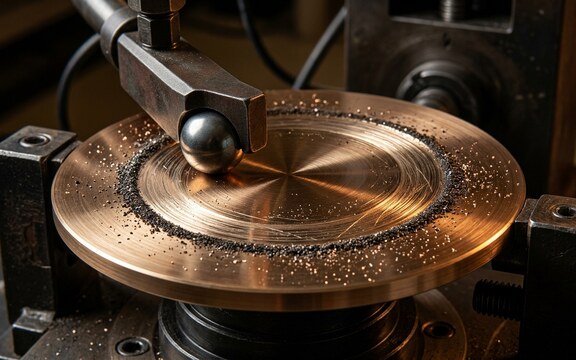
The amount of material lost by wear grows in proportion to load and sliding distance, but the proportionality constant varies by a factor of a million between materials and cannot be predicted. Its link to what happens at single contacts is unclear.
Status in the literature
Unverified note: it names recent work and was partly written without a live literature search; it awaits a check by an editor.
Atomistic simulations since 2016 identify a critical junction size for debris formation; quantitative prediction of K for real surfaces is lacking (2026).
No solutions, ideas or subproblems yet.
Details, signature and history
- Kind
- Phenomenon to explain
- Answer
- Mechanism
- Topic review
- A. Vanossi, N. Manini, M. Urbakh, S. Zapperi, E. Tosatti, Colloquium: Modeling friction: From nanoscale to mesoscale, Reviews of Modern Physics, 2013. Link
- Record
- Revision 2 · notation repaired by the platform · compiled by AI, not yet reviewed by an editor
- Batch approval
- Approved for the batch by Victor Galitski (ORCID 0000-0001-5532-1096) · approval record · bundle This approves the batch, not each problem (what it means).
- Earlier revisions
- revision 1 bundle
Proof
- Fingerprint
- ff41ca193e41…
- Public log
- Entry 773, in checkpoint 2,123
- In the log by
- Block 969,698, 2026-10-03
This text was in the PubPhys log by that date. The date says nothing about when the problem was first posed.
Comments (0)
Comments are not records: they are not signed, stamped or logged. How comments work
No comments yet.
Sign in to comment.