Sustained exponential self-replication by a polymerase ribozyme
78No. 39 in all physics · No. 3 in Soft Matter and Biological Physics
This text mentions work from 2024 on. Those parts were partly written without a live literature search and have not been checked by an editor yet.
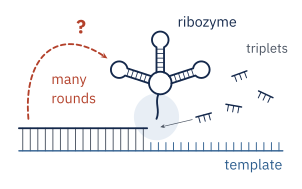
In the RNA-world idea, early life used RNA both as genes and as enzymes, which requires an RNA able to copy itself. In 2026 a 45-nucleotide RNA enzyme copied itself and its partner strand, but too slowly and too inaccurately for its numbers to keep growing over many rounds.
Status in the literature
Unverified note: it names recent work and was partly written without a live literature search; it awaits a check by an editor.
In 2026 the 45-nucleotide ribozyme QT45 synthesized its complementary strand ($94.1\%$ fidelity) and a copy of itself at about $0.2\%$ yield in $72\,\mathrm{days}$; sustained self-replication has not been reported (Science, doi 10.1126/science.adt2760).
Parent problems
- Special case of How chemistry produced the first evolving replicator · open · from revision 1
No solutions, ideas or subproblems yet.
See also
- Related Separating copied RNA strands for repeated nonenzymatic copying
- Related Escape from Eigen's paradox for prebiotic genomes
Details, signature and history
- Kind
- Well-posed question
- Answer
- Yes no
- Topic review
- Jack W. Szostak, David P. Bartel, P. Luigi Luisi, Synthesizing life, Nature, 2001. Link
- Record
- Revision 2 · notation repaired by the platform · compiled by AI, not yet reviewed by an editor
- Batch approval
- Approved for the batch by Victor Galitski (ORCID 0000-0001-5532-1096) · approval record · bundle This approves the batch, not each problem (what it means).
- Earlier revisions
- revision 1 bundle
Proof
- Fingerprint
- f090f5868ce5…
- Public log
- Entry 820, in checkpoint 2,123
- In the log by
- Block 969,698, 2026-10-03
This text was in the PubPhys log by that date. The date says nothing about when the problem was first posed.
Comments (0)
Comments are not records: they are not signed, stamped or logged. How comments work
No comments yet.
Sign in to comment.