Is there a hydride superconducting above 77 K at ambient pressure?
80No. 33 in all physics · No. 4 in Condensed Matter Physics
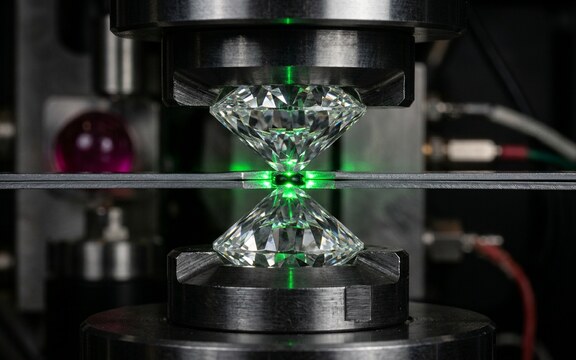
Determine whether any thermodynamically stable or long-lived metastable hydride has $T_c > 77\ \mathrm{K}$ at ambient pressure. An answer is a synthesized compound with zero resistance and diamagnetic shielding above 77 K at 1 bar, or a computational search with stated completeness showing none exists among a defined class.
What would settle it
Synthesis and characterization of a predicted candidate with resistive and magnetic transitions above 77 K at ambient pressure.
Status in the literature
Unverified note: it names recent work and was partly written without a live literature search; it awaits a check by an editor.
Calculations (2024) predicted $\mathrm{Mg_2IrH_6}$ with $T_{c}$ above $100\,\mathrm{K}$ at ambient pressure; no superconducting sample has been reported.
No solutions, ideas or subproblems yet.
See also
Details, signature and history
- Kind
- Well-posed question
- Answer
- Yes no
- Topic review
- A. P. Drozdov, M. I. Eremets, I. A. Troyan, V. Ksenofontov, S. I. Shylin, Conventional superconductivity at 203 kelvin at high pressures in the sulfur hydride system, Nature, 2015. Link
- Record
- Revision 2 · notation repaired by the platform · compiled by AI, not yet reviewed by an editor
- Batch approval
- Approved for the batch by Victor Galitski (ORCID 0000-0001-5532-1096) · approval record · bundle This approves the batch, not each problem (what it means).
- Earlier revisions
- revision 1 bundle
Proof
- Fingerprint
- 4b0b7a8cc6c7…
- Public log
- Entry 1,029, in checkpoint 2,123
- In the log by
- Block 969,698, 2026-10-03
This text was in the PubPhys log by that date. The date says nothing about when the problem was first posed.
Comments (0)
Comments are not records: they are not signed, stamped or logged. How comments work
No comments yet.
Sign in to comment.