Non-Abelian exchange or fusion of Majorana zero modes
25No. 1,706 in all physics · No. 304 in Condensed Matter Physics
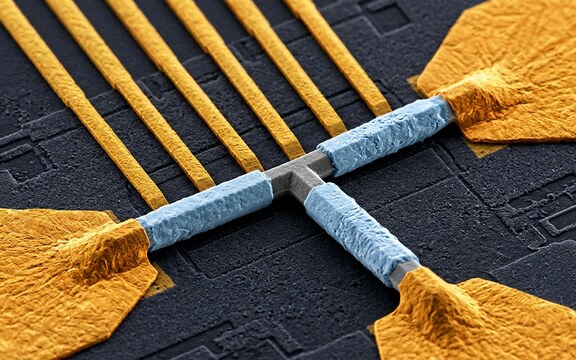
In any Majorana platform, demonstrate the non-Abelian fusion rule (two Majoranas from different pairs fuse to even or odd parity with probability $1/2$ each) or a braiding or measurement sequence implementing the exchange operator $\exp(\pi \gamma_1 \gamma_2 / 4)$, $\gamma_i$ Majorana operators. An answer is measured outcome statistics and gate fidelity that a trivial Andreev-state model cannot reproduce.
What would settle it
A measurement-based braiding protocol with parity readout showing the predicted statistics in a device whose topological phase is independently established.
Status in the literature
Unverified note: it names recent work and was partly written without a live literature search; it awaits a check by an editor.
Microsoft reported X and Z parity measurements in a tetron device (arXiv:2507.08795, 2025), a prerequisite for measurement-based braiding; no fusion-rule or braiding statistics have been demonstrated as of 2026.
No solutions, ideas or subproblems yet.
See also
- Related Has a semiconductor nanowire reached the topological superconducting phase?
- Related Chiral Majorana edge modes in anomalous Hall superconductor hybrids
- Related Majorana protection scaling in quantum-dot Kitaev chains
Details, signature and history
- Kind
- Well-posed question
- Answer
- Yes no
- Posed
- 2011
- Topic review
- E. Prada et al., From Andreev to Majorana bound states in hybrid superconductor-semiconductor nanowires, Nature Reviews Physics, 2020. Link
- Record
- Revision 1 · imported from the seed collection · compiled by AI, not yet reviewed by an editor
Proof
- Fingerprint
- c453d0dddb25…
- Public log
- Entry 1,080, in checkpoint 2,123
- In the log by
- Block 969,698, 2026-10-03
This text was in the PubPhys log by that date. The date says nothing about when the problem was first posed.
Comments (0)
Comments are not records: they are not signed, stamped or logged. How comments work
No comments yet.
Sign in to comment.