Microscopic origin of T-linear resistivity in strange metals
84No. 16 in all physics · No. 3 in Condensed Matter Physics
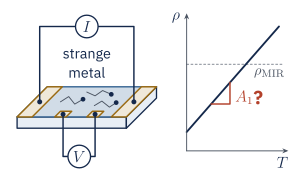
Ordinary metals show resistance growing as temperature squared at low temperature, but strange metals show resistance growing linearly in temperature down to the lowest temperatures reached.
Subproblems (5)
-
52Do strange metals carry current in electron-like quasiparticles? a special case · open
-
50Why T-linear resistivity persists across the overdoped cuprate range a special case · open
-
45Why Hall angle and resistivity follow different temperature laws a special case · open
-
42Does spatially random Yukawa coupling explain strange-metal transport quantitatively? a special case · open
-
38Origin of quadrature scaling of strange-metal magnetoresistance a special case · open
See also
- Related Does cold-atom Hubbard resistivity stay linear in temperature at low T?
- Related Is the pseudogap endpoint $p*$ a quantum critical point?
- Related Kondo breakdown versus spin-density-wave criticality in heavy-fermion metals
- Related Is the Planckian scattering rate universal, and is it a bound?
Details, signature and history
- Kind
- Phenomenon to explain
- Answer
- Mechanism
- Posed
- 1987
- Topic review
- P. W. Phillips, N. E. Hussey, P. Abbamonte, Stranger than metals, Science, 2022. Link
- Record
- Revision 2 · notation repaired by the platform · compiled by AI, not yet reviewed by an editor
- Batch approval
- Approved for the batch by Victor Galitski (ORCID 0000-0001-5532-1096) · approval record · bundle This approves the batch, not each problem (what it means).
- Earlier revisions
- revision 1 bundle
Proof
- Fingerprint
- 55615a03bfc1…
- Public log
- Entry 1,179, in checkpoint 2,123
- In the log by
- Block 969,698, 2026-10-03
This text was in the PubPhys log by that date. The date says nothing about when the problem was first posed.
Comments (0)
Comments are not records: they are not signed, stamped or logged. How comments work
No comments yet.
Sign in to comment.