Why is the vacuum energy density so small yet nonzero?
84No. 13 in all physics · No. 3 in Cosmology
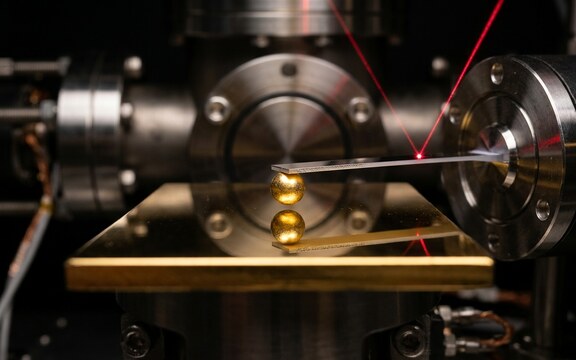
Quantum theory says empty space should be full of energy from fluctuating fields, which would curl up or blow apart the universe. The observed value is smaller than naive estimates by 44 to about 120 powers of ten, yet not zero.
No solutions, ideas or subproblems yet.
See also
- Related Why are the dark energy and matter densities comparable today?
- Related Is the dark energy density constant in time?
- Related What probability measure applies to observations in eternal inflation?
- Related Is de Sitter space stable against infrared quantum back-reaction?
- Related Is the weak scale set by cosmological dynamics or selection?
- Related Does string theory have controlled metastable de Sitter vacua?
Details, signature and history
- Kind
- Phenomenon to explain
- Answer
- Mechanism
- Topic review
- Weinberg S., The cosmological constant problem, Reviews of Modern Physics, 1989. Link
- Record
- Revision 2 · notation repaired by the platform · compiled by AI, not yet reviewed by an editor
- Batch approval
- Approved for the batch by Victor Galitski (ORCID 0000-0001-5532-1096) · approval record · bundle This approves the batch, not each problem (what it means).
- Earlier revisions
- revision 1 bundle
Proof
- Fingerprint
- f6f1c7f06f70…
- Public log
- Entry 1,239, in checkpoint 2,123
- In the log by
- Block 969,698, 2026-10-03
This text was in the PubPhys log by that date. The date says nothing about when the problem was first posed.
Comments (0)
Comments are not records: they are not signed, stamped or logged. How comments work
No comments yet.
Sign in to comment.