Why has the observed warming pattern damped Earth's apparent sensitivity?
74No. 73 in all physics · No. 10 in Earth, Atmospheric and Planetary Physics
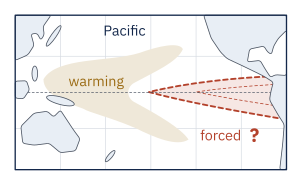
Over roughly 1980 to 2020 the eastern equatorial Pacific and Southern Ocean warmed less than in coupled models, making the effective historical feedback more negative than the long-term feedback. Determine whether this sea surface temperature pattern is forced (and will persist) or internal variability (and will reverse), and the resulting correction to ECS inferred from historical warming. An answer is an attribution of the pattern with uncertainty and the implied pattern-effect correction.
What would settle it
Attribution of observed tropical Pacific trends with models that reproduce observed trends and their response to forcing.
Status in the literature
Unverified note: it names recent work and was partly written without a live literature search; it awaits a check by an editor.
A 2026 analysis (arXiv:2603.12515) reports recent weakening of the global radiative feedback.
Parent problems
- Special case of What is Earth's equilibrium climate sensitivity? · open · from revision 1 The parent was revised since revision 1: it now states another question.
No solutions, ideas or subproblems yet.
Details, signature and history
- Kind
- Phenomenon to explain
- Answer
- Mechanism
- Topic review
- S. C. Sherwood, M. J. Webb, J. D. Annan and 22 coauthors, An Assessment of Earth's Climate Sensitivity Using Multiple Lines of Evidence, Reviews of Geophysics, 2020. Link
- Record
- Revision 1 · imported from the seed collection · compiled by AI, not yet reviewed by an editor
Proof
- Fingerprint
- e3b53e165cec…
- Public log
- Entry 1,301, in checkpoint 2,123
- In the log by
- Block 969,698, 2026-10-03
This text was in the PubPhys log by that date. The date says nothing about when the problem was first posed.
Comments (0)
Comments are not records: they are not signed, stamped or logged. How comments work
No comments yet.
Sign in to comment.