Origin of anomalous scaling exponents in three-dimensional turbulence
73No. 84 in all physics · No. 2 in Fluid Dynamics and Turbulence
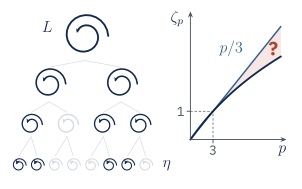
In turbulence, velocity differences between two points grow with their separation, and the simplest theory (Kolmogorov 1941) predicts how; measurements show rare violent events that break this prediction more and more strongly for higher statistical moments. Nobody can yet calculate the observed deviations from the equations of fluid motion.
Status in the literature
Unverified note: it names recent work and was partly written without a live literature search; it awaits a check by an editor.
Multifractal and log-Poisson models fit the data with adjustable inputs; no first-principles derivation exists as of 2026.
Subproblems (1)
-
36Do high-order structure-function exponents saturate at large order? a special case · open
See also
- Related Controlled closure calculation of the Kolmogorov constant
- Related Do Lagrangian intermittency exponents follow from Eulerian ones?
- Related Does small-scale anisotropy of a mixed scalar vanish at high Reynolds number?
- Related Is the dissipation anomaly strong or weak in wall-free turbulence?
- Related Is active turbulence described by universal statistical laws?
Details, signature and history
- Kind
- Phenomenon to explain
- Answer
- Mechanism
- Posed
- 1962
- Topic review
- K. P. Iyer, K. R. Sreenivasan, P. K. Yeung, Scaling exponents saturate in three-dimensional isotropic turbulence, Physical Review Fluids, 2020. Link
- Record
- Revision 1 · imported from the seed collection · compiled by AI, not yet reviewed by an editor
Proof
- Fingerprint
- 70b03dbd933e…
- Public log
- Entry 1,433, in checkpoint 2,123
- In the log by
- Block 969,698, 2026-10-03
This text was in the PubPhys log by that date. The date says nothing about when the problem was first posed.
Comments (0)
Comments are not records: they are not signed, stamped or logged. How comments work
No comments yet.
Sign in to comment.