What information do Reynolds-averaged models lack to predict smooth-surface separation?
75No. 64 in all physics · No. 1 in Fluid Dynamics and Turbulence
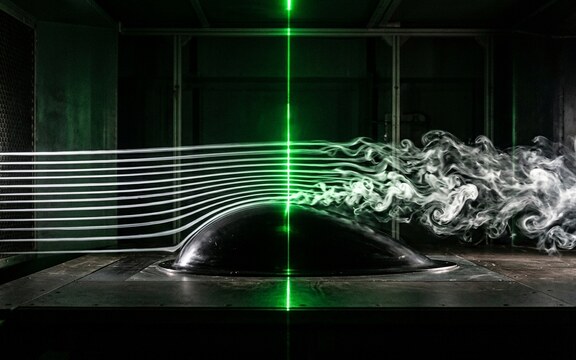
Engineering simulations cannot afford to resolve every eddy, so they use approximate models of turbulence. These models still fail to predict reliably where a turbulent flow detaches from a smooth curved surface, which governs stall and drag, and it is not known what information they are missing.
Status in the literature
Unverified note: it names recent work and was partly written without a live literature search; it awaits a check by an editor.
Data-driven closures improve agreement on training cases but have not shown reliable transfer to unseen geometries as of 2026.
No solutions, ideas or subproblems yet.
See also
Details, signature and history
- Kind
- Phenomenon to explain
- Answer
- Identification
- Topic review
- I. Marusic, B. J. McKeon, P. A. Monkewitz, H. M. Nagib, A. J. Smits, K. R. Sreenivasan, Wall-bounded turbulent flows at high Reynolds numbers: recent advances and key issues, Physics of Fluids, 2010. Link
- Record
- Revision 1 · imported from the seed collection · compiled by AI, not yet reviewed by an editor
Proof
- Fingerprint
- d2d18d6bbf5d…
- Public log
- Entry 1,455, in checkpoint 2,123
- In the log by
- Block 969,698, 2026-10-03
This text was in the PubPhys log by that date. The date says nothing about when the problem was first posed.
Comments (0)
Comments are not records: they are not signed, stamped or logged. How comments work
No comments yet.
Sign in to comment.