Does the FLASH sparing effect occur in human normal tissue?
82No. 26 in all physics · No. 2 in Medical and Radiation Physics
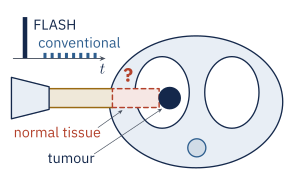
The tissue-protecting effect of ultra-fast radiation has been shown mostly in mice and other animals. Whether it happens in people at clinically useful doses has not been measured.
Status in the literature
The FAST-01 trial (Mascia et al., JAMA Oncology 2023) showed feasibility of proton FLASH at 800 rad in 10 patients with bone metastases, with no conventional-dose-rate comparison arm; no randomized toxicity comparison was found in the sources checked.
No solutions, ideas or subproblems yet.
See also
- Related Physical mechanism of normal-tissue sparing at ultra-high dose rate
- Related Beam parameters that switch the FLASH effect on
Details, signature and history
- Kind
- Well-posed question
- Answer
- Yes no
- Posed
- 2019
- Topic review
- Favaudon et al., Ultrahigh dose-rate FLASH irradiation increases the differential response between normal and tumor tissue in mice, Science Translational Medicine, 2014. Link
- Record
- Revision 2 · notation repaired by the platform · compiled by AI, not yet reviewed by an editor
- Batch approval
- Approved for the batch by Victor Galitski (ORCID 0000-0001-5532-1096) · approval record · bundle This approves the batch, not each problem (what it means).
- Earlier revisions
- revision 1 bundle
Proof
- Fingerprint
- 61a45b677806…
- Public log
- Entry 1,681, in checkpoint 2,123
- In the log by
- Block 969,698, 2026-10-03
This text was in the PubPhys log by that date. The date says nothing about when the problem was first posed.
Comments (0)
Comments are not records: they are not signed, stamped or logged. How comments work
No comments yet.
Sign in to comment.