Runaway electron current after mitigated disruptions in ITER
85No. 11 in all physics · No. 2 in Plasma Physics and Fusion
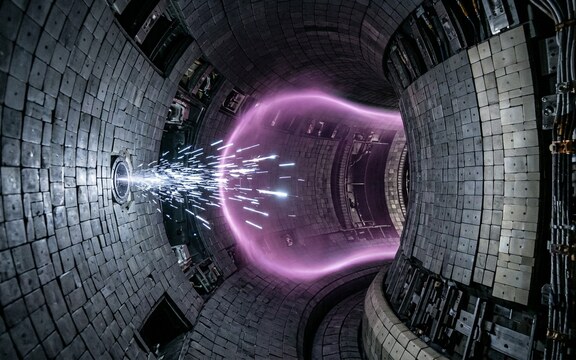
ITER plans to shoot frozen pellets of deuterium and neon into a disrupting plasma to radiate its energy safely. Whether this also prevents a dangerous runaway electron beam, which grows by an avalanche of knock-on collisions, is uncertain.
Status in the literature
Unverified note: it names recent work and was partly written without a live literature search; it awaits a check by an editor.
2026 modeling with improved physics (arXiv:2602.22177) finds most D-T H-mode SPI scenarios exceed tolerable runaway currents but identifies one theoretically viable D-T scheme; no experiment reaches ITER-scale avalanche gain.
No solutions, ideas or subproblems yet.
See also
- Related Mechanism and duration of the disruption thermal quench
- Related What produces terrestrial gamma-ray flashes?
- Related Scaling of benign runaway beam termination to ITER
Details, signature and history
- Kind
- Well-posed question
- Answer
- Value
- Topic review
- S. Ratynskaia, M. Hoelzl, E. Nardon, P. Aleynikov et al., Runaway electron-induced plasma facing component damage in tokamaks, arXiv:2506.10411, 2025. Link
- Record
- Revision 2 · notation repaired by the platform · compiled by AI, not yet reviewed by an editor
- Batch approval
- Approved for the batch by Victor Galitski (ORCID 0000-0001-5532-1096) · approval record · bundle This approves the batch, not each problem (what it means).
- Earlier revisions
- revision 1 bundle
Proof
- Fingerprint
- edd05eba805e…
- Public log
- Entry 1,829, in checkpoint 2,123
- In the log by
- Block 969,698, 2026-10-03
This text was in the PubPhys log by that date. The date says nothing about when the problem was first posed.
Comments (0)
Comments are not records: they are not signed, stamped or logged. How comments work
No comments yet.
Sign in to comment.