Does logical error suppression continue exponentially to large code distance?
89No. 3 in all physics · No. 1 in Quantum Information and Foundations
This text mentions work from 2024 on. Those parts were partly written without a live literature search and have not been checked by an editor yet.
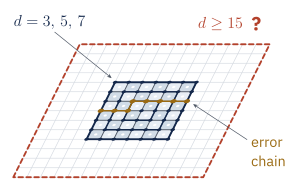
Recent chips showed that enlarging an error-correcting code cuts the error rate by a constant factor at each step. It is unknown whether this continues to the much larger codes that useful computations need, or whether rare correlated events set a floor.
Status in the literature
Unverified note: it names recent work and was partly written without a live literature search; it awaits a check by an editor.
In the same 2025 work, repetition codes up to $d = 29$ reached a logical-error floor near $10^{-10}\ \text{per cycle}$ (approximate), set by rare correlated events occurring about once per hour.
No solutions, ideas or subproblems yet.
See also
Details, signature and history
- Kind
- Well-posed question
- Answer
- Yes no
- Topic review
- B. M. Terhal, Quantum error correction for quantum memories, Reviews of Modern Physics, 2015. Link
- Record
- Revision 2 · notation repaired by the platform · compiled by AI, not yet reviewed by an editor
- Batch approval
- Approved for the batch by Victor Galitski (ORCID 0000-0001-5532-1096) · approval record · bundle This approves the batch, not each problem (what it means).
- Earlier revisions
- revision 1 bundle
Proof
- Fingerprint
- 4b0b1c6e2482…
- Public log
- Entry 1,993, in checkpoint 2,123
- In the log by
- Block 969,698, 2026-10-03
This text was in the PubPhys log by that date. The date says nothing about when the problem was first posed.
Comments (0)
Comments are not records: they are not signed, stamped or logged. How comments work
No comments yet.
Sign in to comment.