Observe entanglement created only by gravity between two masses
78No. 40 in all physics · No. 4 in Quantum Information and Foundations
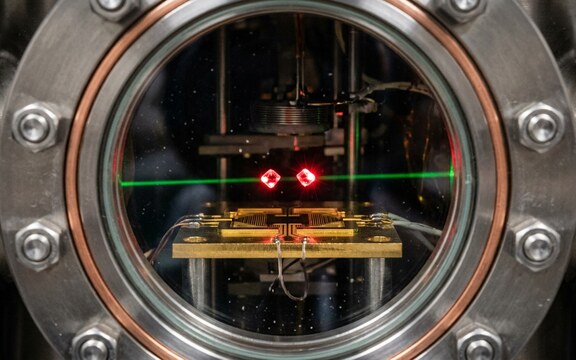
Two tiny crystals, each in a superposition of two places, are let fall side by side; if gravity is quantum, their attraction should entangle them within seconds. This needs masses of roughly a hundred-billionth of a gram kept coherent for seconds with almost no other force between them.
Status in the literature
Unverified note: it names recent work and was partly written without a live literature search; it awaits a check by an editor.
As of 2026 no spatial superposition of a mass near $10^{-11}\,\mathrm{g}$ has been made; 2026 analyses give witness values of order $-10^{-2}$ for $m = 10^{-11}\,\mathrm{g}$ over 0.1 s with decoherence rates of $0.1 \text{ to } 1\,\mathrm{s}^{-1}$ (arXiv:2609.10697).
Parent problems
- Special case of Must the gravitational field obey quantum superposition? · open · from revision 1
No solutions, ideas or subproblems yet.
See also
- Related Measure the gravity of a mass that is in superposition
- Related Spatial superposition of a levitated nanoparticle larger than its size
- Related Can causal inequalities be violated when spacetime itself is superposed?
- Related Bell test for temporal order using a mass in superposition
- Related Does gravity-mediated entanglement prove the gravitational field is quantum?
Details, signature and history
- Kind
- Well-posed question
- Answer
- Yes no
- Posed
- 2017
- Topic review
- Bose et al., Spin entanglement witness for quantum gravity, Physical Review Letters, 2017. Link
- Record
- Revision 2 · notation repaired by the platform · compiled by AI, not yet reviewed by an editor
- Batch approval
- Approved for the batch by Victor Galitski (ORCID 0000-0001-5532-1096) · approval record · bundle This approves the batch, not each problem (what it means).
- Earlier revisions
- revision 1 bundle
Proof
- Fingerprint
- 53e6ac3ec360…
- Public log
- Entry 2,000, in checkpoint 2,123
- In the log by
- Block 969,698, 2026-10-03
This text was in the PubPhys log by that date. The date says nothing about when the problem was first posed.
Comments (0)
Comments are not records: they are not signed, stamped or logged. How comments work
No comments yet.
Sign in to comment.