This browser is older than PubPhys supports. Every page can be read, but signing in to contribute, voting and signing need Safari 15.4, Chrome or Edge 99, Firefox 97 or newer. Browsers
All problems
57 problems
Starting order drafted by AI. Votes change it. How ranking works
-
AI-generated illustration
For systems of 100 to 1000 atoms (molecular crystal lattice energies, host-guest binding, molecules adsorbed on metal or oxide surfaces), devise an electronic-structure method with computational cost scaling at most as $O(N^3)$ in system size $N$ that delivers interaction or reaction energies within $1\,\mathrm{kcal}/\mathrm{mol}$ of the exact Born-Oppenheimer value with a computed, verifiable error estimate. An answer is the method with benchmark evidence against converged references, or a complexity argument showing the target is unattainable for a stated class of methods.
-
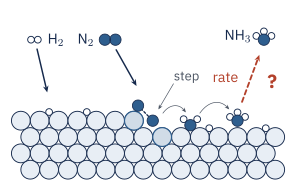
For benchmark heterogeneous reactions ($\mathrm{NH_3}$ synthesis on Ru(0001) step sites, CO oxidation on Pt(111), methanol synthesis on Cu/ZnO), predict the absolute turnover frequency under specified temperature and pressure within a factor of 10 from first-principles energetics and kinetic modeling with no fitted parameters. An answer is a protocol (electronic structure accuracy, treatment of coverage, entropy and site heterogeneity) meeting this target on several reactions.
-
AI-generated illustration
For graphite and lithium-metal anodes in carbonate electrolytes (for example 1 mol/L $\mathrm{LiPF_6}$ in ethylene carbonate and ethyl methyl carbonate), determine the nanoscale arrangement of inorganic (LiF, $\mathrm{Li_2CO_3}$, $\mathrm{Li_2O}$) and organic phases in the solid-electrolyte interphase (SEI), the transport process that sustains its growth (electron tunneling, neutral lithium interstitial diffusion, solvent diffusion through pores), and the resulting thickness law $L(t)$, often reported near $t^{1/2}$. An answer is a model with first-principles rate parameters that predicts $L(t)$ and the measured calendar-aging capacity loss.
-

AI-generated illustration
For the E4 (Janus) state of FeMoco, determine the positions of the four added hydrogens (bridging hydrides, protonated sulfides), the site of $\mathrm{N_2}$ binding (Fe2/Fe6 face, Mo, or after sulfide displacement), and the energetics of reductive elimination of $\mathrm{H_2}$ coupled to $\mathrm{N_2}$ binding. An answer is a structure and mechanism consistent with ENDOR/EPR data and with converged electronic-structure energetics.
-
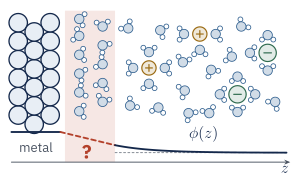
For Pt(111) and Au(111) in dilute aqueous perchlorate or fluoride electrolyte at 300 K, compute from first principles the potential of zero charge, the water orientation profile and the differential capacitance $C(\phi)$ as a function of electrode potential $\phi$, including the capacitance maximum near the potential of zero charge measured on Pt(111) and the Gouy-Chapman minimum at the potential of zero charge measured on Au(111) in dilute electrolyte. An answer is a simulation at fixed electrode potential that reproduces the measured potential of zero charge within $3.3 \times 10^{-4}\ \mathrm{statvolt}$ and $C(\phi)$ within 20 percent.
-

AI-generated illustration
How the O-O bond forms in photosystem II
Partially resolved 73For the $\mathrm{Mn_4CaO_5}$ oxygen-evolving complex of photosystem II, identify the O-O bond-forming step in the S3 to S4 to S0 transition: which oxygen atoms couple (O5 with the inserted O6, or a water-derived ligand), the mechanism (oxyl-oxo radical coupling or nucleophilic attack), the Mn oxidation and spin states at the transition state, and its barrier consistent with the measured millisecond kinetics. An answer is a mechanism supported by time-resolved structural and spectroscopic data and by converged electronic-structure calculations.
-
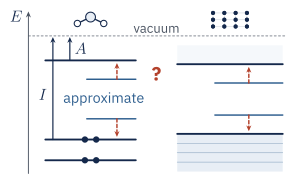
Find a generalized Kohn-Sham functional with no system-specific tuning that gives the fundamental gap $I - A$ ($I = \text{ionization energy}, A = \text{electron affinity}$) of molecules (the GW100 set of ionization potentials and electron affinities and similar sets) and the band gap of semiconductors and insulators (Si to LiF) with mean absolute error below $0.2\,\mathrm{eV}$. An answer is such a functional or an argument that tuning-free accuracy at this level requires orbital-dependent nonlocal terms of a specified type.
-
For a machine-learned exchange-correlation functional trained only on main-group molecular data, determine its errors on out-of-distribution sets: 3d transition-metal reaction energies and spin gaps, lattice constants and cohesive energies of metals, and band gaps of solids, relative to the best conventional hybrid. An answer is a quantitative transfer test, or a training principle (exact constraints, data types) shown to guarantee transfer.
-
A practical functional that obeys the flat-plane condition
Partially resolved 68Construct an exchange-correlation approximation, at cost no higher than a global hybrid, whose energy $E(N, S_z)$ is piecewise linear in fractional electron number N (no delocalization error) and constant in fractional spin at fixed N (no static correlation error), as tested on H2+ and $\mathrm{H_2}$ dissociation, fractional-charge atoms and the stretched-bond benchmark sets, while keeping main-group thermochemistry errors below 3 kcal/mol. An answer is such a functional, or a proof that no functional of a given class can satisfy both conditions.
-
Explain the drop of the exchange current density of the hydrogen evolution and oxidation reactions on Pt from pH 0 to pH 13 (about two orders of magnitude), distinguishing between hydrogen binding energy shifts, the interfacial water reorganization and the potential of zero free charge, and cation-hydroxyl interactions. An answer is a model that predicts the measured rate versus pH and versus cation identity.
-
For organic molecular crystals with known polymorphs, compute relative lattice free energies at 300 K, including vibrational and thermal-expansion contributions, with errors below 0.25 kcal/mol per molecule, and predict the observed stable form. An answer is a method that ranks the experimentally known polymorphs correctly across a blind test set of at least 10 systems.
-
Construct an exchange-correlation functional $E_{\mathrm{xc}}[n]$ that is exact for every one-electron density ($E_{\mathrm{xc}}[n_1] = -J[n_1]$, with J the classical Coulomb self-energy), gives total energies $E(N)$ piecewise linear in fractional electron number N between integers, and retains main-group thermochemistry and barrier-height accuracy at least equal to the best hybrid functionals on a broad benchmark such as GMTKN55 (a set of 55 standard chemistry test databases). An answer is an explicit functional with these properties demonstrated numerically, or a proof that no functional of a given class (semilocal, hybrid, or orbital-dependent of fixed form) can satisfy them together.
-
For $\mathrm{CO_2}$ reduction on Cu and Au electrodes in aqueous MHCO3 ($M = \mathrm{Li}, \mathrm{Na}, \mathrm{K}, \mathrm{Cs}$), identify the mechanism by which the cation controls the rate of the first $\mathrm{CO_2}$ activation step and the product selectivity: interfacial field stabilization of adsorbed $\mathrm{CO2}-$, direct coordination, local buffering of pH, or modification of the hydrogen-bond network. An answer is a model predicting partial current densities versus cation identity and concentration.
-
For Cu/ZnO/$\mathrm{Al_2O_3}$ under industrial conditions (about 500 K, $5 \times 10^{7}\ \text{to}\ 10^{8}\ \mathrm{dyn}/\mathrm{cm}^{2}$ of CO/$\mathrm{CO_2}$/$\mathrm{H_2}$), identify the site responsible for most methanol turnover: Zn-decorated Cu steps (Behrens et al., Science 2012, https://doi.org/10.1126/science.1219831), a Cu-Zn surface alloy whose Zn coverage sets the rate (Kuld et al., Science 2016, https://doi.org/10.1126/science.aaf0718), or the Cu-$\mathrm{ZnO}_{x}$ interface, and whether the site differs for $\mathrm{CO_2}$ and CO hydrogenation. An answer is operando identification of site structure correlated with site-normalized rates and reproduced by first-principles kinetics.
-
Explain the growth of the isothermal compressibility $\kappa_T$, the isobaric heat capacity $C_P$ and the magnitude of the thermal expansion coefficient $\alpha_P$ in supercooled liquid water at ambient pressure down to about 230 K, distinguishing between the liquid-liquid critical point scenario, the singularity-free scenario, the critical-point-free scenario and the stability-limit conjecture. An answer is a thermodynamic model consistent with all measured response functions in the accessible range and with predictions that experiment can test.
-
Gold-standard coupled-cluster accuracy for metals and small-gap solids
Partially resolved 62The perturbative triples correction (T) of CCSD(T) diverges for the uniform electron gas and for metals in the thermodynamic limit because of the long-range Coulomb interaction (infrared divergence). Determine whether a modified triples treatment (for example CCSD(cT), 2023) or full CCSDT gives cohesive energies, lattice constants and adsorption energies of simple and noble metals (Li, Na, Al, Cu) within 1 kcal/mol per atom of experiment or of numerically exact quantum Monte Carlo, with finite-size errors controlled. An answer is a convergent method demonstrated on these metals.
-
For the published VSC rate-change claims (for example silane deprotection and ester hydrolysis reactions), determine which reproduce within error when cavity-length non-uniformity, local heating, radiative energy transfer, mirror-surface chemistry and spectroscopic readout artifacts in the strongly coupled spectrum are controlled. An answer is a classification of the reported effects into reproduced, artifact-explained, or unresolved, with the artifact quantified for each.
-
Explain spin polarizations P of 10 to 60 percent reported in photoemission through chiral monolayers and in magnetoconductance of chiral molecular junctions, given atomic spin-orbit coupling constants of about 3 meV (C) to 20 meV (O), and much smaller effective couplings in the molecular orbitals. An answer is a microscopic mechanism with no fitted parameters that reproduces P, its sign versus handedness, and its dependence on molecular length and temperature.
-
In Fabry-Perot microcavities under vibrational strong coupling (Rabi splitting of order $100\, \mathrm{cm}^{-1}$ for a reactant vibration) and no external pumping, determine whether thermal rate constants $k(T)$ differ from those of identical out-of-cavity or detuned-cavity controls beyond errors from heating, concentration and mixing, and if so identify the mechanism. An answer is a reproducible rate change with controls plus a quantitative theory, or a demonstration that reported changes come from artifacts.
-
For the resting state $E0$ of FeMoco ($\mathrm{MoFe_7S_9C}$ cluster with homocitrate, total spin $S = 3/2$), determine the Fe oxidation-state distribution consistent with Mo(III), the spin-coupling pattern of the eight metal spins and the ordering of the lowest spin states, with energies converged to $1\,\mathrm{kcal}/\mathrm{mol}$ in an active space large enough that the answer no longer changes with its size. An answer is a converged wavefunction calculation (or set of agreeing methods) that also reproduces measured Mossbauer, EPR and X-ray spectroscopic data.
-
For high-mobility organic semiconductors (rubrene, pentacene, C8-BTBT) at 100 to 300 K, with transfer integrals of order 0.1 eV comparable to thermal fluctuations of these integrals, predict the mobility $\mu(T)$ (measured about $3 \times 10^{3}$ to $1.2 \times 10^{4}$ $\mathrm{cm}^2/(\mathrm{statvolt}\ \mathrm{s})$ at room temperature in rubrene single crystals, lower in pentacene and C8-BTBT) and its temperature dependence from a microscopic model with ab initio parameters, deciding between transient localization, small-polaron and band pictures. An answer is a theory reproducing $\mu(T)$ and the Hall and terahertz data.
-
For benchmark photoreactions in condensed phases (retinal isomerization in rhodopsin, quantum yield about 0.65; azobenzene and stilbene isomerization in solvents; thymine relaxation in water), predict product quantum yields within 0.05 and excited-state lifetimes within 20 percent using an electronic-structure method accurate near conical intersections, an atomistic environment, and a nuclear dynamics method with controlled decoherence and nuclear quantum errors. An answer is a protocol meeting these targets in blind tests, or an identification of which approximation (electronic structure, environment, or dynamics) dominates the error.
-
Coupled-cluster versus Monte Carlo binding energies of large molecular complexes
Partially resolved 60For noncovalent complexes of about 50 to 200 atoms (the coronene dimer, the $\mathrm{C_{60}}$ in a cycloparaphenylene ring complex, and the L7 and S30L type sets), determine the basis-set-limit interaction energy $E_{\int}$ to 0.5 kcal/mol and the source of the discrepancy of up to several kcal/mol between CCSD(T) and fixed-node diffusion Monte Carlo (DMC) reported in 2021. An answer is agreement between a modified coupled-cluster method and DMC with controlled fixed-node, time-step and finite-size errors on the same geometries.
-
Molecular mechanism of the Hofmeister series
Contested 58Explain the anion ordering of the Hofmeister series (roughly SO4^2- > F- > Cl- > Br- > $\mathrm{NO_3}$- > I- > $\mathrm{ClO_4}$- > SCN-) in protein salting-out, nonpolar solute solubility and electrolyte surface tension, choosing among bulk water structure making and breaking, direct ion-solute pairing, interfacial adsorption driven by polarizability and partial dehydration, and ion-specific dispersion forces. An answer is a quantitative model with parameters from first principles or independent data that reproduces the ordering and its reversal on positively charged or hydrophobic surfaces.
-
For benchmark photoreactions (cyclobutanone photodissociation at 200 nm, azobenzene trans-cis isomerization, retinal isomerization in rhodopsin), predict product branching ratios and quantum yields to within 0.1 absolute, and ultrafast electron diffraction or photoelectron signals within experimental error, using electronic structure and nuclear dynamics without fitting to the target data. An answer is a protocol (electronic structure level plus dynamics method) shown to meet this accuracy in blind tests.
-
Mechanism of reaction acceleration in microdroplets
Contested 56For bimolecular reactions in aqueous microdroplets of radius 1 to 50 micrometers, determine the true acceleration factor of the rate constant relative to bulk after correcting for evaporation, concentration changes, gas-phase reactions in the mass spectrometer inlet and ion-source chemistry, and identify the dominant cause (interfacial electric field, partial solvation, interfacial pH, charge). An answer is a corrected acceleration factor for benchmark reactions plus a mechanism that predicts it.
-
For chiral molecules (helical peptides, DNA oligomers, amino acids) adsorbing on perpendicularly magnetized ferromagnetic films, determine whether the initial adsorption rate differs between enantiomers for opposite magnetization directions by more than the combined experimental error, under controlled surface preparation and blinded magnetization direction. An answer is a yes or no with an effect size from independent replications.
-
For $N$ molecules each with a reactive coordinate and a bright vibration coupled with strength $g/\sqrt{N}$ to one or many cavity modes, at fixed collective Rabi splitting $2 g$ and temperature $T$, determine whether the thermal reaction rate per molecule differs from its free value by an amount that stays finite as $N\ \text{goes to}\ \infty$ ($N$ of about $10^{6}\ \text{to}\ 10^{10}$ in experiments), including disorder, multimode cavities and dark states. An answer is a proof or exact calculation in a defined model.
-
Derive a mixed quantum-classical method in which nuclei follow independent trajectories and that (i) reproduces exact population dynamics within 0.05 absolute at all times for the three Tully one-dimensional models and the spin-boson model over the coupling and temperature ranges of standard benchmarks, (ii) yields Boltzmann-weighted state populations at long times (detailed balance), (iii) gives correct decoherence without adjustable parameters, and (iv) costs no more per trajectory than surface hopping (one electronic-structure call per nuclear time step). An answer is the method with its derivation from the exact equations, or a proof that independent trajectories cannot satisfy (i) to (iii) together.
-
For acene crystals (tetracene, pentacene) and covalent dimers, determine whether singlet fission proceeds through real charge-transfer intermediates or a coherent superexchange pathway, and identify the rate and mechanism of conversion of the spin-entangled pair 1(TT) into independent triplets (spin mixing to 5(TT) and 3(TT), spatial separation). An answer is an ab initio rate model reproducing measured fission times (about 80 fs in pentacene) and triplet yields.