This browser is older than PubPhys supports. Every page can be read, but signing in to contribute, voting and signing need Safari 15.4, Chrome or Edge 99, Firefox 97 or newer. Browsers
All problems
61 problems
Starting order drafted by AI. Votes change it. How ranking works
-
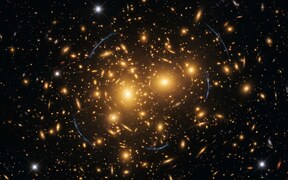
AI-generated illustration
What is dark matter made of?
Open 93Determine the microscopic identity (mass, spin, non-gravitational couplings, production mechanism) of the non-baryonic component with $\Omega_c h^{2} = 0.120 \pm 0.001$ inferred from the CMB in LCDM. An answer is a candidate confirmed by a reproducible non-gravitational signal (direct, indirect or collider detection, or a compact-object census) whose abundance accounts for $\Omega_c$.
-
AI-generated illustration
Is the dark energy density constant in time?
Contested 86In the parametrization $w(a) = w0 + wa (1 - a)$, with w the pressure-to-density ratio and a the scale factor, determine whether $(w0, wa) = (-1, 0)$ is excluded at $5\sigma$ by baryon acoustic oscillations, CMB and type Ia supernovae. DESI DR2 BAO plus CMB plus DES-Dovekie supernovae give $w0 = -0.803 \pm 0.054, wa = -0.72 \pm 0.21$. Answer yes or no at $5\sigma$ with datasets whose systematics are independently validated.
-
AI-generated illustration
The observed dark energy density is $\rho_{\Lambda} \sim 6 \times 10^{-30}\ \mathrm{g}/\mathrm{cm}^{3}$, i.e. $\rho_{\Lambda}^{1/4} \sim 2.3 \times 10^{-3}\ \mathrm{eV}$ in natural units, while Standard Model contributions (electroweak symmetry breaking ~ $(100\ \mathrm{GeV})^{4}$, QCD ~ $(0.2\ \mathrm{GeV})^{4}$) exceed it by $\sim 10^{55}$ and $\sim 10^{44}$, and a Planck-scale cutoff by $\sim 10^{123}$ (often quoted as $10^{120}$, using the reduced Planck mass). Find a mechanism that yields the observed value without tuning to that precision, or show that environmental selection in a multiverse is the only consistent explanation.
-
AI-generated illustration
Establish or refute an inflationary epoch by a signature that alternatives cannot reproduce, such as a nearly scale-invariant primordial tensor spectrum with tilt $n_t = -r/8$ (single-field consistency relation); refutation requires a demonstration that a non-inflationary model reproduces all CMB and large-scale-structure data including any detected tensor modes. For r below $\sim 0.01$ the consistency relation cannot be measured, and a yes answer then requires a detected tensor spectrum with amplitude and scale dependence that non-inflationary models are shown unable to produce.
-
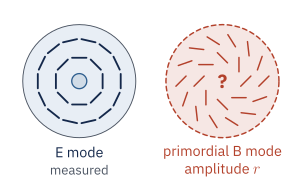
Measure the tensor-to-scalar ratio r at pivot $k = 0.05\ \mathrm{Mpc}^{-1}$, which fixes the inflation energy scale $V^{(1/4)} \sim 1.04 \times 10^{16}\ \mathrm{GeV}\ (r / 0.01)^{(1/4)}$. Current bound $r < 0.036$ (95 percent, BICEP/Keck 2021), $r < 0.038$ with ACT DR6. An answer is a detection or a bound $r < 0.001$ after delensing and foreground separation.
-
AI-generated illustration
What causes the Hubble tension?
Contested 81Write $H0 = h x 3.24 \times 10^{-18}\ \mathrm{s}^{-1}$. The SH0ES Cepheid plus type Ia supernova ladder gives $h = 0.730 \pm 0.010$, while Planck CMB in LCDM gives $h = 0.674 \pm 0.005$. Identify whether the discrepancy comes from distance-ladder systematics, from physics before recombination that shrinks the sound horizon, or from late-time physics, with a model that fits all data at least as well as LCDM.
-
AI-generated illustration
Is dark matter the QCD axion?
Open 77Does a QCD axion with mass $m_a$ in roughly $10^{-6} \text{ to } 10^{-3}\, \mathrm{eV}$ and photon coupling $g_a-\gamma$ on the KSVZ or DFSZ model bands constitute $\Omega_c$? An answer is a haloscope or helioscope detection at a fixed frequency $\nu = m_a c^2 / h$ with the predicted coupling, or exclusion of the DFSZ band over the mass range favored by post-inflationary production.
-
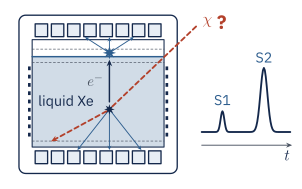
Does a particle of mass $1\,\mathrm{GeV}\text{ to }100\,\mathrm{TeV}$, produced by thermal freeze-out with annihilation cross section $\langle \sigma v\rangle \sim 3 \times 10^{-26}\,\mathrm{cm}^{3}/\mathrm{s}$, make up $\Omega_c$? Answer yes (a detection of nuclear recoils, annihilation products or collider production consistent with the thermal cross section) or no for named benchmarks: exclusion of Higgs-portal and Z-portal thermal relics by direct detection, and of the pure wino ($\sim 2.9\,\mathrm{TeV}$) and pure Higgsino ($\sim 1.1\,\mathrm{TeV}$) thermal relics by gamma-ray line and continuum searches from the Galactic Center. Thermal relics with loop-suppressed nuclear couplings (pure Higgsino, $\sigma_{\mathrm{SI}} \sim 10^{-49}\text{ to }10^{-48}\,\mathrm{cm}^{2}$) lie at or below the xenon neutrino background floor, so direct detection alone cannot close the question.
-
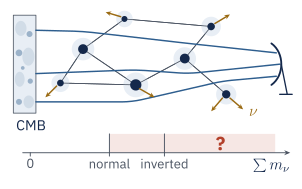
Measure sum $m_\nu$ with uncertainty $\sigma \le 0.015\,\mathrm{eV}$ from CMB lensing, galaxy clustering and BAO, with the reionization optical depth $\tau$ measured independently to $\sigma(\tau) \sim 0.002$. An answer is a value that also discriminates normal from inverted ordering.
-
Measure the subhalo and line-of-sight halo mass function $dn/dM$ over $M = 10^{6}\text{ to }10^{9}\ M_{\mathrm{sun}}$. CDM predicts dn/dM ~ M^-1.9 with no cutoff above $\sim 10^{-6}\ M_{\mathrm{sun}}$; warm, fuzzy or interacting dark matter predict suppression below a half-mode mass $M_{\mathrm{hm}}$. An answer is a measured amplitude and slope or a bound on $M_{\mathrm{hm}}$ from strong-lens flux ratios, gravitational imaging and stellar-stream gaps, with the density profiles of detected clumps.
-
Measure the local bispectrum amplitude $f_{\mathrm{NL}}^{\mathrm{local}}$; Planck 2018 gives $f_{\mathrm{NL}}^{\mathrm{local}} = -0.9 \pm 5.1$. Single-field inflation predicts $\left|f_{\mathrm{NL}}^{\mathrm{local}}\right| \ll 1$ in the squeezed limit; many multi-field models give $\left|f_{\mathrm{NL}}^{\mathrm{local}}\right| \ge 1$. An answer is $f_{\mathrm{NL}}^{\mathrm{local}}$ with $\sigma$ below 0.5 from scale-dependent galaxy bias and CMB.
-
Measure $h$ to 1 percent from at least one method independent of both the distance ladder and $r_d$: gravitational-wave standard sirens, strong-lens time delays with independent mass-profile constraints, water-maser distances, or $r_d$-free galaxy clustering. An answer is $h$ with uncertainty below 0.007 and a statement of which side it matches.
-
Identify the inflaton potential class from ($n_s, r$, running $\alpha_s$, non-Gaussianity). ACT DR6 combined with Planck and DESI gives $n_s = 0.974 \pm 0.003$ versus Planck alone $0.965 \pm 0.004$, which puts Starobinsky $R^2$ inflation at about $2\sigma$ for $N = 60$ e-folds. An answer is the potential class (plateau, monomial, hilltop, multi-field) singled out at high confidence, with the reheating history it requires.
-
Detect the dimensionless 21-cm power spectrum $\Delta^2_{21}(k, z)$ at $k \sim 0.1 \text{ to } 0.5\,h/\mathrm{Mpc}$ for $z = 6 \text{ to } 25$, separating Galactic and extragalactic foregrounds. An answer is a detection with signal-to-noise above 5 in at least one redshift bin, giving the timing of X-ray heating and reionization.
-
COSMO Primordial black holes
For primordial black holes with masses $M = 10^{17} \text{ to } 10^{22}\,\mathrm{g}$, no current constraint excludes a dark-matter fraction $f_{\mathrm{PBH}} = \Omega_{\mathrm{PBH}} / \Omega_c = 1$. Determine whether $f_{\mathrm{PBH}} = 1$ is allowed anywhere in this window, via detection (Hawking evaporation products at the light end, femtolensing or microlensing of stars and gamma-ray bursts, dynamical capture in stars) or exclusion of $f_{\mathrm{PBH}} = 1$ across the whole window for monochromatic and extended mass functions.
-
Measure the growth index $\gamma$ in $f(z) = \Omega_m(z)^\gamma$, where $f = d\mathrm{ln}(\delta)/d\mathrm{ln}(a)$, over $0 < z < 2$ from redshift-space distortions, peculiar velocities and lensing; general relativity with LCDM gives $\gamma \sim 0.55$. An answer is $\gamma$ with uncertainty below 0.02 and a test of its redshift dependence.
-
Using one JWST sample of type Ia supernova host galaxies, determine the mean distance-modulus offsets between Cepheid, tip of the red giant branch (TRGB) and J-region asymptotic giant branch (JAGB) calibrations, and the resulting h from each. An answer is each offset with uncertainty below 0.02 mag and an explanation of any nonzero offset.
-
The Borde-Guth-Vilenkin theorem (2003) shows that any spacetime with averaged expansion rate $H_{\mathrm{avg}} > 0$ along past-directed geodesics is past-incomplete, so eternal inflation alone cannot be past-eternal. Determine what quantum gravity puts at that boundary (no-boundary state, bounce, emergent or quantum creation) in a framework that yields predictions for observable spectra or spatial curvature.
-
The radial acceleration relation $g_{\mathrm{obs}} = g_{\mathrm{bar}} / (1 - \exp(-\sqrt{g_{\mathrm{bar}} / a0}))$ with $a0 \sim 1.2 \times 10^{-8}\ \mathrm{cm}/\mathrm{s}^{2}$ fits about 150 SPARC rotation curves with small scatter, and the baryonic Tully-Fisher relation $M_{b}$ proportional to $V_{\mathrm{flat}}^{4}$ holds over 5 decades in mass. Explain whether LCDM galaxy formation produces one relation with a single a0 and the observed small scatter, or whether the relation signals modified dynamics or a dark matter coupling to baryons.
-
Measure the self-interaction cross section per unit mass $\sigma/m$ ($\mathrm{cm}^2/\mathrm{g}$) as a function of relative velocity v from about $3 \times 10^{6}\ \mathrm{cm}/\mathrm{s}$ (dwarfs) to $10^{8}\ \mathrm{cm}/\mathrm{s}$ (clusters) using dwarf rotation curves, satellite central densities, strong-lens perturbers, cluster cores and cluster mergers. Kaplinghat, Tulin and Yu (2016, PRL 116, 041302) infer about $2\ \mathrm{cm}^2/\mathrm{g}$ at galaxy scales and $0.1\ \mathrm{cm}^2/\mathrm{g}$ at cluster scales. An answer is a nonzero $\sigma/m(v)$ detected at more than $3\sigma$, or an upper bound below $0.1\ \mathrm{cm}^2/\mathrm{g}$ at dwarf velocities.
-
In LCDM, DESI DR2 BAO plus CMB gives $\sum\, m_\nu < 0.064\,\mathrm{eV}$ (95 percent; 0.053 eV with the Feldman-Cousins construction), while oscillations require $\sum\, m_\nu \ge 0.059\,\mathrm{eV}$ (normal ordering) or $\ge 0.10\,\mathrm{eV}$ (inverted ordering), and the posterior extended to an effective negative mass peaks below zero. Determine whether a positive $\sum\, m_\nu \ge 0.059\,\mathrm{eV}$ is consistent with the data, or whether the deficit requires new physics (evolving dark energy, modified lensing amplitude, neutrino decay or non-standard interactions) or unrecognized systematics.
-
Measure the isotropic polarization rotation angle $\beta$, which converts $E$-modes into $B$-modes and produces nonzero EB correlations; analyses of Planck and WMAP using Galactic foreground EB as calibration reported $\beta \sim 0.34 \pm 0.09\ \mathrm{degrees}$ (about $3.6\sigma$, 2022). Answer whether $\beta$ is nonzero with detector polarization angles calibrated independently to below $0.05\ \mathrm{degrees}$.
-
COSMO Primordial black holes
The curvature power spectrum is $P_{\zeta} \sim 2.1 \times 10^{-9}$ at $k = 0.05\,\mathrm{Mpc}^{-1}$, while a cosmologically relevant PBH abundance needs $P_{\zeta} \sim 10^{-2}$ at the scale entering the horizon at formation. Measure or bound $P_{\zeta}(k)$ for $k > 1\,\mathrm{Mpc}^{-1}$ using CMB spectral distortions (the COBE/FIRAS mu-distortion limit is about three orders of magnitude stronger than the PBH limit at $k \sim 10^{1} \text{ to } 10^{4}\,\mathrm{Mpc}^{-1}$, Chluba, Erickcek and Ben-Dayan 2012), scalar-induced gravitational waves in pulsar-timing, LISA and ground-based bands, and ultracompact minihalos. An answer is a detected enhancement or an upper bound below the PBH-forming level at each $k$.
-
Determine the ratio $P(k) / P_{\mathrm{DMonly}}(k)$ of the total matter power spectrum to the dark-matter-only one for $k = 0.1 \text{ to } 10\,h/\mathrm{Mpc}$ at $z < 1$, with 1 to 2 percent precision. Use kinetic and thermal Sunyaev-Zeldovich profiles, X-ray gas fractions and lensing; state whether the suppression at $k \sim 1\,h/\mathrm{Mpc}$ is large enough (of order 20 to 30 percent, moderate confidence on this figure) to bring lensing S8 into agreement with the CMB.
-
Galaxies and clusters host fields of $\sim 10^{-6}$ G coherent over $\sim 10\,\mathrm{kpc}$, amplified by dynamos from seeds $B_{\mathrm{seed}}$. Identify the origin of the seeds: Biermann battery in the first collapsed structures ($\sim 10^{-20}$ G), inflationary magnetogenesis, or first-order phase transitions. An answer identifies the origin through the void field strength, coherence length and helicity, which differ between scenarios.
-
The number density of galaxies with $M_{\mathrm{UV}} < -20$ at $z \sim 10\ \text{to}\ 15$ exceeds pre-JWST models by factors of 10 to 100 (the spectroscopically confirmed MoM-z14 at $z = 14.44$ implies a factor $\sim 100$ at $z \sim 14$). Identify the mechanism: high star-formation efficiency (feedback-free starbursts), bursty star formation, a top-heavy initial mass function, negligible dust, active-galactic-nucleus light, or enhanced small-scale primordial power. An answer reproduces the UV luminosity function at $z = 10\ \text{to}\ 15$ together with clustering and spectral constraints.
-
At fixed maximum circular velocity $V_{\mathrm{max}} = (5 \text{ to } 10)e6\,\mathrm{cm}/\mathrm{s}$, observed circular velocities at $r = 2\,\mathrm{kpc}$ vary by a factor $\sim 3$, wider than in LCDM hydrodynamic simulations, and many dwarfs show inner density slopes $\gamma = -d\operatorname{ln}(\rho)/d\operatorname{ln}(r) \sim 0$ instead of the NFW value 1. Find the mechanism: supernova-driven gas outflows, self-interacting dark matter with $\sigma/m \sim 1\,\mathrm{cm}^2/\mathrm{g}$, wave dark matter, or observational systematics (non-circular motions, pressure support). An answer reproduces the observed scatter and slope distribution in a population-level comparison.
-
Determine whether any model that reduces the sound horizon $r_d$ by $\sim 7\%$ (early dark energy, extra radiation $\Delta N_{\mathrm{eff}}$, varying electron mass, primordial magnetic fields) fits Planck, ACT DR6 and SPT-3G CMB spectra plus DESI DR2 BAO with $h \ge 0.72$ and total $\chi^2$ no worse than LCDM. Answer yes with an explicit model or no with a general argument.
-
With S8 = sigma8 (Omega_m / 0.3)^0.5, combined Planck, ACT DR6 and SPT-3G give $S8 = 0.836 (+0.012, -0.013)$ in LCDM. KiDS-Legacy agrees within $1\ \sigma$ while DES Y6 is lower by $2.4\ \text{to}\ 2.7\ \sigma$. Determine whether late-time S8 measured to 1 percent differs from the CMB prediction at more than $3\ \sigma$ after photometric-redshift, intrinsic-alignment and shear calibration are validated.
-
The CMB dipole implies a velocity of about $3.7 \times 10^{7}\,\mathrm{cm/s}$, which predicts a kinematic number-count dipole (Ellis-Baldwin test) for distant sources. CatWISE2020 quasars and NVSS radio galaxies give amplitudes about twice the prediction, reported at about $5\sigma$ in joint analyses. Determine whether this signals a non-kinematic, intrinsic anisotropy incompatible with FLRW cosmology, or catalog systematics and clustering contributions.