This browser is older than PubPhys supports. Every page can be read, but signing in to contribute, voting and signing need Safari 15.4, Chrome or Edge 99, Firefox 97 or newer. Browsers
All problems
70 problems
Starting order drafted by AI. Votes change it. How ranking works
-
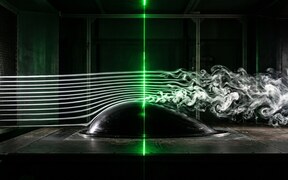
AI-generated illustration
For turbulent boundary layers separating under an adverse pressure gradient from a smooth surface (benchmarks such as $2\mathrm{D}\ \text{and}\ 3\mathrm{D}$ smooth bumps at $\mathrm{Re}_L \sim 10^6\ \text{to}\ 10^7$), identify which non-local or history information absent from single-point Reynolds-averaged equations (for example upstream pressure-gradient history, transport of Reynolds-stress anisotropy, or large-scale unsteadiness) is needed to predict separation and reattachment locations within experimental uncertainty. Answer: the minimal added information, demonstrated by a model that uses it and predicts an unseen geometry blind.
-
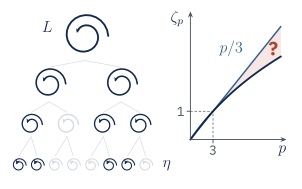
System: statistically stationary, homogeneous, isotropic turbulence of the 3D incompressible Navier-Stokes equations at $\mathrm{Re}_{\lambda} \to \infty$. Quantity: inertial-range exponents $\zeta_{p}$ in S_p(r) = <|delta_r u|^p> ~ r^zeta_p, which deviate from the Kolmogorov 1941 value $p/3$ (measured $\zeta_{6} \sim 1.78$, approximately). Answer: a derivation of zeta_p from the Navier-Stokes equations, or from an approximation with controlled error, that reproduces measured values for p up to about 10 and identifies the flow structures responsible.
-
Define the flux coefficient $\Gamma = B/\epsilon$ ($B$ buoyancy flux, $\epsilon$ kinetic-energy dissipation rate), set to 0.2 in ocean parameterizations (Osborn 1980). Determine $\Gamma$ as a function of buoyancy Reynolds number $\mathrm{Re}_b = \epsilon/(\nu N^2)$ ($N$ buoyancy frequency), gradient Richardson number Ri and Prandtl number Pr for stationary stratified shear turbulence, including whether $\Gamma$ tends to a constant as $\mathrm{Re}_b \to \infty$ at fixed Ri.
-
In warm (ice-free) cumulus, droplets grow by condensation to about 10-15 micron radius and by gravitational collection above about 40 micron, with slow growth in between, yet rain appears 15-30 min after cloud formation. Identify which process (turbulent collision enhancement, giant aerosol nuclei, entrainment mixing, lucky-droplet statistics, electrostatic forces) dominates growth across the gap for typical cloud dissipation rates $\epsilon \sim 10\text{ to }1000\,\mathrm{cm}^2/\mathrm{s}^3$.
-
Let $D = \epsilon L / U^{3}$ be the mean kinetic-energy dissipation rate $\epsilon$ normalized by rms velocity $U$ and box scale $L$, for body-forced Navier-Stokes turbulence in a periodic box. As $\mathrm{Re} = U L / \nu \to \infty$, does $D$ tend to a positive constant (strong anomaly), or decay as $\mathrm{Re}^{-\alpha}$ with small $\alpha > 0$ (weak anomaly)? A strong anomaly requires $\zeta_3 \le 1$ for absolute increments; $\zeta_3 > 1$ forces $D \to 0$ and bounds alpha from below. Answer: the limit of $D$, or $\alpha$ with error bar, shown to be independent of forcing details.
-
For channel or boundary-layer flow with spanwise wall velocity $W(x,t) = A \sin(k_x x - \omega t)$, determine the maximum net power saving $S$ (drag reduction minus actuation power, as a fraction of uncontrolled pumping power) over $(A, k_x, \omega)$ as a function of $\mathrm{Re}_{\tau}$, and its limit as $\mathrm{Re}_{\tau} \to \infty$. At $\mathrm{Re}_{\tau} \sim 10^3$ drag reduction reaches about 30 percent; experiments at $\mathrm{Re}_{\tau}$ of order $10^4$ report net savings with actuation tuned to large scales.
-
In fully rough wall turbulence the mean-velocity shift is $\Delta U+ = (1/\kappa)\ln k_s+ + \mathrm{const}$, which defines the equivalent sand-grain height $k_s$. Determine whether $k_s/k$ ($k$ a roughness height) is a function of a finite set of topographic statistics (rms height, effective slope, skewness, correlation lengths) for generic random surfaces, give that function, and predict the transitionally rough curve $\Delta U+(k_s+)$. Answer: a relation with error well below 10 percent on surfaces not used for calibration.
-
For a premixed fuel-air flame (for example stoichiometric $\mathrm{H_2}$-air or $\mathrm{CH_4}$-air) in homogeneous isotropic turbulence with no walls or obstacles, determine whether deflagration-to-detonation transition (DDT) occurs, and the threshold in turbulent intensity $u'/S_L$ and integral scale $L/\delta_L$ ($S_L$ laminar flame speed, $\delta_L$ laminar flame thickness). Test the proposed route in which the turbulent flame speed exceeds the Chapman-Jouguet deflagration speed (the fastest steady deflagration allowed by conservation laws), so pressure builds up in the flame brush and forms shocks that trigger detonation. An answer is a verified criterion for unconfined DDT as a function of mixture and turbulence.
-
Does the ultimate $\mathrm{Nu} \sim \mathrm{Ra}^{1/2}$ regime exist in Rayleigh-Benard convection?
Contested 62System: Oberbeck-Boussinesq Rayleigh-Benard convection between smooth isothermal no-slip plates, Prandtl number $\mathrm{Pr} \sim 1$, aspect ratio $\Gamma \sim 1$. Quantity: Nusselt number $\mathrm{Nu}(\mathrm{Ra})$ as $\mathrm{Ra} \to \infty$. Question: does the effective exponent $\gamma = d \mathrm{ln} \mathrm{Nu} / d \mathrm{ln} \mathrm{Ra}$ cross over from about $1/3$ to the Kraichnan form $\mathrm{Nu} \sim \mathrm{Ra}^{1/2} (\mathrm{ln} \mathrm{Ra})^{-c}$ at finite Ra, or does $\mathrm{Nu} \sim \mathrm{Ra}^{1/3}$ persist? Answer: $\gamma(\mathrm{Ra})$ up to $\mathrm{Ra} \sim 10^{17}$ with non-Boussinesq, sidewall and plate corrections quantified.
-
For a premixed mixture in a tube of diameter $D$, smooth or with obstacles of blockage ratio BR, predict the run-up distance $X_{\mathrm{DDT}}/D$ and the location and mechanism of the final transition (hot-spot ignition through a gradient of ignition delay, shock-flame interaction, boundary-layer and wall effects) as functions of mixture reactivity, expansion ratio and $D$. An answer is a validated prediction without constants fitted to the same experiments.
-
For water droplets of radii 10 to 40 micron in air turbulence with $\mathrm{Re}_{\lambda} \sim 10^4$ and $\epsilon \sim 10 \text{ to } 1000\ \mathrm{cm}^2/\mathrm{s}^3$, including gravity, hydrodynamic interactions and non-continuum lubrication, compute the collision kernel and its enhancement over gravitational collection. DNS with resolved Kolmogorov scales reach $\mathrm{Re}_{\lambda}$ of only a few hundred to about $10^3$, so the $\mathrm{Re}_{\lambda}$ dependence must be established.
-
In the inertial range $E(k) = C_K \epsilon^{2/3} k^{-5/3}$ up to small intermittency corrections, with measured $C_K \sim 1.5 \text{ to } 1.7$ (approximately). Compute $C_K$ from the Navier-Stokes equations by a closure (Lagrangian closures of Kraichnan type, eddy-damped quasi-normal Markovian closure, functional renormalization group) in which the neglected terms are bounded or shown to be small. Answer: a value with an error estimate derived within the method.
-
For incompressible miscible Rayleigh-Taylor turbulence with Atwood number $A=(\rho_1-\rho_2)/(\rho_1+\rho_2)$ and acceleration g, the bubble penetration grows as $h_b=\alpha_b A g t^2$ at late times. Determine whether $\alpha_b$ reaches a universal limit independent of the initial interface perturbation spectrum as $h_b/\lambda_0\to \infty$ ($\lambda_0$ the dominant initial wavelength), or retains permanent memory of long-wavelength initial content, and give its value at low $A$.
-
For premixed flames the turbulent burning velocity $S_T/S_L$ grows nearly linearly with $u'/S_L$ at low intensity and then bends to slower growth at $u'/S_L$ from a few to several tens depending on geometry and mixture; whether the onset is set by the Karlovitz number Ka (flame time over smallest-eddy time) is part of the question. Identify the mechanism (saturation of flame-surface production by stretch, local extinction, Lewis-number Le and differential-diffusion effects, geometry-dependent definitions of $S_T$, finite residence time) and give a predictive $S_T(u'/S_L, L/\delta_L, \mathrm{Le}, \mathrm{Ka})$. An answer is a closed theory confirmed by direct numerical simulation and by Bunsen, spherical and stagnation-flame experiments.
-
In turbulent pipe flow of polymer solutions, the Fanning friction factor f approaches Virk's maximum drag reduction asymptote $1/\sqrt{f} = 19.0\operatorname{log10}(\mathrm{Re}\sqrt{f}) - 32.4$, independent of polymer species. Identify the flow state that realizes it (elasto-inertial turbulence driven by polymer stress, or marginally sustained Newtonian-like turbulence), derive the asymptote, and explain why friction can fall below it toward laminar values.
-
The no-slip Stokes solution near a contact line moving at speed $U$ gives viscous stress $\sim \eta U / r$ and a logarithmically divergent dissipation. For specific liquid-solid pairs (for example silicone oil on silanized glass, water on glass, volatile liquids near saturation), determine which cutoff sets the inner length $L_{\mathrm{micro}}$ entering the Cox-Voinov law: Navier slip length $\ell_s$, precursor film, diffuse-interface width with its mobility, evaporation and condensation, or molecular hopping at the line. An answer identifies the dominant mechanism for each class of system and predicts $L_{\mathrm{micro}}$ and its dependence on $U$, viscosity and wettability.
-
Is the oceanic internal-wave spectrum a wave-turbulence steady state?
Partially resolved 52Wave turbulence of weakly nonlinear internal gravity waves in a rotating stratified fluid, with the deep ocean as application. The Garrett-Munk spectrum has $E(\omega) \sim \omega^{-2}$ for $f << \omega << N$ ($f$ Coriolis frequency, $N$ buoyancy frequency) and a vertical-wavenumber spectrum $\sim m^{-2}$ above a roll-off. Determine whether it is a stationary constant-flux solution of the internal-wave kinetic equation with a convergent collision integral and dominantly local interactions, and whether the implied downscale energy flux matches dissipation rates of order $10^{-6}\ \text{to}\ 10^{-5}\ \mathrm{cm}^{2}/\mathrm{s}^{3}$.
-
For gaseous detonations ($\mathrm{H_2}$-$\mathrm{O_2}$-Ar, $\mathrm{H_2}$-air, hydrocarbon-air) at initial pressure $p_0$ and temperature $T_0$, predict the mean cell width $\lambda$ from the detailed chemical mechanism. Empirical correlations $\lambda = A \Delta_I$, with $\Delta_I$ the induction length of the one-dimensional steady detonation, need $A$ between about 10 and 50 depending on mixture. An answer predicts $\lambda$ within 20 percent across mixtures and initial conditions with no fitted $A$.
-
Determine whether the dynamic angle $\theta_d$ as a function of capillary number $Ca = \eta U / \gamma$ follows the hydrodynamic Cox-Voinov relation $\theta_d^3 - \theta_e^3 = 9 Ca \ln(L/L_{\mathrm{micro}})$, the molecular-kinetic relation $U = 2 \kappa_0 \lambda \sinh(\gamma (\cos \theta_e - \cos \theta_d) \lambda^2 / (2 k_B T))$ with hopping frequency $\kappa_0$ and site spacing $\lambda$, or a combination, for advancing and receding lines. An answer is a law whose parameters are measured independently rather than fitted, valid for Ca from $10^{-6}$ to $10^{-1}$ across viscosity and wettability.
-
For a turbulent shear layer, wake or tip vortex in water with nuclei size distribution $n(R)$, predict the inception cavitation number $\sigma_i = (p_{\infty} - p_v)/(\rho U^2/2)$ as a function of Reynolds number Re and $n(R)$, including the empirical power laws $\sigma_i \sim \mathrm{Re}^a$ ($a$ near 0.4 for tip vortices). An answer combines the statistics of pressure minima and their lifetimes in turbulent vortices with the dynamic response of nuclei (Blake critical pressure, residence time) and is validated across model and full scale.
-
Laboratory confirmation of diffusion-free heat transport in rapidly rotating convection
Partially resolved 50Rotating Rayleigh-Benard convection with Ekman number $\mathrm{Ek}=\nu/(2\Omega H^{2})\to 0$ and supercriticality $\mathrm{Ra}\sim=\mathrm{Ra}\,\mathrm{Ek}^{4/3} >> 1$ ($\Omega\ \text{rotation rate},\ H\ \text{layer height}$). The diffusion-free (geostrophic turbulence) prediction is $\mathrm{Nu} - 1 \sim$ $\mathrm{Ra}\sim$$^{(3/2)}$ at fixed Pr. Determine whether this law holds in laboratory cells with sidewalls and centrifugal effects, its Prandtl-number dependence for Pr from about 0.03 to 7, and the $\mathrm{Ra}\sim$ at which it crosses over to non-rotating convection.
-
Which collapse load, liquid jet or shock wave, causes cavitation erosion?
Partially resolved 50For a bubble of maximum radius $R_{\max}$ collapsing at stand-off parameter $\gamma = d/R_{\max}$ from a rigid wall, determine the peak wall pressure, its duration and impulse from jet impact (jet speeds $\sim 10^{4}\,\mathrm{cm/s}$ and above) versus the shock emitted at the collapse of the toroidal bubble, as functions of $\gamma$, and which quantity correlates with measured pit formation in metals. An answer is a damage criterion in terms of $\gamma$, $R_{\max}$ and driving pressure that predicts pit depth and occurrence.
-
Forced 2D incompressible Navier-Stokes turbulence with large-scale friction, inverse-cascade range $\ell_f \ll r \ll L$. Zero-vorticity isolines are statistically consistent with Schramm-Loewner evolution $\mathrm{SLE}_{\kappa}$ with $\kappa = 6$ (Bernard, Boffetta, Celani, Falkovich 2006), the class of critical percolation cluster boundaries. Is this conformal invariance exact as $L/\ell_f \to \infty$, and which property of the dynamics implies it? Answer: a derivation, or a measured deviation of $\kappa$ beyond error bars.
-
In the overlap layer of smooth-wall turbulence, $U+ = (1/\kappa) \ln y+ + B$, with $U+ = U/u_{\tau}, y+ = y u_{\tau}/\nu$ and $u_{\tau}$ the friction velocity. Determine the $\mathrm{Re}_{\tau} \to \infty$ limit of $\kappa$ for pipe, channel and zero-pressure-gradient boundary layer, and whether the three coincide; reported values range from about 0.37 to 0.42. Answer: $\kappa$ for each flow with uncertainty below 0.005.
-
For heavy particles with $\mathrm{St}\sim 1$ and settling parameter $\mathrm{Sv}=v_s/u_{\eta}\sim 1$ (still-fluid settling speed over Kolmogorov velocity) in homogeneous turbulence, preferential sweeping (Wang and Maxey 1993) raises the mean settling velocity while nonlinear drag and loitering lower it. Determine the sign and magnitude of the change in mean settling velocity as a function of St, Sv, particle Reynolds number and $\mathrm{Re}_{\lambda}$, including two-way coupling at mass loading of order 1.
-
Threshold speed for air entrainment in forced wetting
Partially resolved 46For a solid plunging at speed $U$ into a liquid of viscosity $\eta$ and surface tension $\gamma$, surrounded by gas of viscosity $\eta_g$ and pressure $p$, predict the critical capillary number $\mathrm{Ca}* = \eta U*/\gamma$ for dynamic wetting failure, including its dependence on the viscosity ratio $\eta_g/\eta$, on gas rarefaction when the mean free path approaches the air-film thickness, and on the large increase of $\mathrm{Ca}*$ when the flow pushes the liquid against the solid (curtain coating). An answer predicts $\mathrm{Ca}*$ within experimental error for $\eta_g/\eta$ from $10^{-6}$ to $10^{-2}$ and across reduced gas pressures.
-
For a liquid on a solid with chemical or topographic defects of density $n_d$, size $d$ and wettability contrast $f_d$, all measured independently, predict the hysteresis $\cos\theta_r-\cos\theta_a$, including the crossover between dilute defects that each pin the line independently and dense defects that pin it collectively. An answer is a formula or simulation protocol that predicts hysteresis within experimental error for surfaces with designed disorder, with no fitted parameters.
-
A low-viscosity drop of radius $R \sim 0.1\,\mathrm{cm}$ hitting a smooth dry solid at speed $V$ of a few hundred cm/s splashes at 1 atm but not below a threshold gas pressure $P_{T}$ (Xu, Zhang, Nagel, PRL 2005). Identify the gas-mediated force that lifts the thin liquid sheet ejected near the contact line, and derive $P_{T}$(V, R, liquid viscosity, gas mean free path) together with the time and position of sheet ejection.
-
Freely decaying homogeneous isotropic Navier-Stokes turbulence at high Re has kinetic energy $K(t) \sim t^{-n}$. Kolmogorov's argument with a conserved Loitsyansky integral gives $n = 10/7$ for an initial spectrum $E(k) \sim k^4$ at small $k$; Saffman's conserved integral gives $n = 6/5$ for $E(k) \sim k^2$. Determine whether n is fixed by the low-wavenumber exponent of the initial spectrum alone as $\mathrm{Re} \to \infty \text{ and } t \to \infty$ in a domain much larger than the integral scale, whether the Loitsyansky integral is conserved, and the value of n for each class.
-
For finite-size particles (diameter $d > \eta$, particle-to-fluid density ratio, volume fraction $\phi$) in homogeneous and wall-bounded turbulence, find a predictive criterion for whether carrier-phase turbulent kinetic energy increases or decreases, replacing the empirical threshold $d/L \sim 0.1$ ($L$ integral scale; Gore and Crowe 1989), and derive the magnitude of the change.