This browser is older than PubPhys supports. Every page can be read, but signing in to contribute, voting and signing need Safari 15.4, Chrome or Edge 99, Firefox 97 or newer. Browsers
All problems
87 problems
Starting order drafted by AI. Votes change it. How ranking works
-
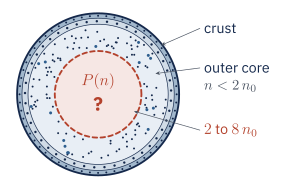
Pressure of neutron-star matter between two and eight times nuclear density
Partially resolved 78Determine the pressure $P(n)$ of cold beta-equilibrated matter for baryon density n between $2\,n_0$ and $8\,n_0$ ($n_0 = 0.16\,\mathrm{fm}^{-3}$) with 10 percent uncertainty, combining chiral EFT below about $2\,n_0$, perturbative QCD above about $40\,n_0$, pulsar masses, NICER (X-ray timing telescope) radii and gravitational-wave tidal deformabilities. Answer: a $P(n)$ band with stated priors.
-

AI-generated illustration
Compute the pressure $P(T,\mu_{B})$ and the chiral transition line of $2+1$-flavor QCD at physical quark masses for $\mu_{B}/T$ between 3 and 6 with controlled continuum extrapolation, despite the complex fermion determinant. Answer: $P$ and $T_{\mathrm{pc}}(\mu_{B})$ with percent-level uncertainty, by any method (reweighting, Taylor expansion, imaginary $\mu_{B}$, complex Langevin, Lefschetz thimbles) validated against established results at $\mu_{B}/T<2$.
-
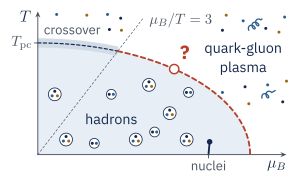
Determine whether the chiral crossover line $T_{\mathrm{pc}}(\mu_B)$ ($T_{\mathrm{pc}}(0)$ about $156\,\mathrm{MeV}$, $\mu_B$ the baryon chemical potential) ends at a critical point $(T_c, \mu_B,c)$ beyond which the transition is first order, and locate it. Lattice QCD disfavors a critical point at $\mu_B/T$ below about 3. Answer: yes or no, and $(T_c, \mu_B,c)$ with uncertainty.
-
For light Majorana neutrino exchange, compute $M^{0\nu}$ for 76Ge, 82Se, 100Mo, 130Te and 136Xe including long-range, short-range contact and two-body-current terms, with quantified uncertainty below 30 percent. Shell model, QRPA (quasiparticle random-phase approximation), energy density functional and ab initio (in-medium similarity renormalization group, coupled cluster) results span roughly a factor of 3. Answer: $M^{0\nu}$ with uncertainties, validated on related observables (2nubb rates, double Gamow-Teller strengths, muon capture).
-
Extend time-dependent density-functional theory with pairing (TDHFB, TDSLDA) by a beyond-mean-field treatment of fluctuations (time-dependent generator coordinate method, stochastic mean field, or time-dependent random phase approximation) so that it predicts the mass and charge yields $Y(A)$, $Y(Z)$, the total kinetic energy distribution $\mathrm{TKE}(A)$ and their widths for $\mathrm{235U}(n_{\mathrm{th}},f)$ and $\mathrm{252Cf}(\mathrm{sf})$ within experimental uncertainty. The functional must be fixed by non-fission data only, and the answer is a demonstration of such predictions.
-
Determine the total astrophysical S-factor $S_{\mathrm{tot}}(E_{\mathrm{cm}}=300\,\mathrm{keV})$ of $\mathrm{12C}(\alpha,\gamma)\mathrm{16O}$ (E1 and E2 ground-state transitions plus cascades), at the Gamow peak for $T \sim 2 \times 10^{8}\,\mathrm{K}$, with total uncertainty below 10 percent. Direct data stop near $E_{\mathrm{cm}} \sim 1\,\mathrm{MeV}$, so the answer requires either direct data closer to 300 keV or an R-matrix extrapolation whose subthreshold-state inputs (1- at 7.12 MeV and 2+ at 6.92 MeV in 16O) are fixed to the needed accuracy.
-
Establish whether the growth of the gluon distribution $x\,g(x, Q^2)$ in protons and heavy nuclei at $x < 10^{-3}$ and $Q^2$ of a few $\mathrm{GeV}^2$ is modified by nonlinear recombination, as described by the Balitsky-Kovchegov and JIMWLK evolution equations, with a saturation scale $Q_s^2(x) \sim A^{1/3} x^{-\lambda}, \lambda \sim 0.3$. A yes requires an observable whose measured A and x dependence is reproduced by nonlinear evolution and excluded, at high significance, by linear DGLAP evolution with fitted nuclear parton distributions.
-
Determine $M_{\mathrm{TOV}}$, the maximum gravitational mass of a cold nonrotating neutron star (the Tolman-Oppenheimer-Volkoff limit). Lower bounds come from PSR J0740+6620 at about $2.08\ \text{solar masses}$ and PSR J0952-0607 at $2.35 \pm 0.17\ \text{solar masses}$; arguments about the GW170817 merger remnant suggest $M_{\mathrm{TOV}}$ below about $2.3\ \text{solar masses}$. Answer: $M_{\mathrm{TOV}}$ with uncertainty below $0.1\ \text{solar mass}$.
-
For a neutron star near $M_{\mathrm{TOV}}$, determine whether the central density exceeds the onset of deconfined quark matter, diagnosed by the polytropic index $\gamma=d\ln P/d\ln\epsilon$ approaching its conformal value 1 and the normalized trace anomaly $(\epsilon-3P)/(3\epsilon)$ approaching 0, where $\epsilon$ is energy density. Answer: yes or no, with posterior probability given all astrophysical data and perturbative QCD limits.
-
Simultaneous binding energies and charge radii of medium-mass nuclei
Partially resolved 64With NN plus 3N interactions from chiral EFT fitted only to few-body data ($A \le 4$, optionally nuclear-matter saturation), predict ground-state energies and charge radii of 16O, 40Ca, 48Ca and 208Pb within 1 percent, and saturation of symmetric nuclear matter ($n_0$ about $0.16\ \mathrm{fm}^{-3}$, $E/A$ about $-16\ \mathrm{MeV}$). Answer: an interaction with quantified truncation errors meeting these targets, and identification of the 3N terms that control saturation.
-
How the proton spin divides among quarks and gluons
Partially resolved 64In a fixed gauge-invariant decomposition (Jaffe-Manohar: $1/2=\Delta \Sigma/2+\Delta G+L_{q}+L_{g}$, or Ji: $1/2=J_{q}+J_{g}$) at $\mu^{2}=10\,\mathrm{GeV}^{2}$ in the MS-bar scheme, determine each term with uncertainty below 0.05. $\Delta \Sigma \sim 0.3$ is known from polarized deep-inelastic scattering; the answer is the complete set of values from data, cross-checked by lattice QCD at the physical pion mass.
-
Determine whether residual cross-section model errors after near-detector constraints (axial form factor, 2p2h, pion production, $\nu$ versus antineutrino and $\nu_e$ versus $\nu_\mu$ differences) shift the fitted $\delta_{\mathrm{CP}}$ by more than its statistical uncertainty at full DUNE and Hyper-Kamiokande exposure. The answer is the size of the bias in degrees for realistic alternative nuclear models, obtained from mock-data studies that use models outside the fitting model's freedom.
-
Compute the $I=0$ (deuteron) and $I=1$ (dineutron) S-wave nucleon-nucleon phase shifts and pole positions in lattice QCD at the physical pion mass, with continuum and infinite-volume extrapolation. Answer: deuteron binding energy (experiment $2.2246\,\mathrm{MeV}$) and the $1S0$ nn scattering length (experiment about $-18.9\,\mathrm{fm}$), plus resolution of the dependence of results on the choice of interpolating operators found at $m_{\pi}$ above $300\,\mathrm{MeV}$.
-
For chi_c1(3872), $Z_c(3900)$, $T_{cc}+(3875)$, $P_c(4312)$, $P_c(4440)$ and $P_c(4457)$, determine the structure: the weight of the two-hadron component (compositeness, between 0 and 1) versus compact diquark-antidiquark or pentaquark components. Answer: a classification supported by pole positions, line shapes, production rates in high-multiplicity pp collisions, and lattice QCD finite-volume spectra.
-
Why small collision systems show collective flow
Contested 59High-multiplicity pp and p-Pb collisions at the LHC show long-range two-particle correlations (the ridge), azimuthal anisotropies $v_{2}$ and $v_{3}$ from multi-particle cumulants, and strangeness enhancement comparable to Pb-Pb. Determine the mechanism (hydrodynamic response of a quark-gluon plasma droplet, initial-state gluon correlations, or kinetic transport with few rescatterings) and the minimum system size for hydrodynamic behavior. Answer: one model reproducing $v_{n}$ versus multiplicity and system size from pp to Pb-Pb with fixed parameters.
-
With hyperon-nucleon (YN) and hyperon-nucleon-nucleon (YNN) forces constrained by hypernuclear binding energies, femtoscopic correlations and lattice QCD, determine the density at which $\Lambda$ and $\Sigma-$ hyperons appear and whether $M_{\mathrm{TOV}} \ge 2\ \text{solar masses}$ survives. Answer: the mechanism (repulsive YNN forces, early quark deconfinement, or absence of hyperons) and the interaction parameters that produce it.
-
Determine $\Delta G(\mu^{2})=\int_{0}^{1}\mathrm{d}x\ \Delta g(x,\mu^{2})$ at $\mu^{2}=10\ \mathrm{GeV}^{2}$, where $\Delta g$ is the gluon helicity distribution and x the gluon momentum fraction. RHIC polarized pp data give $\int_{0.05}^{0.2}\Delta g\ \mathrm{d}x=0.20\ (+0.06,-0.07)$ (de Florian et al., 2014) under a positivity assumption; the open part is $x<0.01$, where no data exist, together with the residual dependence of the sign on high-x and $\mathrm{SU}(3)$ assumptions. Answer: $\Delta G$ with total uncertainty below 0.05.
-
PREX-II gives $R_{\mathrm{skin}}(208\mathrm{Pb})$ = $R_{n} - R_{p}$ = $0.283 \pm 0.071\ \mathrm{fm}$ and CREX gives $R_{\mathrm{skin}}(48\mathrm{Ca})$ = $0.121 \pm 0.026\ (\mathrm{exp}) \pm 0.024\ (\mathrm{model})\ \mathrm{fm}$. Determine whether a single nuclear Hamiltonian or energy density functional reproduces both measured parity-violating asymmetries $A_{\mathrm{PV}}$, and fix $R_{\mathrm{skin}}(208\mathrm{Pb})$ to $\pm 0.03\ \mathrm{fm}$. Answer: a consistent description, or the identified experimental or theoretical cause of the tension.
-
Measure atomic masses to 10 keV and beta-decay half-lives to 10 percent for $N = 126$ isotones with $Z = 64\text{ to }72$ and neighbors with $N = 124\text{ to }130$, and test mass models (typical rms deviation about 0.5 MeV away from stability) and half-life predictions. Answer: measured values and the resulting shift in the predicted position and width of the $A\text{ about }195$ abundance peak.
-
Determine $(n, \gamma)$ rates at $T\ \text{about}\ 10^{9}\,\mathrm{K}$ for nuclei 10 to 20 neutrons beyond stability to within a factor of 2 (model predictions differ by up to two orders of magnitude far from stability), using indirect methods: the beta-Oslo method (gamma strength and level density from beta-decay feeding), surrogate reactions, and $(d, p)$ on radioactive beams. Answer: rates for the nuclei with largest abundance sensitivity and validated statistical-model inputs.
-
Quantify the bias and spread of reconstructed versus true neutrino energy, $E_{\mathrm{reco}} - E_{\mathrm{true}}$, for calorimetric reconstruction on 40Ar (DUNE, $E_\nu \sim 0.5 \text{ to } 5\,\mathrm{GeV}$) and lepton-kinematics reconstruction on 16O (Hyper-Kamiokande, $E_\nu \sim 0.6\,\mathrm{GeV}$), from 2p2h events, nucleon and pion final-state interactions, and undetected neutrons, to 1 percent of the energy scale. The answer is a model-independent bound or a validated model, tested on electron-scattering data with known beam energy (for example e4nu) and on near-detector data.
-
Origin of the proton mass from quark and gluon energies
Partially resolved 55Using the QCD energy-momentum tensor $T^{\mu \nu}$ split into quark and gluon parts, determine for the proton at rest the quark mass (sigma-term) contribution, quark and gluon kinetic and potential contributions, and the trace-anomaly term $(\beta(g)/2g) F^{2}$, in MS-bar at $\mu = 2\,\mathrm{GeV}$, as fractions of $M_p = 938.27\,\mathrm{MeV}$. Also determine whether the split depends on the chosen decomposition (Ji 1995 versus Lorce 2018 and Metz-Pasquini-Rodini 2020) and which terms are measurable. Answer: numerical fractions with uncertainties plus a statement of which are scheme independent.
-
Physical origin of the EMC effect
Contested 55The per-nucleon ratio $F2^{A}(x)/F2^{d}(x)$ of deep-inelastic structure functions falls below 1 for $0.3 < x < 0.7$, with slope correlated with $a_{2}$, the number of short-range correlated (SRC) pairs per nucleon. Determine the mechanism: mean-field modification of all nucleons, strong modification of nucleons in high-virtuality SRC pairs, or another effect. Answer: a model reproducing the A- and x-dependence that is also consistent with tagged and flavor-separated measurements.
-
How the quark-gluon plasma becomes a fluid so quickly
Partially resolved 55Determine how and when the energy-momentum tensor of matter formed in $A+A$ collisions reaches viscous-hydrodynamic form (hydrodynamization) while the pressure anisotropy $P_L/P_T$ is still far from 1, at proper times $\tau$ about $0.5\ \text{to}\ 1\ \mathrm{fm}/c$. Answer: a QCD-based mechanism (attractor solutions, weak-coupling kinetic theory, or strong-coupling holography) with a predicted hydrodynamization time as a function of $\eta/s$ and energy density, tested against data.
-
For the NN interaction in chiral EFT with one-pion exchange treated nonperturbatively, find a power counting under which amplitudes at each order are independent of the momentum cutoff $\Lambda$ for $\Lambda$ well above the breakdown scale (about 600 MeV) in all partial waves, including singular attractive tensor channels such as $3P0$ and $3P2-3F2$, and which converges for observables at physical $m_{\pi}$. Answer: the scheme with a demonstration of order-by-order renormalization and convergence, or a proof that none exists.
-
Given $c_s^{2}(n) > c^{2}/3$ somewhere below the central density of a maximum-mass star, determine the density $n_{\mathrm{peak}}$ of the maximum of $c_s^{2}$ and its height, and the microscopic mechanism: quarkyonic matter (a phase with a quark Fermi sea surrounded by a shell of nucleons near the Fermi surface), a hadron-quark crossover, a first-order transition, or strongly repulsive hadronic interactions. Answer: $n_{\mathrm{peak}}/n_0$ and the maximum $c_s^{2}$ with uncertainties, plus a mechanism consistent with chiral EFT at low density and perturbative QCD at high density.
-
Determine which proton number $Z$ (114, 120 or 126) gives the next spherical shell gap above $Z = 82$ for $N$ near 184, from measured $\alpha$-decay $Q$ values, fission half-lives and spectroscopy of nuclei with $Z \ge 110$, and from theory with quantified spin-orbit and density-functional uncertainty. Answer: the $Z$ of the shell closure and the predicted half-life of the doubly magic nucleus.
-
Determine $F_A(Q^{2})$ for $0<Q^{2}<1\ \mathrm{GeV}^{2}$ to 5 percent and resolve why lattice QCD results exceed z-expansion fits to neutrino-deuterium bubble-chamber data by roughly 20 to 30 percent at $Q^{2}\sim 0.5\ \text{to}\ 1\ \mathrm{GeV}^{2}$, which implies quasielastic cross sections higher by a similar amount. The answer identifies whether the discrepancy lies in lattice systematics (excited states, continuum and volume extrapolation), in deuteron corrections and normalization of the old data, or in both, using the antineutrino-hydrogen measurement of MINERvA (2023) as an independent check.
-
Extract the quark orbital angular momentum $L_q = J_q - \Delta \Sigma_q/2$ with $J_q = (1/2)\,\int dx\, x\, [H_q(x,0,0) + E_q(x,0,0)]$, where $H$ and $E$ are generalized parton distributions (GPDs, functions encoding both momentum and transverse position of partons) measured in deeply virtual Compton scattering and exclusive meson production, together with the gluon $J_g$. Answer: $L_u, L_d\ \text{and}\ J_g$ at $\mu^2 = 4\,\mathrm{GeV}^2$ with uncertainties below 0.05, satisfying the spin sum rule.
-
STAR Beam Energy Scan II (PRL 2025) measured the net-proton cumulant ratio $C4/C2$ in 0-5 percent central $\mathrm{Au}+\mathrm{Au}$ collisions at $\sqrt{s_{NN}} = 7.7 \text{ to } 27 \mathrm{GeV}$ and found a minimum near 19.6 GeV deviating from non-critical baselines by 2 to 5 standard deviations. Determine whether this follows from a critical point, using dynamical models with baryon-number conservation, finite size and lifetime, and non-equilibrium evolution, or from non-critical effects. Answer: yes or no with quantified model uncertainty.