This browser is older than PubPhys supports. Every page can be read, but signing in to contribute, voting and signing need Safari 15.4, Chrome or Edge 99, Firefox 97 or newer. Browsers
All problems
74 problems
Starting order drafted by AI. Votes change it. How ranking works
-
AI-generated illustration
Find a quantum system whose observables compute those of quantum gravity in asymptotically de Sitter space, for example a Euclidean CFT at future infinity (dS/CFT, Strominger 2001), a static-patch or horizon dual, or double-scaled SYK, reproducing at least the Gibbons-Hawking entropy and the tree-level wavefunction of the universe.
-
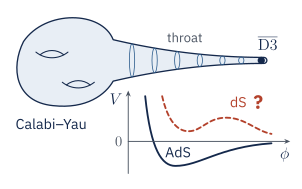
Determine whether there exist solutions of string theory, with $\alpha'$ and $g_s$ corrections under control, whose 4D effective potential has a local minimum with $V > 0$ and lifetime longer than the Hubble time, such as KKLT or Large Volume Scenario constructions in type IIB orientifolds with anti-D3-brane uplift.
-
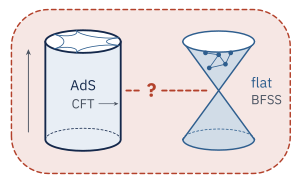
Exact definitions of string and M-theory exist for asymptotically AdS spacetimes (dual CFTs) and for flat space in light-cone frame (BFSS matrix theory), each tied to asymptotic boundary conditions. Find a formulation whose Hilbert space and observables do not presuppose a background and which contains these as special sectors.
-
For a 4D anomaly-free chiral gauge theory with nonabelian gauge group (for example SU(5) with 5bar + 10, or one Standard Model generation), construct a lattice regularization with exact gauge invariance at finite lattice spacing, a local action and fermion measure, and the correct continuum limit, extending Luscher's 1999 abelian construction based on Ginsparg-Wilson fermions beyond perturbation theory.
-
The Gibbons-Hawking entropy of a d-dimensional de Sitter horizon is $S = A c^3/(4 G \hbar)$ with $k_B = 1$. Find a statistical system whose state count reproduces S including the one-loop logarithmic correction computed by Anninos, Denef, Law and Sun (2020).
-
Derive full nonlinear Einstein equations from boundary entanglement
Partially resolved 64The entanglement first law plus the Ryu-Takayanagi formula implies the linearized Einstein equations around AdS (Faulkner, Guica, Hartman, Myers, Van Raamsdonk 2014), extended to second order in 2017. Derive the full nonlinear bulk Einstein equations with matter from CFT entanglement constraints, or identify the additional input required.
-
In $4\mathrm{D}$ $\mathrm{SU}(N)$ Yang-Mills theory, identify the class of gauge-field configurations (center vortices, Abelian monopoles in a chosen gauge, calorons and their dyon constituents, or other) whose statistics reproduce the area law $\langle W(C)\rangle \sim \exp(-\sigma A)$ of large Wilson loops, the full string tension $\sigma$, Casimir scaling of string tensions at intermediate distances and N-ality dependence at large distances. An answer is a gauge-invariant (or demonstrably gauge-independent) definition of the configurations, together with evidence that removing them removes $\sigma$ and keeping only them reproduces it.
-
Does the weak gravity conjecture hold in all quantum gravity theories?
Partially resolved 63Weak gravity conjecture (Arkani-Hamed, Motl, Nicolis, Vafa 2006): every U(1) gauge theory coupled to gravity has a state with charge-to-mass ratio at least that of extremal black holes. Determine whether this holds in every consistent quantum gravity theory, and whether the sublattice or tower versions hold.
-
The refined de Sitter conjecture (2018) states that in asymptotic, weakly coupled regions of moduli space, $\mid \operatorname{grad} V \mid \ge c V/M_{P}$ or $\mathrm{min}\ \mathrm{eigenvalue}(\operatorname{grad}\ \operatorname{grad} V) \le -c' V/M_P^{2}$ with c, c' of order 1. Determine whether this holds in all asymptotic regions of string moduli spaces and find the optimal value of c in d dimensions.
-
Determine whether an analogue of the Ryu-Takayanagi formula $S = \mathrm{Area}/(4 G \hbar)$ for extremal surfaces holds in de Sitter or asymptotically flat quantum gravity, with an identified quantum system whose subregion entropies it computes (candidates include surfaces anchored at horizons or future infinity and timelike entanglement).
-
Absence of global symmetries in quantum gravity outside anti-de Sitter
Partially resolved 61Harlow and Ooguri (2018) proved in AdS/CFT that bulk quantum gravity has no global symmetries and that the gauge charge spectrum is complete. Determine whether the same holds in asymptotically flat and de Sitter quantum gravity, including higher-form and non-invertible global symmetries.
-
Which conformal field theories have a semiclassical gravity dual?
Partially resolved 59Heemskerk, Penedones, Polchinski and Sully (2009) conjectured that a CFT with large central charge $c$ and a large gap $\Delta_{\mathrm{gap}}$ to single-trace operators of spin greater than 2 has a local Einstein-gravity dual. Determine necessary and sufficient conditions on CFT data for a semiclassical local bulk, and prove or refute the conjecture.
-
Worldsheet string theory dual to free $N=4$ super-Yang-Mills
Partially resolved 57Planar free $N=4\ \operatorname{SU}(N)$ super-Yang-Mills ($g_{\mathrm{YM}} = 0$, $N \to \infty$) should be dual to tensionless type IIB strings on $\mathrm{AdS}_5 x S^5$. For $\mathrm{AdS}_3 x S^3 x T^4$ with one unit of NS-NS flux this was established with a worldsheet theory reproducing the symmetric-orbifold CFT (Eberhardt, Gaberdiel, Gopakumar 2018-2019). Construct the $\mathrm{AdS}_5$ worldsheet theory and show that its genus-zero correlators equal the planar free-field correlators of all single-trace operators.
-
The 6D $N=(2,0)$ superconformal theory of type $A_{N-1}$ is defined as the low-energy limit of N coincident M5-branes or of type IIB string theory on $C^2/Z_N$. Give a self-contained definition independent of string and M-theory (operator algebra and Hilbert space, a UV completion via 5D maximally supersymmetric Yang-Mills, deconstruction, or a lattice limit) that reproduces known data: anomaly coefficients scaling as $N^3$, the $W_N$ chiral algebra, and the protected spectrum.
-
3D QED with $N_{f}$ two-component Dirac fermions of unit charge ($N_{f}$ even, parity invariant) flows to an interacting CFT for large $N_{f}$. Determine $N_{f}^{c}$ such that for $N_{f} < N_{f}^{c}$ the IR breaks the $\mathrm{SU}(N_{f})$ flavor symmetry or is otherwise not conformal; in particular decide $N_{f} = 2$ and $N_{f} = 4$ (the latter describes the Dirac spin liquid).
-
Compute the coefficient of the seven-loop logarithmic ultraviolet divergence (the $D^{8}R^{4}$ counterterm) of the four-graviton amplitude in $D=4$ $N=8$ supergravity, or prove it vanishes. The highest computed order gives critical dimension $D_{c}=24/5$ at five loops (Bern et al., Phys. Rev. D 98, 086021, 2018).
-
For 4D theories with massless gauge bosons or gravitons, define nonperturbatively asymptotic observables (dressed amplitudes, Faddeev-Kulish states, or inclusive cross sections) that are infrared finite and obey unitarity, analyticity and crossing in a form usable for numerical bootstrap. An answer is such a definition with proofs of these properties, or a demonstration that one of them must fail.
-
Is there a consistent celestial CFT for four-dimensional gravity?
Partially resolved 55Celestial holography maps the 4D asymptotically flat S-matrix, via a Mellin transform in energy, to correlators on the celestial sphere. Determine whether for Einstein gravity beyond tree level these correlators form a CFT with a local operator algebra, OPE and state-operator map, and find an intrinsic definition independent of the bulk.
-
Is the number of string vacua finite?
Partially resolved 55Determine whether the set of string compactifications to 4D with a bounded number of light fields and effective theories valid below a fixed cutoff is finite, including whether the number of topologically distinct Calabi-Yau threefolds is finite.
-
The type IIB (IKKT) matrix model of ten $N$ x N Hermitian bosonic matrices and fermions is proposed as a nonperturbative definition of type IIB string theory. Determine whether its Lorentzian version at large N dynamically generates a smooth expanding $(3+1)$-dimensional spacetime with $\mathrm{SO}(9) \to \mathrm{SO}(3)$ breaking, rather than singular configurations.
-
In asymptotically free theories ($4\mathrm{D}$ Yang-Mills and QCD, $2\mathrm{D}$ $\mathrm{O}(N)$, $\mathrm{CP}^{N-1}$ and principal chiral models), the Borel transform of perturbation series has renormalon singularities at positions set by the one-loop beta-function coefficient, not matched by any finite-action classical solution. Identify the nonperturbative sectors (saddles, fractional instantons, bions on R^{d-1} x S^1, or OPE condensates) whose imaginary ambiguities cancel the renormalon ambiguities, and demonstrate the cancellation.
-
With dynamical matter in the fundamental representation, the $Z_N$ one-form center symmetry is explicitly broken and the Wilson-loop area law is no longer an order parameter; Fradkin and Shenker (1979) showed the phases can be connected. Determine whether, in theories with additional global symmetries (for example a $U(1)$ broken in both regimes, as in dense QCD), a vortex-holonomy or other non-local order parameter sharply separates Higgs and confining phases, and whether this holds generally.
-
For asymptotically free 4D chiral gauge theories such as SU(5) with fermions in 5bar + 10, or the Bars-Yankielowicz and Georgi-Glashow families, determine the infrared phase: confinement with massless composite fermions saturating 't Hooft anomalies, dynamical Higgsing (tumbling, color-flavor locking), or an IR CFT.
-
$\mathrm{SU}(3)$ gauge theory with $N_{f}$ massless Dirac fermions in the fundamental representation is asymptotically free for $N_{f} < 16.5$ and has a perturbative IR fixed point near that value. Determine $N_{f}^{*}$ such that for $N_{f}^{*} \le N_{f} < 16.5$ the IR is a CFT and for smaller $N_{f}$ chiral symmetry breaks; in particular decide $N_{f} = 8, 10 \text{ and } 12$.
-
Does BFSS matrix theory recover eleven-dimensional Lorentz invariance?
Partially resolved 52The BFSS model, $SU(N)$ maximally supersymmetric quantum mechanics, is conjectured to describe M-theory in light-cone frame as $N \to \infty$ with $p^+ = N/R$. Determine whether its amplitudes (graviton scattering) reproduce 11D Lorentz-invariant results beyond terms protected by supersymmetry, i.e. whether the large-N limit at fixed $p^+$ exists and is boost invariant.
-
Does confinement imply chiral symmetry breaking in QCD-like theories?
Partially resolved 52In 4D $\mathrm{SU}(N_{c})$ gauge theory with $N_{f}$ massless Dirac quarks in the fundamental representation, assume confinement in the sense that all massless bound states are color singlets. Prove that $\mathrm{SU}(N_{f})_{L}$ x $\mathrm{SU}(N_{f})_{R}$ breaks to $\mathrm{SU}(N_{f})_{V}$ for every $N_{c} \ge 3$ and every $N_{f}$ below the conformal window, using 't Hooft anomaly matching without further dynamical assumptions, or exhibit a consistent chirally symmetric confining spectrum.
-
When do non-invertible symmetries forbid a featureless gapped phase?
Partially resolved 51For a QFT with a finite non-invertible symmetry $C$, find a computable criterion on $C$ that decides whether a trivially gapped, symmetric, non-degenerate phase is possible. In 2D the criterion is the existence of a fiber functor for the fusion category $C$; find the analogue in $d=3 \text{ and } 4$.
-
In mirror-fermion or domain-wall lattice formulations of an anomaly-free chiral theory, add interactions that gap the mirror sector by symmetric mass generation while the target sector stays massless. Determine whether, after weak gauging, the continuum limit is the target chiral gauge theory with no extra massless states and no fermion propagator zeros that act as ghost-like states. Minimal test case: the 2D U(1) 3-4-5-0 model of Wang and Wen.
-
Closed superstring field theory gives a consistent perturbative definition, including D-instanton contributions with fixed normalizations (Sen 2020-2024). Determine whether it admits classical solutions describing distant backgrounds (full background independence) and a nonperturbative formulation beyond the $g_{s}$ expansion.
-
Determine whether the flat-space limit $R_{\mathrm{AdS}} \to \infty$ at fixed string length of $N=4$ super-Yang-Mills correlators (via Mellin amplitudes, Penedones 2010) yields a well-defined nonperturbative $10\mathrm{D}$ type IIB S-matrix, including energies where black holes form.