This browser is older than PubPhys supports. Every page can be read, but signing in to contribute, voting and signing need Safari 15.4, Chrome or Edge 99, Firefox 97 or newer. Browsers
All problems
99 problems
Starting order drafted by AI. Votes change it. How ranking works
-
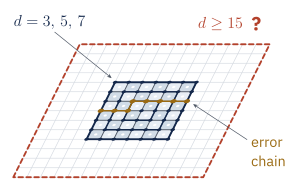
For surface-code memories on superconducting hardware, the logical error per cycle is modeled as $\epsilon_L(d) \sim A \Lambda^{-(d+1)/2}$ with code distance $d$; Google Quantum AI (Nature 638, 920, 2025, arXiv:2408.13687) reported $\Lambda$ of about 2.1 up to $d = 7$. Determine whether this law holds to $d \ge 15 \text{ and } \epsilon_L \le 10^{-10}$ per cycle, or whether correlated, leakage or drift events produce a floor; the answer is the measured $\epsilon_L(d)$ curve or a validated model of its floor.
-
AI-generated illustration
Fix a size-indexed chemical family, for example iron-sulfur clusters with $N_{\mathrm{Fe}} = 2, 4, 8, ...$ iron centers and active spaces of N orbitals growing linearly with $N_{\mathrm{Fe}}$, or linear transition-metal chains of length N. For ground-state energy to chemical accuracy ($1.6\,\mathrm{mHa}$), compare the scaling with N of the best classical cost (DMRG, coupled cluster, selected CI, quantum Monte Carlo) with that of quantum phase estimation including the cost of preparing a state with sufficient ground-state overlap; decide whether the ratio grows exponentially in N. Lee et al. (arXiv:2208.02199, Nature Communications 2023) found no evidence of a generic exponential advantage.
-
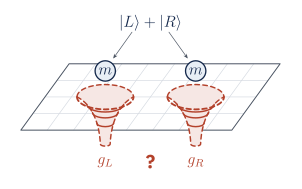
Determine whether the low-energy gravitational field of laboratory masses can exist in superpositions of distinct configurations and carry quantum information, or is a classical field coupled to quantum matter (mean-field semiclassical, stochastic classical-quantum, or collapse-based). An answer is an experimental result that excludes one class under stated assumptions, such as locality of the mediator.
-
AI-generated illustration
Two masses $m \sim 10^{-11}\,\mathrm{g}$, each in a spatial superposition of size $\Delta x \sim 2.5 \times 10^{-2}\,\mathrm{cm}$ at separation $d \sim 4.5 \times 10^{-2}\,\mathrm{cm}$, acquire branch-dependent phases $\phi = G m^{2} t / (\hbar d)$ over $t \sim 2.5\,\mathrm{s}$ (illustrative parameters of Bose et al. 2017, approximate). Demonstrate a positive entanglement witness (e.g. embedded-spin correlations) with Casimir-Polder and electromagnetic couplings suppressed below the gravitational one and decoherence rates below $1/t$.
-
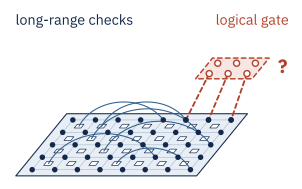
Low-overhead universal logical gates on constant-rate qLDPC codes
Partially resolved 78For a constant-rate qLDPC family with distance d, give a fault-tolerant implementation of a universal logical gate set (all logical Clifford gates plus one non-Clifford gate on any chosen logical qubits) that uses O(n) ancilla qubits, has space-time cost per logical gate O(d polylog d), and has a threshold under circuit-level noise. Candidate ingredients include code surgery, code automorphisms and codes with transversal CCZ.
-
AI-generated illustration
Can radiation-induced error bursts in superconducting chips be made rare enough?
Partially resolved 75In transmon arrays, ionizing-radiation impacts in the substrate produce phonons that break Cooper pairs and raise the quasiparticle density near Josephson junctions, causing $T1$ drops and frequency shifts over regions of order $\mathrm{cm}^2$ for times of about 1 to 30 ms. Establish the quantitative chain (energy deposition, phonon transport, quasiparticle generation, trapping and recombination) that sets the burst rate and footprint, and determine whether gap engineering, phonon traps and shielding can lower the rate of bursts that defeat a distance-d surface-code patch to the level required for logical error rates near $10^{-12}$ per cycle.
-
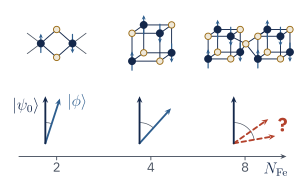
For strongly correlated molecules and clusters (e.g. iron-sulfur clusters with $N_{\mathrm{Fe}}$ iron atoms), determine how the maximal overlap $\mid\langle \phi \mid \psi_0\rangle\mid^2$ between the ground state $\psi_0$ and states $\phi$ preparable classically in poly time (bounded-bond-dimension MPS, broken-symmetry determinants and short sums of them) scales with system size; exponential decay would remove the exponential advantage of phase estimation.
-
In fusion-based quantum computation with linear optics, entangled resource states of bounded size are joined by probabilistic two-photon fusion measurements (success probability $1/2$ without ancilla boosting), and each photon is lost with probability $\eta_L$. Determine the supremum of $\eta_L$ for which a fault-tolerance threshold exists, as a function of resource-state size and fusion boosting, and decide whether loss tolerance well above the $10.4\%$ loss per fusion reported for a ballistic scheme by Bartolucci et al. (arXiv:2101.09310, 2021) is reachable with bounded-size resource states.
-
For controlled-Z gates between alkali or alkaline-earth atoms in optical tweezers using the Rydberg blockade, the error has contributions from radiative and blackbody-induced decay of the Rydberg state (lifetime $\tau_R$ of order $10^{-4}\,\mathrm{s}$ at 300 K for principal quantum number $n \sim 50-70$, approximate), finite blockade shift $B$ relative to the Rabi frequency, laser phase and intensity noise, and atomic motion. Determine the lowest achievable two-qubit error once all intrinsic contributions are minimized jointly over pulse shape and gate time, and decide whether errors $\le 10^{-4}$ are reachable at room temperature or require cryogenic environments or conversion of errors into detectable erasures.
-
Find a task executable by circuits of depth $O(\operatorname{polylog} n)$ on $n \le 10^{3}$ qubits with two-qubit gate error $\sim 10^{-3}$ and no error correction such that (i) a classical verifier checks the output in $\operatorname{poly}(n)$ time, (ii) the task is classically hard under a standard assumption such as learning with errors, and (iii) soundness holds at the output fidelity actually achievable. Answer: a protocol with all three properties, or a no-go result relating verifiability, noise rate and depth.
-
Qubits on a $D$-dimensional lattice couple through $H_{\int} = \sum_i \sigma_i B_i$ to a Gaussian bath with fixed single-qubit noise strength $\langle B_i B_i\rangle$ and spatial correlations $\langle B_i(t) B_j(t')\rangle$ decaying as $\left|r_i - r_j\right|^{-\alpha}$. A threshold is proved when the system-bath coupling decays faster than $1/r^D$ (Aharonov, Kitaev and Preskill, Phys. Rev. Lett. 96, 050504, 2006, arXiv:quant-ph/0510231). Decide whether a positive threshold in the single-qubit noise strength exists for $\alpha \le D$, or prove a logical-error floor independent of code size.
-
For parametrized circuits with loss $L(\theta) = \operatorname{Tr}[O U(\theta) \rho U(\theta)^{\mathrm{dag}}]$ whose gradient variance provably decays at most polynomially in qubit number $n$, is there always a classical algorithm that, after collecting $\operatorname{poly}(n)$ measurement data from a quantum device once, estimates $L(\theta)$ to $1/\operatorname{poly}(n)$ for any $\theta$ in $\operatorname{poly}(n)$ time? Cerezo et al. (arXiv:2312.09121, Nat. Commun. 16, 7907, 2025) argue yes for known families. An answer is a proof, or a barren-plateau-free family with a hardness proof.
-
For a system $S$ in state $\sum_{k} c_k |k>$ coupled unitarily to apparatus $A$ and environment $E$, unitary evolution gives $\sum_{k} c_k |k>|A_k>|E_k>$; decoherence makes the reduced density matrix of $S+A$ diagonal but selects no single $k$. Required: a modified dynamics, an added ontology (hidden variables, branches) or a principled account that yields single outcomes with frequencies $\mid c_k\mid^2$, together with either predictions that differ from standard quantum mechanics or a proof of empirical equivalence. This is the root problem of the topic; its workable sharper forms are listed under related.
-
Prepare a source mass $M$ in a spatial superposition of separation $\Delta x$ and measure a probe's response that distinguishes a field sourced by the expectation value $\langle T_{00}\rangle$ (Moller-Rosenfeld semiclassical gravity) from a branch-correlated field, at force scale $\sim G M m_{\mathrm{probe}} \Delta x / d^3$. Required: source masses small enough to superpose ($M <\sim 10^{-11}\,\mathrm{g}$) and probe force sensitivity at that scale.
-
For a free particle of mass m delocalized over $\Delta x$ for time t, with all known environmental decoherence (gas collisions, thermal photon emission and absorption, light scattering) accounted for, determine whether fringe visibility falls below the quantum prediction, i.e. whether an extra decoherence rate $\Gamma(m,\Delta x)>0$ exists. Progress is measured by the macroscopicity $\mu=\operatorname{log10}(\tau_e/1\,\mathrm{s})$ of Nimmrichter and Hornberger, with $\tau_e$ the largest classicalization time, referred to a single electron, that the experiment excludes for minimal macrorealistic modifications of quantum mechanics.
-
In classical-quantum gravity (Oppenheim and coworkers), the decoherence coefficient $D_2$ for mass superpositions and the diffusion coefficient $D_0$ of the Newtonian potential obey a trade-off with $D_0D_2$ bounded below (Oppenheim, Sparaciari, Soda, Weller-Davies, Nature Communications 2023). Determine whether coherence times from matter-wave interferometry combined with acceleration-noise data (torsion balances, Cavendish-type experiments, LISA Pathfinder) exclude the entire allowed $(D_0,D_2)$ region for each choice of kernel.
-
Does any parameter window of white-noise CSL remain viable?
Partially resolved 66Markovian (white-noise) CSL has collapse rate $\lambda$ and correlation length $r_{C}$. X-ray spontaneous emission in XENONnT gives $\lambda / r_{C}^{2} < 3.0 \times 10^{-7}\,\mathrm{s}^{-1}\,\mathrm{cm}^{-2}$ (90 percent C.L.) for $r_{C}$ below about $10^{-3}\,\mathrm{cm}$; mechanical and interferometric bounds cover larger $r_{C}$. Theoretical lower bounds require collapse of a barely visible object within about $10^{-2}\,\mathrm{s}$. Determine whether the region between experimental upper bounds and theoretical lower bounds is empty for all $r_{C}$.
-
Optimal Polynomial Intersection (OPI): given a prime $p$, points $x_{1}..x_{m}$ in $F_{p}$ and subsets $S_{i}$ of $F_{p}$, find a polynomial $Q$ over $F_{p}$ of $\mathrm{degree}<n$ maximizing the number of $i$ with $Q(x_{i})$ in $S_{i}$. For the parameter families of Jordan et al. (Nature 646, 831, 2025, arXiv:2408.08292), decoded quantum interferometry reaches a satisfied fraction (given by a semicircle-law formula) above that of every known polynomial-time classical algorithm. Answer: a classical polynomial-time algorithm achieving the same fraction, or a hardness proof under a standard complexity assumption.
-
The LOCC argument (local operations and classical communication cannot create entanglement) assumes the gravitational mediator acts as a classical channel. Determine under which explicit assumptions (locality, field-theoretic matter, linearity) observed entanglement at the rate $\phi = G m^2 t/(\hbar d)$ excludes classical gravity, and compute the entanglement producible by semiclassical or stochastic classical gravity coupled to quantum-field matter, which Aziz and Howl find enters at higher order in G and grows with mass toward the Planck mass (about $2 \times 10^{-5}$ g).
-
Existence of a self-correcting quantum memory in three dimensions
Partially resolved 63Does there exist a family of geometrically local Hamiltonians on qubits in $R^{3}$, with bounded interaction strength and qubit density, whose ground space encodes at least one qubit with a memory time, under a weakly coupled thermal bath (Davies dynamics), that grows as $\exp(c L^{b})$, $b > 0$, at some fixed temperature $T > 0$?
-
Zhai et al. (arXiv:2601.04621, 2026) report the ground energy of the standard 76-orbital, 113-electron FeMoco model to chemical accuracy ($1.6\,\mathrm{mHa}$), with several spin isomers degenerate within that accuracy, using unrestricted coupled cluster and DMRG at roughly $10^{5}$-$10^{6}$ CPU core hours, while fault-tolerant estimates for the same model need of order 2000 logical qubits and $10^{9}$-$10^{10}$ Toffoli gates (approximate). Identify a chemically meaningful extension (larger active space, catalytic intermediates, relative energies of the near-degenerate spin isomers) where the classical cost to $1.6\,\mathrm{mHa}$ exceeds the quantum cost, with both costs computed explicitly.
-
Let $H = \sum_{i=1}^m H_i$ be a $k$-local Hamiltonian on $n$ qubits with $\mid\mid H_i\mid\mid \le 1$ and each qubit in $O(1)$ terms. Is it QMA-hard to approximate its ground energy to additive error $\epsilon m$ for some constant $\epsilon > 0$? An answer is a proof of QMA-hardness, or a proof that the problem lies in NP (or a smaller class).
-
Test of gravity-related collapse in the Diosi-Penrose model
Partially resolved 62In the Diosi-Penrose model a superposition decays at rate $\Gamma = E_G / \hbar$, with $E_G$ the gravitational self-energy of the difference of the two mass distributions, regularized by a length $R_0$. X-ray bounds give $R_0 > 4.9 \times 10^{-8}\,\mathrm{cm}$ (XENONnT, 90 percent C.L.) for the Markovian version. Determine whether a superposition experiment, or a non-radiating dissipative version of the model, can reach the regime where $\Gamma$ exceeds all environmental decoherence for allowed $R_0$, and measure or exclude it.
-
For an optically or magnetically levitated dielectric particle of mass about $10^{-15} \text{ to } 10^{-14}\,\mathrm{g}$ (radius $r \sim 5 \times 10^{-6} \text{ to } 10^{-5}\,\mathrm{cm}$) prepared near its motional ground state, create a coherent spatial superposition or wave packet with coherence length exceeding $r$, and verify coherence by interference fringes or Wigner-function negativity, since position variance alone does not distinguish coherent from incoherent spreading.
-
Trapped ions at ion-electrode distance $d$ and secular frequency $\omega$ show electric-field noise spectral density $S_E(\omega)$ orders of magnitude above the Johnson-noise value, with approximate power laws $S_E \sim \omega^{-a} d^{-b}$ ($b$ reported roughly between 2 and 4), strong dependence on electrode temperature and large reductions after surface cleaning (exponents approximate). Identify the dominant microscopic mechanism (fluctuating adsorbate dipoles, two-level fluctuators in surface layers, patch-potential diffusion or other) and give a model that predicts $S_E$ as a function of $d$, $\omega$, $T$ and surface preparation.
-
For the $2\mathrm{D}$ Fermi-Hubbard model at $U/t = 8$ and hole doping near $1/8$ on L x L lattices, determine the minimum logical qubit count and Toffoli count for phase estimation to give the energy per site to accuracy $10^{-3} t$ at a size L beyond reliable classical extrapolation, including state-preparation cost. Published estimates (e.g. Kivlichan et al., Quantum 2020) give roughly $10^{6}-10^{8}$ Toffoli gates for lattices of about $10 \times 10 \text{ to } 20 \times 20$ sites, without full overlap costs (figures approximate).
-
Efficient contraction of PEPS for gapped two-dimensional ground states
Partially resolved 54For an injective PEPS of bond dimension $\chi = O(1)$ on an $L$ x L lattice whose parent Hamiltonian is gapped uniformly in L, is there a classical algorithm computing a local expectation value to additive error $\epsilon$ in time $\operatorname{poly}(L, 1/\epsilon)$? Exact contraction of general PEPS is #P-hard (Schuch et al. 2007) and random PEPS are average-case hard to contract (Haferkamp et al. 2020). Schwarz, Buerschaper and Eisert (Phys. Rev. A 95, 060102, 2017, arXiv:1606.06301) give a quasi-polynomial algorithm under additional assumptions (a gapped transfer operator and conditions on the boundary state); the open question is polynomial time from the bulk gap alone.
-
For CSL with noise correlation cutoff frequency $\Omega$ (colored) and/or collapse-noise temperature $T_{\mathrm{CSL}}$ (dissipative), determine the excluded region of $(\lambda, r_{C}, \Omega, T_{\mathrm{CSL}})$ from levitated and clamped mechanical oscillators, gravitational-wave detectors, bulk heating and interferometry, and whether parameters giving macroscopic collapse survive when $\Omega$ lies below the X-ray frequency range.
-
Does every language in BQP have an interactive proof with a BPP verifier exchanging only classical messages with a single BQP prover, sound against computationally unbounded provers? Known protocols need a verifier holding a few qubits, two non-communicating entangled provers (Reichardt, Unger and Vazirani 2013), or soundness only against provers who cannot solve learning with errors (Mahadev, arXiv:1804.01082, 2018).
-
For the second-order out-of-time-order correlator (OTOC(2)) circuits run by Google Quantum AI in 2025 (arXiv:2506.10191), compute the reported observables with error at or below the experimental error bars using classical methods (tensor networks, Pauli-path or Monte Carlo) in time comparable to the experiment, or give complexity-theoretic evidence that no such algorithm exists at that size.