What causes the super-Arrhenius slowdown of supercooled liquids?
80No. 35 in all physics · No. 2 in Soft Matter and Biological Physics
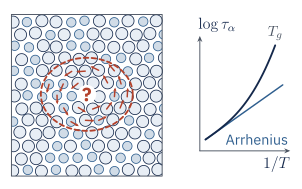
As a glass-forming liquid is cooled, the time its molecules take to rearrange grows by about 14 powers of ten over a narrow temperature range, much faster than the simple Arrhenius law (a fixed energy barrier) predicts. Which microscopic mechanism produces this growth is unknown.
Status in the literature
Unverified note: it names recent work and was partly written without a live literature search; it awaits a check by an editor.
Swap Monte Carlo has equilibrated model liquids below the experimental $T_{g}$ since about 2017, but as of 2026 no test has eliminated the main competing theories.
Subproblems (1)
-
55Does a growing static length control relaxation near $T_g$? a special case · open
See also
- Related How close can vapor-deposited glasses approach the ideal glass?
- Related How self-propulsion changes the glass transition of dense active matter
- Related What sets the fragility of a glass-forming liquid?
- Related Microscopic nature of the Johari-Goldstein secondary relaxation
- Related Does an ideal glass transition occur at finite temperature in 3D?
Details, signature and history
- Kind
- Phenomenon to explain
- Answer
- Mechanism
- Topic review
- L. Berthier and G. Biroli, Theoretical perspective on the glass transition and amorphous materials, Reviews of Modern Physics, 2011. Link
- Record
- Revision 2 · notation repaired by the platform · compiled by AI, not yet reviewed by an editor
- Batch approval
- Approved for the batch by Victor Galitski (ORCID 0000-0001-5532-1096) · approval record · bundle This approves the batch, not each problem (what it means).
- Earlier revisions
- revision 1 bundle
Proof
- Fingerprint
- 60848fcc6e7d…
- Public log
- Entry 779, in checkpoint 2,123
- In the log by
- Block 969,698, 2026-10-03
This text was in the PubPhys log by that date. The date says nothing about when the problem was first posed.
Comments (0)
Comments are not records: they are not signed, stamped or logged. How comments work
No comments yet.
Sign in to comment.