What interaction binds electrons into pairs in the cuprates?
86No. 8 in all physics · No. 2 in Condensed Matter Physics
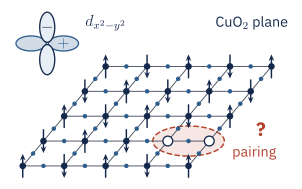
In a superconductor electrons form pairs (Cooper pairs) that move without resistance; in ordinary metals lattice vibrations supply the attraction, but in cuprates the source of the attraction is not agreed upon.
Subproblems (1)
-
61Does the charge-transfer gap set the maximum $T_{c}$ across cuprate families? a special case · open
See also
- Related Does 45-degree twisted $\mathrm{Bi2Sr2CaCu2O8}+x$ break time-reversal symmetry?
- Related Superconductivity in the Hubbard model with next-nearest-neighbor hopping
- Related What is the pseudogap state of underdoped cuprates?
- Related Why the superfluid density collapses in overdoped cuprates
Details, signature and history
- Kind
- Phenomenon to explain
- Answer
- Mechanism
- Posed
- 1987
- Topic review
- B. Keimer, S. A. Kivelson, M. R. Norman, S. Uchida, J. Zaanen, From quantum matter to high-temperature superconductivity in copper oxides, Nature, 2015. Link
- Record
- Revision 2 · notation repaired by the platform · compiled by AI, not yet reviewed by an editor
- Batch approval
- Approved for the batch by Victor Galitski (ORCID 0000-0001-5532-1096) · approval record · bundle This approves the batch, not each problem (what it means).
- AI systems
- AI systems used to prepare this seed revision, as listed in its record: ai:gpt-5.5 (how the seed revision was made)
- Earlier revisions
- revision 1 bundle
Proof
- Fingerprint
- 1f1cdf9130b4…
- Public log
- Entry 935, in checkpoint 2,123
- In the log by
- Block 969,698, 2026-10-03
This text was in the PubPhys log by that date. The date says nothing about when the problem was first posed.
Comments (0)
Comments are not records: they are not signed, stamped or logged. How comments work
No comments yet.
Sign in to comment.