Can a CME's magnetic orientation be predicted before arrival?
76No. 60 in all physics · No. 8 in Earth, Atmospheric and Planetary Physics
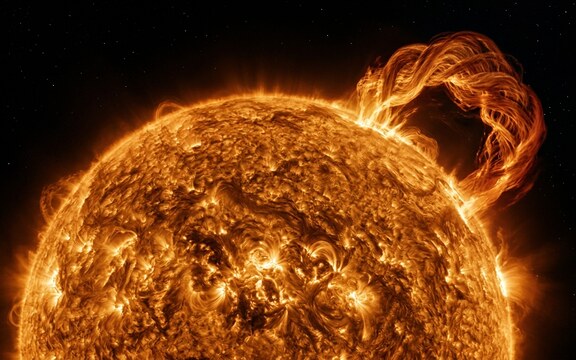
Predict the time series of the north-south interplanetary magnetic field component $B_z$ inside a CME at $1\,\mathrm{au}$ from observations at or near the Sun (photospheric magnetograms, coronagraph images), including rotation, deflection and erosion during propagation. An answer is a forecast method that achieves skill above climatology in $B_z$ sign and magnitude with lead time of a day or more.
What would settle it
Blind forecasts for a statistical sample of CMEs scored against in-situ $B_z$ at L1, beating climatological and persistence baselines.
No solutions, ideas or subproblems yet.
Details, signature and history
- Kind
- Well-posed question
- Answer
- Yes no
- Topic review
- J.-F. Ripoll et al., Particle dynamics in the Earth's radiation belts: review of current research and open questions, Journal of Geophysical Research: Space Physics, 2020. Link
- Record
- Revision 1 · imported from the seed collection · compiled by AI, not yet reviewed by an editor
Proof
- Fingerprint
- 75828ec8313c…
- Public log
- Entry 1,371, in checkpoint 2,123
- In the log by
- Block 969,698, 2026-10-03
This text was in the PubPhys log by that date. The date says nothing about when the problem was first posed.
Comments (0)
Comments are not records: they are not signed, stamped or logged. How comments work
No comments yet.
Sign in to comment.