Is any ELM-free or small-ELM regime compatible with reactor conditions?
85No. 10 in all physics · No. 1 in Plasma Physics and Fusion
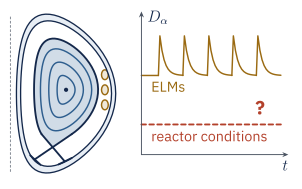
Candidate regimes are QH-mode (edge harmonic oscillation), I-mode, EDA H-mode, small or grassy ELM regimes (quasi-continuous exhaust) and negative-triangularity L-mode edges. Determine whether at least one achieves $H_{98}$ near 1, no type-I ELMs and a detached divertor simultaneously at reactor-relevant $n_{e}/n_{G}$ of about 0.8 or more, low external torque, high separatrix density and pedestal collisionality as low as ITER $Q = 10$. An answer is a demonstrated discharge meeting all conditions on one device, or a validated stability analysis showing that each regime's access window excludes them.
What would settle it
A steady discharge meeting all listed conditions simultaneously, together with a validated model of its access window extrapolated to ITER.
No solutions, ideas or subproblems yet.
See also
- Related Predicting pedestal pressure height and width in reactor conditions
- Related Will resonant magnetic perturbations suppress ELMs in ITER?
- Related What sets the energy lost per ELM at low collisionality?
Details, signature and history
- Kind
- Well-posed question
- Answer
- Yes no
- Topic review
- A. W. Leonard, Edge-localized-modes in tokamaks, Physics of Plasmas, 2014. Link
- Record
- Revision 2 · notation repaired by the platform · compiled by AI, not yet reviewed by an editor
- Batch approval
- Approved for the batch by Victor Galitski (ORCID 0000-0001-5532-1096) · approval record · bundle This approves the batch, not each problem (what it means).
- Earlier revisions
- revision 1 bundle
Proof
- Fingerprint
- 20533b0e83e6…
- Public log
- Entry 1,832, in checkpoint 2,123
- In the log by
- Block 969,698, 2026-10-03
This text was in the PubPhys log by that date. The date says nothing about when the problem was first posed.
Comments (0)
Comments are not records: they are not signed, stamped or logged. How comments work
No comments yet.
Sign in to comment.