This browser is older than PubPhys supports. Every page can be read, but signing in to contribute, voting and signing need Safari 15.4, Chrome or Edge 99, Firefox 97 or newer. Browsers
All problems
121 problems
Starting order drafted by AI. Votes change it. How ranking works
-
AI-generated illustration
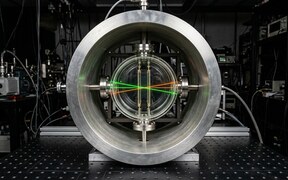
Current bound $\mid d_{e}\mid < 4.1 \times 10^{-30}\,e\,\mathrm{cm}$ (90% CL, JILA HfF+, 2023), with the Standard Model contribution many orders smaller. Determine whether $d_{e}$ (or the equivalent electron-nucleon coupling $C_{\mathrm{S}}$) is nonzero at the $10^{-31}\,e\,\mathrm{cm}$ level using polar molecules (ThO, ThF+, YbOH, BaF or others).
-
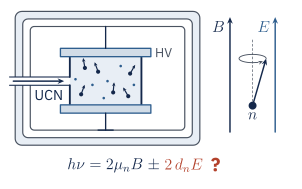
The best bound is $\left|d_n\right| < 1.8 \times 10^{-26}\,e\,\mathrm{cm}$ (90% CL, PSI 2020) using ultracold neutrons with a Hg-199 comagnetometer. Determine whether $d_n$ is nonzero at the $10^{-27}\,e\,\mathrm{cm}$ level, which corresponds to the QCD vacuum angle $\left|\theta_{\mathrm{bar}}\right|$ of order $10^{-11}$ (using $d_n$ of about $10^{-16}\,\theta_{\mathrm{bar}}\,e\,\mathrm{cm}$).
-
Two-dimensional square-lattice Fermi-Hubbard model, $U/t = 6\ \text{to}\ 8$, hole doping $\delta = 0.1\ \text{to}\ 0.2$, nearest-neighbour hopping $t$ and optional next-nearest hopping $t'$. Measure the d-wave pair correlation $P_d(r) = \langle \Delta_d^{\mathrm{dag}}(r) \Delta_d(0)\rangle$, with $\Delta_d(r)$ the d-wave singlet pair operator on the four bonds of site r, by quantum gas microscopy or pair-transport protocols at the lowest achievable $T/t$. True long-range order is excluded at $T > 0$ in 2D, so the answer is whether $P_d(r)$ decays algebraically below a Kosterlitz-Thouless temperature $T_{\mathrm{KT}}$, or at least has a correlation length above 10 lattice sites, together with the temperature and entropy at which this appears.
-
Give a protocol using $\operatorname{poly}(N)$ measurements and $\operatorname{poly}(N)$ classical post-processing (for example Hamiltonian learning, time-reversal echoes, cross-platform comparison of randomized measurements) that bounds the error of local observables of the prepared state relative to the ideal Hamiltonian, for $N > 100$ in a regime where classical simulation is believed hard. Answer: protocol with a proof of soundness and an experimental demonstration.
-
Drive the $8.36\,\mathrm{eV}$ ($148.4\,\mathrm{nm}$) Th-229 isomer transition with a laser in a trapped, sympathetically cooled Th-229 ion (Th3+, whose single valence electron allows laser cooling and state detection, or higher charge states), detect excitation through the hyperfine structure of the electronic transitions, and determine the achievable systematic uncertainty of the resulting clock, predicted to approach $10^{-19}$ (Campbell et al, Physical Review Letters, 2012).
-
In the doped 2D Hubbard model at $U/t = 8$, $\delta = 0.1 \text{ to } 0.2$, measure the resistivity $\rho(T)$ from charge-current relaxation or from density diffusion via the Nernst-Einstein relation for $T/t$ from 1 down to 0.1. Answer: whether $\rho \sim T$ persists below $T = 0.3 t$ and whether the transport rate approaches the Planckian value $\hbar/\tau \sim k_B T$.
-
With $g/2 = -\mu_e/\mu_B$ measured to 0.13 ppt ($a_e = (g-2)/2$ to 0.11 ppb, absolute uncertainty $1.3 \times 10^{-13}$; Fan et al 2023) and $a_e(\mathrm{SM})$ computed from $\alpha(\mathrm{recoil})$ plus QED (five-loop coefficient now agreed between two groups), hadronic and electroweak terms, determine whether $\delta a_e = a_e(\exp) - a_e(\mathrm{SM})$ differs from zero; at present $\delta a_e$ has opposite signs for $\alpha(\mathrm{Cs})$ and $\alpha(\mathrm{Rb})$, at roughly $-2.2\ \sigma$ and $+2\ \sigma$. The answer is $\delta a_e$ with total uncertainty below $10^{-13}$ and its significance.
-
Continuous spontaneous localization with rate $\lambda$ and length $r_C$. Exclude $\lambda = 10^{-16}\ \mathrm{s}^{-1}$ at $r_C = 10^{-5}\ \mathrm{cm}$ (the GRW value of Ghirardi, Rimini and Weber) by interferometric or non-interferometric (heating, noise) tests with massive objects. Answer: yes or no, with the excluded region in the $(\lambda, r_C)$ plane.
-
For axion dark matter with mass $m_a$ in $10^{-14} \text{ to } 10^{-6}\,\mathrm{eV}$ and gluon coupling producing an oscillating $d_n \sim 10^{-34}\,e\,\mathrm{cm}$ at QCD-axion strength, determine whether an oscillating nucleon EDM or axion-nucleon gradient coupling is present at that strength, using solid-state NMR (CASPEr-type) or comagnetometers.
-
For Th-229 in $\mathrm{CaF_2}$, $\mathrm{LiSrAlF_6}$ or $\mathrm{ThF_4}$ hosts, identify the mechanisms (temperature-dependent electric-field gradients, inhomogeneous broadening from charge-compensating defects, isomer quenching by radiation-induced defects) limiting linewidth and frequency reproducibility, and determine the achievable fractional uncertainty of a solid-state nuclear clock.
-
Demonstrate an optical lattice or tweezer clock whose absolute fractional frequency instability, with entangled or squeezed atomic states, is below that of the best unentangled clock with the same atom number and interrogation hardware, at instability levels of order $10^{-17}$ at 1 s or better.
-
Light-field-driven currents in dielectrics ($\mathrm{SiO_2}$), graphene-gold junctions and metal nanoantenna tunnel junctions, switched within one optical cycle (frequency about $10^{15}\,\mathrm{s}^{-1}$). Quantities: the maximum switching bandwidth $f_{\max}$ and minimum energy per switching event set by real versus virtual carrier populations, dephasing, heating and circuit parasitics, and whether a logic stage can drive the next one with gain above 1. An answer is a cascaded light-field-driven gate with measured gain above 1 at f above $10^{14}\,\mathrm{s}^{-1}$, or a derived bound that excludes it.
-
Achieve a comparison of optical clocks separated by more than 5000 km with total uncertainty below $10^{-18}$, including link noise and the gravitational redshift ($1.1 \times 10^{-18}$ per cm height), which requires geopotential differences known to $10^{3}\,\mathrm{cm}^2\,\mathrm{s}^{-2}$.
-
Which simulator observables have size-independent error bounds?
Partially resolved 62Local Hamiltonian $H$ on $N$ sites; the device implements $H+\sum_i \delta h_i$ with $\mid\mid \delta h_i\mid\mid \le \epsilon$. Characterize the classes of states (Gibbs states at temperature T, quench dynamics to time t) and local observables O for which $\left|\langle O\rangle_{\mathrm{device}}-\langle O\rangle_{\mathrm{ideal}}\right|\le f(\epsilon,T,t)$ independent of $N$. Answer: theorems with explicit $f$, and counterexamples outside these classes.
-
For scalar dark matter $\phi$ of mass $m_{\phi}$ in $10^{-23}$ to $10^{-15}$ eV with local density $0.4\,\mathrm{GeV}\,\mathrm{cm}^{-3}$ and dimensionless linear coupling $d_{\gamma}$ to the photon (called $d_e$ in the Damour-Donoghue convention, unrelated to the electron EDM), determine whether $d_{\gamma}$ is nonzero below present limits from clock comparisons and the MICROSCOPE equivalence-principle bound, by searching for oscillations of optical-clock frequency ratios at angular frequency $m_{\phi} c^2/\hbar$.
-
Atom-interferometric photon-recoil determinations give $\alpha^{-1}(\mathrm{Cs},\ \mathrm{Berkeley}\ 2018) = 137.035999046(27)$ and $\alpha^{-1}(\mathrm{Rb},\ \mathrm{LKB}\ 2020) = 137.035999206(11)$, a $5.4\,\sigma$ difference. Identify the systematic effect (or new physics distinguishing the two species) responsible, or produce new $h/m_{\mathrm{Cs}}$ and $h/m_{\mathrm{Rb}}$ values that agree at the 0.1 ppb level.
-
Present laboratory bounds from optical clock ratios (for example the Yb+ E3/E2 comparison) give $\left|\mathrm{d}\,\mathrm{ln}(\alpha)/\mathrm{d}t\right|$ of order $10^{-18}$ per year. Determine whether $\mathrm{d}\,\mathrm{ln}(\alpha)/\mathrm{d}t$ is nonzero at the $10^{-19}$ per year level using multi-year ratios of clocks with large differential sensitivity, including the Th-229 nuclear transition.
-
For the monopole-dipole potential $V(r) = g_s^{N} g_p^{N} (\hbar^2/(8 \pi m_N)) (\sigma . r_{\mathrm{hat}}) (1/(\lambda r) + 1/r^2) \exp(-r/\lambda)$ between an unpolarized nucleon and a polarized nucleon (Moody-Wilczek form), with range $\lambda$ from $10\,\text{micron}\ \text{to}\ 1\,\mathrm{mm}$, determine whether $g_s^{N} g_p^{N}$ is nonzero down to the value expected for a QCD axion with a small CP-violating scalar coupling, using polarized He-3 or other nuclear-spin sensors near a modulated source mass (Arvanitaki and Geraci 2014).
-
Identify a family of local Hamiltonians and a temperature $T$ for which estimating a local observable in the Gibbs state is classically hard (under standard complexity assumptions), while an analog simulator with realistic cooling can prepare that Gibbs state to accuracy $\epsilon$. Answer: an explicit family with a hardness proof and a preparation scheme.
-
Bad-cavity laser with Sr-87 atoms on the 1S0-3P0 clock transition (natural linewidth about 1 mHz), continuously loaded and repumped, as proposed by Meiser, Ye, Carlson and Holland (PRL 2009). Achieve steady-state superradiant output with linewidth below 1 Hz and identify the process that limits it (atom-number fluctuations, inhomogeneous broadening, heating, loading noise). Answer: measured linewidth and fractional frequency stability of the continuous output.
-
Determine whether $\mu = m_p/m_e$ varies, either as $d\ln(\mu)/dt$ today from comparisons of molecular (for example HD+, H2+, N2+, $\mathrm{Sr_2}$) and atomic clocks, or as $\Delta \mu/\mu$ at redshift $z > 1$ from $\mathrm{H_2}$ and $\mathrm{CH_3OH}$ absorption, at the $10^{-17}$ per year and $10^{-7}$ levels respectively.
-
Square-lattice Fermi-Hubbard model with isotropic hopping, $U/t = 8 \text{ to } 10$, $\delta = 1/8$, $t'/t = 0 \text{ and } -0.2$, imaged by quantum gas microscopy. Measure spin-spin and hole-hole correlation functions and determine whether unidirectional stripe correlations with wavelength set by the doping appear at the lowest accessible $T/t$ (about 0.05 to 0.1). Answer: stripe correlation length versus $T/t$ and $t'$, compared with finite-temperature numerics.
-
Laboratory determinations of G (torsion balances in time-of-swing, angular-acceleration and servo modes, beam balances, simple pendulums, atom interferometry) spread over about $5 \times 10^{-4}$ relative, roughly ten times their typical quoted uncertainties of $10^{-5} \text{ to } 5 \times 10^{-5}$, near $G = 6.674 \times 10^{-8}\,\mathrm{cm}^{3}\,\mathrm{g}^{-1}\,\mathrm{s}^{-2}$. Identify the unaccounted systematic effects (or establish any genuine dependence of the measured G on method, material or geometry) that explain the excess scatter.
-
ALPHA measured the antihydrogen $1\mathrm{S}-2\mathrm{S}$ two-photon frequency in agreement with hydrogen at about $2 \times 10^{-12}$ relative precision (2018). Determine whether nu_1S2S(Hbar) - nu_1S2S(H) is nonzero at the $10^{-15}$ level, approaching the hydrogen precision of about 4e-15.
-
Compute the coefficients $a_{0},a_{1},a_{2}$ relating the nuclear Schiff moment $S$ of Hg-199 and of octupole-deformed Ra-225 (or Th-229) to the isoscalar, isovector and isotensor pion-nucleon CP-odd couplings $g_{\pi}^{(0,1,2)}$, with quantified uncertainties below 30%. The answer is a table of coefficients with error bars from an ab initio or uncertainty-quantified nuclear method.
-
Determine whether the mandatory criteria of the CCTF roadmap (Dimarcq et al 2024), including repeated agreement of independent optical clocks and frequency ratios at the low-$10^{-18}$ level, continuous contributions to TAI and intercontinental comparisons at that level, are met by 2029 for one species or for an ensemble defining a weighted geometric-mean frequency.
-
Lifshitz theory for Au or Ni sphere-plate geometries at $T = 300\,\mathrm{K}$ and separations $2 \times 10^{-5}\text{ to }10^{-4}\,\mathrm{cm}$: the Drude permittivity $\epsilon(\omega) = 1 - \omega_p^2/(\omega(\omega + i \gamma))$ removes the zero-frequency transverse-electric Matsubara term, while the plasma model ($\gamma = 0$) keeps it. Micromechanical, dynamic AFM and isoelectronic differential measurements agree with the plasma model and exclude Drude, whereas a torsion-pendulum measurement at larger gaps (Sushkov et al., 2011) favored Drude after subtracting electrostatic patch forces. An answer is a physical mechanism (spatial dispersion, surface states, low-frequency response) that reproduces the data while staying consistent with measured optical and dc conductivity, confirmed at separations above $3 \times 10^{-4}\,\mathrm{cm}$ where the thermal term is large.
-
Vector electromagnetic waves in a 3D disordered, non-absorbing dielectric (index contrast $n$, filling fraction $f$, scatterer size $a$ relative to wavelength $\lambda$, structural correlations). Point-dipole ensembles show no localization at any density because of the longitudinal $1/r^3$ near-field coupling (Skipetrov and Sokolov, PRL 2014), and FDTD simulations of random dielectric sphere packings show none up to $n = 10$. Question: does any dielectric structure (correlated or hyperuniform networks near a photonic band edge, impurities in a solid matrix, high-index nonspherical particles) have a mobility edge, and can an experiment show it with signatures not mimicked by absorption or fluorescence (scale-dependent diffusion $D(L)$, normalized transmission fluctuations $\operatorname{var}(s_{ab}) > 7/3$, Thouless number $g < 1$).
-
Many-multiplet analyses of Keck and VLT spectra (Webb et al 2011) reported a dipole in $\Delta \alpha/\alpha$ of order $10^{-5}$ across the sky at about $4\sigma$; ESPRESSO measurements (Murphy et al 2022) found $\Delta \alpha/\alpha = (1.3 \pm 1.3\,\mathrm{stat} \pm 0.4\,\mathrm{sys})\,\mathrm{ppm}$ toward HE0515-4414. Establish whether any spatial or redshift variation of $\alpha$ exists at the $1\,\mathrm{ppm}$ level once wavelength-calibration, isotopic-abundance and blinding systematics are controlled.
-
Heisenberg scaling with error correction under imperfect control
Partially resolved 52For a sensor Hamiltonian $H$ and Markovian noise with Lindblad operators $L_k$ obeying the HNLS condition ($H \text{ not in } \operatorname{span}\{1, L_k, L_k^{\mathrm{dag}}, L_k^{\mathrm{dag}} L_j\}, 1 = \text{identity}$), a fault-tolerant threshold for Heisenberg scaling is known for a Pauli-Z signal under bit-flip noise with a repetition code and noisy state preparation and measurement (Sahu, Xu, Zhou, arXiv 2601.05457, 2026). Determine whether a threshold exists for every HNLS-satisfying noise model with noisy ancillas, syndrome extraction and recovery, and how the qubit and time overhead scales with $N$ and the target precision.