This browser is older than PubPhys supports. Every page can be read, but signing in to contribute, voting and signing need Safari 15.4, Chrome or Edge 99, Firefox 97 or newer. Browsers
All problems
72 problems
Starting order drafted by AI. Votes change it. How ranking works
-
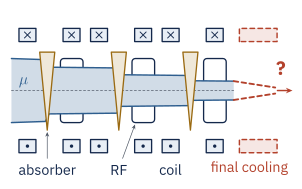
Transverse ionization cooling of muons through a single absorber was demonstrated by MICE (published 2020). Determine whether a realistic 6D cooling channel plus final cooling stage can reach normalized transverse emittance of approximately $2.5 \times 10^{-3}$ cm and longitudinal emittance of approximately $7\,\mathrm{cm}$ with overall muon transmission above $\sim 10$ percent, including RF limits in solenoid fields, absorber heating, space charge and muon decay.
-
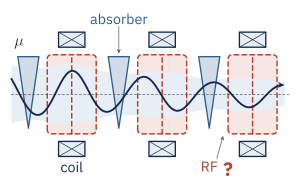
MICE demonstrated transverse (4D) emittance reduction through a single absorber without RF re-acceleration. Demonstrate net 6D emittance reduction over several cells with RF, including emittance exchange via wedges or dispersion, and measured agreement with simulation at the percent level.
-
Vapor-diffusion $\mathrm{Nb_3Sn}$ films ($\sim 2 \times 10^{-4}\,\mathrm{cm}$ thick) on Nb cavities quench at $H_{\mathrm{pk}} \sim 800\text{-}1200\,\mathrm{G}$, compared with a predicted $H_{\mathrm{sh}}$ near $4000\,\mathrm{G}$. Identify the limiting mechanism (thin-grain regions, tin-depleted patches with low $H_c$, vortex entry at grain boundaries, thermal runaway in the low-conductivity film) and predict the quench field from measured film microstructure.
-
Steady-state microbunching (SSMB) uses laser modulators for longitudinal focusing in a low-momentum-compaction ring so that electrons stay in optical-scale microbunches turn after turn; retention of laser-induced microbunching at a $1.064 \times 10^{-4}\,\mathrm{cm}$ wavelength over successive turns was reported at the Metrology Light Source, Berlin, in 2021 (Deng et al., https://doi.org/10.1038/s41586-021-03203-0). Determine whether a ring can hold microbunches of rms length below $\sim 2 \times 10^{-7}\,\mathrm{cm}$ in steady state, with quantum excitation, intrabeam scattering and laser phase noise included, giving coherent radiation at $1.35 \times 10^{-6}\,\mathrm{cm}$ ($13.5\,\mathrm{nm}$) with average power near $10^{10}\,\mathrm{erg}/\mathrm{s}$.
-
In Cu accelerating structures at 3-30 GHz, breakdown occurs at surface fields $eE_{s} \sim 2-3\,\mathrm{MeV}/\mathrm{cm}$, and Fowler-Nordheim fits of dark current give field-enhancement factors $\beta \sim 30-100$ although no protrusions of matching height are observed. Identify the sequence of processes (dislocation-driven surface roughening, field-emission heating of emitters, neutral evaporation, plasma ignition) that turns an intact surface into an arc, with a model that predicts the threshold field and its dependence on hardness and crystal structure of the metal.
-
Determine whether a $\mathrm{Nb_3Sn}$-coated 1.3 GHz elliptical cavity can sustain $E_{\mathrm{acc}}>0.45\,\mathrm{MV}/\mathrm{cm}$ ($B_{\mathrm{pk}}>1900\,\mathrm{G}$) at any temperature with $Q_{0}>10^{10}$, or whether intrinsic film properties (grain boundaries, thin-film thermal limits) forbid it.
-
$\mathrm{Nb_3Sn}$ dipoles and quadrupoles operating at $1.1 \times 10^{5}$ to $1.5 \times 10^{5}$ G often require tens of training quenches to approach 80 to 90 percent of the conductor short-sample limit. Identify the energy-release events that start training quenches (epoxy cracking, conductor-insulation debonding, stick-slip friction at coil-structure interfaces), their energy spectrum relative to the minimum quench energy of the cable, and a model that predicts the training curve from coil prestress and material properties.
-
Muon collider design studies (MAP, the US Muon Accelerator Program, then IMCC, the International Muon Collider Collaboration) set normalized emittance targets of about eps_T ~ 22.5 to 25 micron transverse and eps_L ~ 70 mm (7.5 MeV m) longitudinal at the end of cooling. Determine whether a final-cooling channel using very high field solenoids ($B \sim 300 \text{ to } 400\,\mathrm{kG}$) or thick wedge absorbers reaches eps_T <= 25 micron with eps_L <= 75 mm and muon transmission above $\sim 50\%$, including decay losses.
-
Rutherford cables of $\mathrm{Nb_3Sn}$ filaments in epoxy-impregnated coils at fields up to $\sim 1.6 \times 10^{5}\,\mathrm{G}$ are under transverse stress of order $1.5 \times 10^{9} \text{ to } 2 \times 10^{9}\,\mathrm{dyn}/\mathrm{cm}^{2}$ (approximate). Determine the stress at which the critical current degrades irreversibly, its dependence on filament layout, impregnation and temperature cycling, and the microscopic failure mode (filament cracking, void collapse, debonding), as a function that fixes the maximal practical dipole field.
-
Exponential growth to saturation in a hard x-ray FEL oscillator
Partially resolved 64In an x-ray FEL oscillator, hard x-ray pulses of photon energy $\sim 5\text{-}15\ \mathrm{keV}$ circulate in a Bragg-crystal cavity with round-trip reflectivity above $\sim 85\%$ and are amplified by successive electron bunches synchronized with the round trip. Determine experimentally whether round-trip gain exceeding total cavity loss, sustained exponential growth over many passes, and saturation with relative bandwidth $\sim 10^{-7}$ can be obtained with existing high-repetition-rate linac beams, given crystal heat load and cavity alignment stability.
-
The superheating field of clean Nb is $H_{\mathrm{sh}}$ approximately 2000-2400 G at low T, and the best Nb cavities reach $H_{\mathrm{pk}}$ near 2000 G. Determine whether superconductor-insulator-superconductor multilayers ($\mathrm{Nb_3Sn}$, NbN or similar layers thinner than the London penetration depth on Nb) raise the attainable RF field above bulk Nb $H_{\mathrm{sh}}$ in a cavity at $f \sim 1\, \mathrm{GHz}$, and give the maximal field versus layer thickness and defect density.
-
In coherent electron cooling (CeC) or its microbunched variant (MBEC), hadrons modulate the density of a co-moving electron beam, the modulation is amplified (FEL or plasma-cascade amplifier) and its field acts back on the same hadrons. Determine experimentally whether such a section produces a measurable reduction of hadron energy spread or emittance, with a cooling rate within a factor 2 of theory.
-
In MW-class proton and H- linacs (SNS, J-PARC, ESS, PIP-II) losses must stay below about $10^{-6}$ to $10^{-4}$ of the beam per unit length. Predict, blind and to within a factor 2, the halo population beyond 5 rms beam sizes from the measured initial distribution, lattice errors and space charge, and identify which mechanisms (envelope mismatch, particle-core resonances, intrabeam stripping of H- ions) dominate the measured loss pattern.
-
In $e+e-$ ring colliders the vertical beam-beam parameter $\xi_y$ has saturated in operation at approximately 0.03-0.09 (highest values at LEP and KEKB), with simulations suggesting higher limits at stronger damping; with crab-waist collisions and beamstrahlung, coherent X-Z instabilities intervene. Derive the maximal $\xi_y$ as a function of radiation damping time per turn, synchrotron tune, Piwinski angle and beamstrahlung parameters, and compare with SuperKEKB, DAFNE and LEP data.
-
In a frozen-spin all-electric ring for protons at the magic momentum $0.7007\,\mathrm{GeV}/c$, an EDM d rotates the spin vertically, with target sensitivity $d \sim 10^{-29}\,e\,\mathrm{cm}$. Determine whether counter-rotating beams and field reversals suppress spurious vertical spin rotation from radial magnetic fields, geometric phases of misaligned elements and vertical velocity to below the EDM signal at achievable alignment tolerances, with spin coherence time above $10^{3}\,\mathrm{s}$.
-
In REBCO coated-conductor coils (tape width $\sim 0.4\,\mathrm{cm}$), screening currents induced during field ramps produce field harmonics and slow drifts well above the $10^{-4}$ relative field quality needed for beam optics, and add mechanical stress. Determine whether conductor layout (striated tapes, round twisted-tape cables) and ramp protocols can reduce screening-current field errors below $10^{-4}$ at fields $10^{5}\ \text{to}\ 2 \times 10^{5}\,\mathrm{G}$, and predict their decay in time from flux-creep parameters of the tape.
-
Breakdown limit of RF cavities inside strong solenoid fields
Partially resolved 60Vacuum normal-conducting cavities at $\sim 200\text{-}800\,\mathrm{MHz}$ in axial magnetic fields $B \sim 3 \times 10^{4}\,\mathrm{G}$ show reduced maximum gradient, attributed to field-emitted electrons focused by B onto the walls, causing local heating. Establish the scaling of the safe gradient with B, frequency and wall material up to $B \sim 10^{5}\,\mathrm{G}$ and above, as required for 6D muon ionization cooling channels.
-
Sputtered Nb films $\sim 10^{-4} \text{ to } 5 \times 10^{-4}\,\mathrm{cm}$ thick on Cu cavities, as used at LEP, LHC and HIE-ISOLDE, show surface resistance $R_{\mathrm{s}}$ rising roughly linearly with RF field from $H_{\mathrm{pk}}$ of a few hundred G, unlike bulk Nb. Identify the mechanism (grain-boundary weak links and local hot spots, trapped flux in a granular film, poor film-substrate thermal contact, or other) and predict $R_{\mathrm{s}}(H)$ from measured film microstructure for different deposition methods, including high-power impulse magnetron sputtering.
-
In crab-waist schemes with Piwinski angle $\phi >> 1$, strong-strong simulations predict coherent X-Z instabilities and interplay with longitudinal and transverse impedance. Determine the stability boundary in $(\xi_x,\xi_y,\nu_s,\mathrm{impedance})$ and whether it explains the luminosity shortfall of SuperKEKB relative to its design value of $8 \times 10^{35}\ \mathrm{cm}^{-2}\ \mathrm{s}^{-1}$ (later target about $6.5 \times 10^{35}$).
-
X-band Cu cavities cooled to $T \sim 45-77\,\mathrm{K}$ reached accelerating gradients near 2.5 MeV/cm at low breakdown rate (SLAC tests reported 2018). Determine whether the gain comes from higher yield strength and reduced dislocation mobility, from lower surface resistance and reduced pulsed heating, or from another effect, by predicting the temperature dependence of the breakdown threshold between 20 and 300 K for fixed geometry and pulse length.
-
Determine whether a seeded or cavity-based XFEL at photon energy $> 5\ \mathrm{keV}$ can deliver pulses with time-bandwidth product within 1.5 times the transform limit and pulse-to-pulse energy fluctuation below a few percent, given shot noise and microbunching in the electron beam.
-
Multibend-achromat rings at $6\,\mathrm{GeV}$ operate with natural horizontal emittance eps_x of about $1.3 \times 10^{-8}$ to $1.4 \times 10^{-8}$ cm rad (ESRF-EBS, from 2020) and about $4 \times 10^{-9}$ cm rad (APS-U, from 2024). Determine the minimal equilibrium eps_x at $E = 6\,\mathrm{GeV}$ and circumference $10^{5}-2 \times 10^{5}\,\mathrm{cm}$ with intrabeam scattering at full current, Touschek lifetime above $1\,\mathrm{h}$, and dynamic aperture adequate for on-axis or off-axis injection, and whether eps_x < $10^{-9}$ cm rad (diffraction limit for $\sim 10\,\mathrm{keV}$ photons) is attainable.
-
Origin of the anti-Q-slope in nitrogen-doped niobium
Contested 55N-doped Nb cavities show the temperature-dependent surface resistance $R_{\mathrm{BCS}}$ decreasing with RF amplitude over $H_{\mathrm{pk}} \sim 100-900\,\mathrm{G}$, with a strong dependence on frequency and electron mean free path. Determine which mechanism (field-induced broadening of the quasiparticle density of states with a nonequilibrium quasiparticle distribution, reduced two-level-system losses, or other) reproduces $R_{\mathrm{BCS}}(H, f, T, \text{mean free path})$ quantitatively.
-
At $T <\sim 1.5\,\mathrm{K}$, where the BCS surface resistance at 1.3 GHz is negligible, the quality factor of the best Nb cavities saturates at $Q_0$ of order $10^{11}$ (residual resistance $\sim 1-3\,\mathrm{nOhm}$), set by a temperature-independent residual surface resistance. Determine the fractions contributed by trapped magnetic vortices, two-level systems in the surface $\mathrm{Nb_2O_5}$ oxide, and subgap quasiparticle states, as functions of field, frequency and surface treatment.
-
Resonant depolarization gives the beam energy to below $10^{-6}$ relative precision if a transverse polarization of about 5-10 percent builds up by the Sokolov-Ternov effect. For a $\sim 9 \times 10^{6}\, \mathrm{cm}$ circumference ring at $E = 45.6\, \mathrm{GeV}$ and $E \sim 80\, \mathrm{GeV}$, determine the equilibrium polarization and build-up time with polarization wigglers, including depolarization from energy spread $\sigma_E/E \sim 4 \times 10^{-4} \text{ to } 10^{-3}$ and lattice errors, and whether calibration at the WW threshold is feasible.
-
$\mathrm{Nb_3Sn}$ cavities at 4.2 K and 1.3 GHz show $Q_{0}$ decreasing with $B_{\mathrm{pk}}$ above $\sim 300\ \text{to}\ 500\,\mathrm{G}$. Determine whether this arises from grain-boundary Josephson weak links, vortex penetration at local defects, tin-poor phases, or nonlinear BCS response, with a model predicting $Q_{0}(B_{\mathrm{pk}}, T)$.
-
For clean Nb ($\kappa \sim 1$) Ginzburg-Landau and Eilenberger theory give $H_{\mathrm{sh}}(0) \sim 2300\text{ to }2400\,\mathrm{G}$, while record cavities quench near $B_{\mathrm{pk}} \sim 1900\text{ to }2100\,\mathrm{G}$. Determine whether the gap is caused by local defects that lower the vortex-entry barrier, by thermal runaway at hot spots, or by an intrinsic reduction of $H_{\mathrm{sh}}$ at GHz frequencies, and give the expected achievable field for an ideal surface.
-
For short-pulse photoinjectors the maximal 4D normalized brightness of a pancake-shaped bunch is bounded by the cathode field $E_c$ and MTE (bound derived in 2009). Determine whether measured 4D or 5D brightness of DC, normal-conducting RF and superconducting RF guns can come within a factor 2 of this bound at bunch populations of $1\mathrm{e}8 \text{ to } 1\mathrm{e}9\,\mathrm{electrons}$, and which effects (image charge, nonuniform emission, imperfect emittance compensation, cathode roughness) cause the observed gap.
-
Electropolished bulk Nb cavities at $1.3\,\mathrm{GHz}$ and $T = 2\,\mathrm{K}$ show a steep drop of quality factor $Q_0$ above peak surface magnetic field $H_{\mathrm{pk}} \sim 900-1000\,\mathrm{G}$, removed by in-situ baking at $120\,\mathrm{C}$ for $\sim 48\,\mathrm{h}$. Identify the mechanism (niobium nanohydride precipitation within $\sim 10^{-5}$ cm of the surface, oxygen or vacancy-hydrogen complexes, or other) with a model predicting the onset field and its dependence on bake temperature and duration.
-
A 120 C bake of 24 to 48 h in vacuum eliminates the high-field Q-slope in electropolished Nb. Determine which change in the near-surface region (oxygen diffusion from the native oxide, suppression of hydride nucleation by vacancy-hydrogen complexes, or change in mean free path) is necessary and sufficient, and predict the required bake time and temperature.