This browser is older than PubPhys supports. Every page can be read, but signing in to contribute, voting and signing need Safari 15.4, Chrome or Edge 99, Firefox 97 or newer. Browsers
All problems
67 problems
Starting order drafted by AI. Votes change it. How ranking works
-
AI-generated illustration
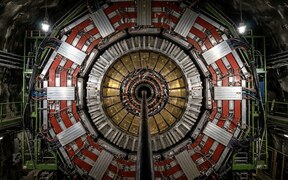
In the SM with a cutoff $\Lambda$, the top loop gives $\delta m_h^{2} \sim -(3 y_t^{2}/(8 \pi^{2})) \Lambda^{2}$, so $m_h = 125\,\mathrm{GeV}$ with $\Lambda \sim M_{\mathrm{Pl}} \sim 1.2 \times 10^{19}\,\mathrm{GeV}$ requires cancellation to about 1 part in $10^{33}$. An answer is a mechanism (symmetry, compositeness, dynamics or selection) that yields $v = 246\,\mathrm{GeV}$ with at most mild tuning and is consistent with all LHC data.
-
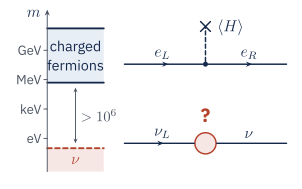
Identify the origin of $m_{\nu} < \sim 0.1\ \mathrm{eV}$: Dirac Yukawas with $y \sim 10^{-12}$ plus right-handed neutrinos, the type I, II or III seesaw ($m_{\nu} \sim y^2 v^2 / M$), or radiative and low-scale mechanisms. An answer is the mechanism together with its scale, confirmed by a signature such as lepton number violation or heavy neutral leptons.
-
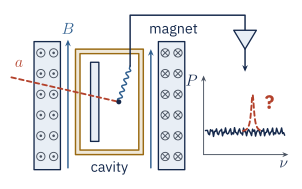
Does the QCD axion exist?
Open 84Determine whether a pseudoscalar a with $m_a \sim 5.7\ \mathrm{micro-eV}\ (10^{12}\ \mathrm{GeV}/f_a)$ and photon coupling $g_{agamma}$ inside the QCD axion band (KSVZ to DFSZ and beyond) exists, for $f_a\ \text{between}\ \sim 10^{8}\ \text{and}\ \sim 10^{17}\ \mathrm{GeV}$. An answer is a detection with $m_a$ and $g_{agamma}$ consistent with the QCD mass-decay constant relation, or exclusion of the band over the full range.
-
AI-generated illustration
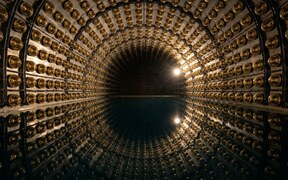
Explain $\eta_B = n_B/n_\gamma \sim 6.1 \times 10^{-10}$ (CMB and BBN) satisfying the Sakharov conditions, given that SM CP violation and the SM crossover fail by many orders of magnitude. An answer is a mechanism (thermal or resonant leptogenesis, electroweak baryogenesis, Affleck-Dine, or others) with an independent experimental confirmation.
-
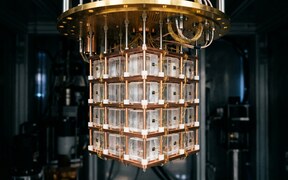
AI-generated illustration
Determine whether lepton number is violated by Majorana neutrino masses via neutrinoless double beta decay, with half-life T_1/2 $\sim 10^{26}$ to $10^{28}$ yr for $m_{bb} \sim 10\ \text{to}\ 50\ \mathrm{meV}$. KamLAND-Zen (2024) gives T_1/2(Xe-136) > $3.8 \times 10^{26}$ yr, $m_{bb} < \sim 28\ \text{to}\ 122\ \mathrm{meV}$ (spread from nuclear matrix elements).
-
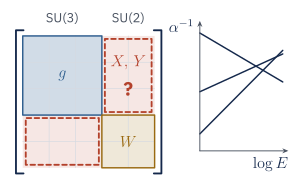
Determine whether SU(3) x SU(2) x U(1) embeds in a simple group ($\mathrm{SU}(5), \mathrm{SO}(10), \mathrm{E6}$) broken near $M_{\mathrm{GUT}} \sim 10^{15}\ \text{to}\ 10^{16}\,\mathrm{GeV}$. In the SM the three couplings do not meet at a point; in the MSSM they meet at $\sim 2 \times 10^{16}\,\mathrm{GeV}$. An answer is an observation of a unification-specific effect such as proton decay with a branching pattern fixed by the group.
-
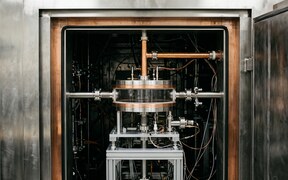
AI-generated illustration
The physical parameter $\theta_{\mathrm{bar}} = \theta - \arg \det(M_{q})$ induces $d_{n} \sim 10^{-16}\ \theta_{\mathrm{bar}}\ e\ \mathrm{cm}$; the PSI bound $\mid d_{n}\mid < 1.8 \times 10^{-26}\ e\ \mathrm{cm}$ (90 percent CL, 2020) gives $\mid\theta_{\mathrm{bar}}\mid < \sim 10^{-10}$. An answer is a mechanism (Peccei-Quinn axion, massless up quark, spontaneous CP or P violation such as Nelson-Barr) consistent with lattice QCD and flavor data.
-

AI-generated illustration
The SM Yukawa couplings span $y_e \sim 3 \times 10^{-6}$ to $y_t \sim 1$, CKM angles are small ($\theta_C \sim 0.23$, $\mid V_{ub}\mid$ $\sim 4 \times 10^{-3}$) while PMNS angles are large ($\theta_{12} \sim 34\,\mathrm{deg}$, $\theta_{23} \sim 45\,\mathrm{deg}$). An answer is a mechanism (Froggatt-Nielsen charges, modular or discrete flavor symmetries, extra-dimensional localization, partial compositeness) that predicts these values with fewer parameters than it explains.
-
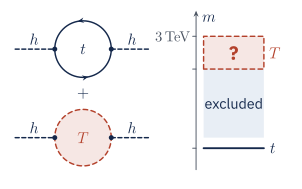
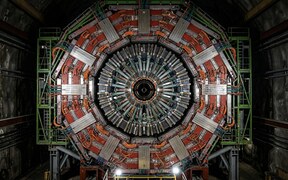
Determine whether colored states that cancel the top-loop contribution to $m_h^2$ (scalar stops in supersymmetry, vector-like fermionic top partners in composite-Higgs models) exist with mass $m_T < \sim 3\ \mathrm{TeV}$. Current LHC 13 TeV limits exclude stops up to about 1.2 to 1.3 TeV for a light neutralino and vector-like top partners up to roughly 1.5 TeV (approximate, model dependent).
-
AI-generated illustration
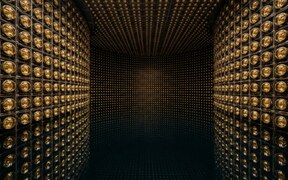
In composite pseudo-Goldstone Higgs models, Higgs couplings to W, Z and fermions deviate from SM values by $\mid \kappa - 1 \mid \sim \xi = v^{2}/f^{2}$ up to $O(1)$ factors, with f the compositeness scale. Determine whether $\xi > 0$ by measuring $\kappa_V$ and $\kappa_f$ to 0.1 to 1 percent, or find the associated resonances of mass $m_\rho \sim g_\rho f$ with $1 < g_\rho < 4\pi$.
-
AI-generated illustration
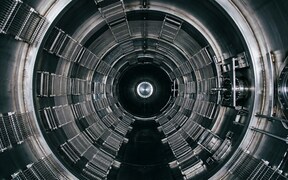
Measure or bound $\tau(p \to e+ \pi0)/B$, currently $> 2.4 \times 10^{34}\,\mathrm{yr}$ (Super-Kamiokande, 2020, 90 percent CL). Non-supersymmetric $\mathrm{SO}(10)$ models with intermediate scales typically predict $10^{34}\text{ to }10^{36}\,\mathrm{yr}$. An answer is a detection or a limit near $10^{35}\,\mathrm{yr}$.
-
AI-generated illustration
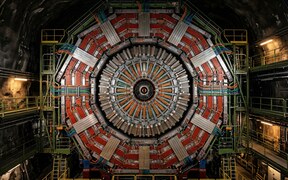
Determine $m_{\mathrm{lightest}}$, or equivalently $m_{\beta}=(\sum\left|U_{ei}\right|^{2}m_i^{2})^{1/2}$ and $\sum m_{\nu}$. KATRIN (2025) gives $m_{\beta}<0.45\ \mathrm{eV}$ (90 percent CL); oscillations require $\sum m_{\nu}\ge \sim 0.059\ \mathrm{eV}$ (normal) or $\sim 0.10\ \mathrm{eV}$ (inverted). An answer is a nonzero value with $\sim 20\%$ uncertainty or a consistent upper limit across laboratory and cosmology.
-
AI-generated illustration
Lattice results show the SM electroweak transition is a crossover for $m_h = 125\,\mathrm{GeV}$. Determine whether nature has BSM scalars or couplings that make it strongly first order, $v(T_c)/T_c > \sim 1$. An answer identifies the order of the transition from measured Higgs potential parameters or excludes all first-order scenarios with a singlet or doublet extension.
-
AI-generated illustration
Measure the PMNS phase $\delta_{\mathrm{CP}}$ and determine whether $\sin(\delta_{\mathrm{CP}}) \ne 0$ at $\ge 5\sigma$ using $\nu_{\mu} \to \nu_e$ versus $\mathrm{anti}-\nu_{\mu} \to \mathrm{anti}-\nu_{e}$ appearance. Answer: $\delta_{\mathrm{CP}}$ with uncertainty $\sim 10\text{ to }20\ \mathrm{deg}$ and the yes-no CP verdict.
-
Measure $\kappa_{\lambda} = \lambda_3/\lambda_3^{\mathrm{SM}}$, where the SM gives $\lambda_3 = m_h^2/(2 v^2) \sim 0.13$ for the cubic term $\lambda_3 v h^3$. An answer is $\kappa_{\lambda}$ with total uncertainty below about 0.3 (30 percent), sufficient to distinguish the SM from models with a strongly first-order phase transition.
-
LEP Z-width data give $N_\nu = 2.9963 \pm 0.0074$ light neutrino species after the 2020 luminosity correction (Janot and Jadach), and Higgs production rates exclude a fourth sequential chiral generation. An answer is a principle (anomaly cancellation in an extended gauge group, string compactification topology, or a symmetry argument) that requires $N_{\mathrm{g}} = 3$ and makes a further testable prediction.
-
Determine whether any model with a strongly first-order electroweak transition and CP violation sufficient for $\eta_B \sim 6 \times 10^{-10}$ is consistent with $\mid d_{e} \mid <$ $4.1 \times 10^{-30}$ e cm (JILA, 2023) and LHC Higgs data. An answer is an explicit viable model with predicted signals, or a general exclusion argument.
-
Measure or bound the coherent conversion rate $R_{\mathrm{mue}} = \Gamma(\mu- N \to e- N)/\Gamma(\mu- \mathrm{capture})$ on aluminum at single-event sensitivity $\sim 10^{-17}$ (Mu2e, COMET), versus the SINDRUM II gold limit of about $7 \times 10^{-13}$. Combine with $\mu \to e\gamma$ (MEG II) and $\mu \to 3e$ (Mu3e) to identify the operator responsible if seen.
-
Determine whether heavy neutral leptons N with $M_N \sim 0.1\ \text{to}\ 100\ \mathrm{GeV}$ and active-sterile mixing $U^2$ in the range where resonant or oscillation-based (ARS) leptogenesis gives $\eta_B \sim 6 \times 10^{-10}$ exist. An answer is a discovery with measured $M_N$, $U_e^2$, $U_{\mu}^2$, $U_{\tau}^2$ consistent with that region, or its exclusion.
-
Test the thermal-freeze-out target y = epsilon^2 alpha_D (m_chi/m_A')^4 for scalar and fermion dark matter with $m_{\chi} \sim 1\,\mathrm{MeV} \text{ to } 1\,\mathrm{GeV}$ coupled through a dark photon, using missing energy and momentum in $e- N \to e- N A'$, A' -> chi chi-bar. An answer is a signal or exclusion of the thermal target for the main benchmark models.
-
Determine the sign of $\Delta m^2_{31}$ ($\left|\Delta m^2_{31}\right| \sim 2.5 \times 10^{-3}\,\mathrm{eV}^2$) at $\ge 3\,\sigma$ from reactor oscillation spectra (JUNO), matter effects in long-baseline accelerator (DUNE, Hyper-K) and atmospheric data. Answer: normal or inverted.
-
Measure or bound $\tau(p \to \mathrm{anti}-\nu K+)/B$, currently $> \sim 5.9 \times 10^{33}\,\mathrm{yr}$ (Super-Kamiokande, 2014). Minimal SUSY $\mathrm{SU}(5)$ with dimension-5 operators predicts values near or below this; an answer is a detection or a limit $\sim 10^{34}\text{ to }10^{35}\,\mathrm{yr}$.
-
Assess mechanisms in which v is fixed dynamically by cosmological evolution (relaxion scanning of $m_h^{2}$, NNaturalness, crunching of regions with large v) rather than by TeV-scale symmetry. An answer is a consistent model that reproduces $v = 246\,\mathrm{GeV}$ without large tuning and an experimental signature (for example relaxion-Higgs mixing or fifth forces) that can confirm or exclude it.
-
Determine whether a $U(1)'$ gauge boson $A'$ with mass $1\,\mathrm{MeV}$ to $10\,\mathrm{GeV}$ and kinetic mixing $\epsilon \sim 10^{-6}\ \text{to}\ 10^{-3}$ exists, in visible ($A' \to \ell+ \ell-$) or invisible decay modes. An answer is a resonance detection or exclusion of the remaining parameter space down to $\epsilon \sim 10^{-6}\ \text{to}\ 10^{-5}$.
-
Determine whether $R(D)=\operatorname{BR}(B \to D \tau \nu)/\operatorname{BR}(B \to D \ell \nu)$ and $R(D*)$ exceed the SM values (HFLAV arithmetic average of predictions $0.296 \pm 0.004\ \text{and}\ 0.254 \pm 0.005$). The HFLAV ICHEP 2026 averages are $R(D)=0.359 \pm 0.024$ and $R(D*) = 0.280 \pm 0.011$ (correlation -0.37), about $3.7\,\sigma$ above the SM combined; an answer is $\ge 5\,\sigma$ confirmation or reduction below $2\,\sigma$.
-
Does the SM match the final muon g-2 measurement?
Partially resolved 59Fermilab's final result (2025) gives $a_{\mu} = 116592070.5(14.8) x 1e-11\ (127\ \mathrm{ppb})$; the world average with BNL is $116592071.5(14.5) x 1e-11\ (124\ \mathrm{ppb})$; the 2025 Theory Initiative prediction using lattice-QCD HVP (hadronic vacuum polarization) is $116592033(62) x 1e-11$, in agreement. The residual question is whether the SM prediction with uncertainty $\sim 20 \times 1e-11$ still agrees once data-driven and lattice HVP are reconciled.
-
In neutral-naturalness models (Twin Higgs, folded supersymmetry, quirky little Higgs) the top-loop contribution to $m_h^{2}$ is cancelled by states without SM color, with a mirror-sector scale f; Higgs couplings shift by about $v^{2}/(2 f^{2})$ and the Higgs can decay to mirror glueballs with displaced vertices (approximate relations, model dependent). Determine whether such a sector exists with $f\ \text{below about}\ 1\ \text{to}\ 2\ \mathrm{TeV}$, by measuring $\mathrm{BR}(h \to \text{mirror hadrons})$ down to about $10^{-4}$ and Higgs couplings at the per-mille level, or exclude it.
-
Explain the LSND (1995) and MiniBooNE electron-like excesses and the gallium deficit in a single consistent framework, or show they have separate conventional origins. An answer is the mechanism (sterile oscillation, decaying heavy states, new interactions, or background and cross-section mismodeling) consistent with disappearance limits.
-
Search for $\Delta B = 2$ neutron-antineutron oscillations with free-neutron oscillation time $\tau_{\mathrm{nnbar}} > 8.6 \times 10^{7}\,\mathrm{s}$ (ILL, 1994) and bound-neutron limits converting to $\sim 4.7 \times 10^{8}\,\mathrm{s}$ (Super-Kamiokande, 2021). An answer is a detection or a free-neutron limit improved by 1 to 3 orders of magnitude.
-
Measure the coupling modifiers $\kappa_{\mu}$ and $\kappa_c$ relative to the SM. ATLAS Run 2 plus Run 3 $H \to \mu\mu$ gives $3.4\sigma$ ($2.5\sigma$ expected) with signal strength $1.4 \pm 0.4$ (Phys. Rev. Lett. 135, 231802, 2025), CMS Run 2 gives $3.0\sigma$; the best direct charm bound is $\left|\kappa_c\right| < 4.2$ at 95 percent CL (ATLAS VH, JHEP 04 (2025) 075). An answer is a $\ge 5\sigma$ observation of $H \to \mu\mu$ with $\kappa_{\mu}$ to $\sim 10\%$, and a $\kappa_c$ measurement that separates 1 from 0.