This browser is older than PubPhys supports. Every page can be read, but signing in to contribute, voting and signing need Safari 15.4, Chrome or Edge 99, Firefox 97 or newer. Browsers
All problems
164 problems
Starting order drafted by AI. Votes change it. How ranking works
-
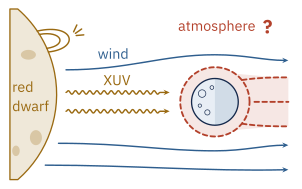
For rocky planets in and near the habitable zones of M dwarfs (e.g., TRAPPIST-1 e, f, g), determine whether secondary atmospheres with surface pressure $\ge 10^{5}\,\mathrm{dyn}/\mathrm{cm}^{2}$ ($0.1\,\mathrm{bar}$) survive XUV-driven escape, flares and stellar winds over Gyr. The answer is yes or no for a defined class of planets, from thermal emission and transmission measurements.
-
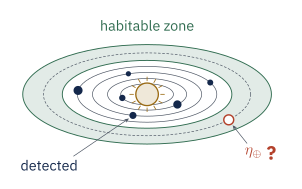
Measure $\eta_{\mathrm{Earth}}$, the number per G and K dwarf of planets with $R = 0.5-1.5\,R_{\mathrm{earth}}$ in the conservative habitable zone. Kepler-based estimates span roughly 0.05-0.6 because of extrapolation in period and radius and stellar property uncertainties. The answer is a value with uncertainty below $\sim 30\%$.
-
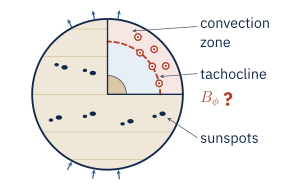
Determine whether the solar cycle is a Babcock-Leighton flux-transport dynamo with toroidal (east-west) field generated and stored in the tachocline ($r \sim 0.7\,R_{\mathrm{sun}}$) or a distributed dynamo in the convection zone. Answer: a model reproducing the butterfly diagram, the 22-year magnetic cycle period, polar-field reversal and helioseismic flows.
-
The quiet corona requires an energy flux of $\sim 3 \times 10^{5}\ \mathrm{erg}\ \mathrm{cm}^{-2}\ \mathrm{s}^{-1}$ and active regions $\sim 10^{7}\ \mathrm{erg}\ \mathrm{cm}^{-2}\ \mathrm{s}^{-1}$. Determine the dominant dissipation mechanism: Alfven-wave turbulence, resonant absorption and phase mixing of waves, or nanoflares (small reconnection events) in braided fields. Answer: mechanisms with energy fluxes matching these requirements, by region type.
-
Do first-principles 3D models reproduce observed supernova energies?
Partially resolved 71In $3\mathrm{D}$ neutrino-radiation hydrodynamics with general relativity and energy-dependent neutrino transport, determine whether the delayed neutrino-heating mechanism reaches asymptotic explosion energies $\sim 10^{51}\,\mathrm{erg}$ and Ni-56 masses $\sim 0.01\ \text{to}\ 0.1\,M_{\mathrm{sun}}$ (median $\sim 0.03\,M_{\mathrm{sun}}$) for progenitors of $9\ \text{to}\ 25\,M_{\mathrm{sun}}$, as observed in Type II-P supernovae. Answer: converged energies and Ni-56 masses versus progenitor, with dependence on resolution and transport method quantified.
-
Identify the dominant process that shuts off and keeps off star formation in central galaxies above $M_* \sim 3x10^{10}\ M_{\mathrm{sun}}$ (halo mass ~ $10^{12}\ M_{\mathrm{sun}}$): radiative AGN winds, radio-jet heating, virial shock heating of accreted gas, morphological stabilization of the gas disk, or cosmic-ray heating. The answer is an energy and momentum budget showing which process reproduces the quenched fraction as a function of $M_*$, halo mass and redshift.
-
Determine the mass function of black hole seeds formed at $z \sim 15-30$: light seeds ($M \sim 10-10^{3}\,M_{\mathrm{sun}}$, Population III remnants), intermediate seeds from runaway mergers in dense star clusters ($M \sim 10^{3}-10^{4}\,M_{\mathrm{sun}}$), or heavy seeds from direct collapse of metal-free atomic-cooling gas ($M \sim 10^{4}-10^{6}\,M_{\mathrm{sun}}$). An answer is the seed mass function, or a demonstration that one channel dominates the progenitors of the $z > 6$ quasar and broad-line AGN population.
-
For $E > 8 \times 10^{18}\ \mathrm{eV}$ (Auger large-scale dipole, amplitude $\sim 6.5\%$, pointing away from the Galactic center) and $E > 4 \times 10^{19}\ \mathrm{eV}$ (intermediate-scale excesses near Centaurus A and starburst galaxies for Auger, the hotspot for Telescope Array), identify the source population (AGN jets, starburst galaxies, gamma-ray bursts, tidal disruption events, magnetars). Answer: a source class whose emissivity, maximum rigidity and composition reproduce the spectrum, the shower-depth ($X_{\max}$) distributions and the arrival-direction anisotropies after propagation through Galactic and extragalactic magnetic fields.
-
Determine the fractional contributions of neutron-star mergers (including neutron star-black hole), collapsars and magnetorotational supernovae, and magnetar giant flares to the Galactic r-process mass. Constraints: binary neutron star merger rate from gravitational waves ($\sim 10\text{ to }1700\,\mathrm{Gpc}^{-3}\,\mathrm{yr}^{-1}$), ejecta per event ($\sim 0.01\text{ to }0.05\,M_{\mathrm{sun}}$), the $[\mathrm{Eu}/\mathrm{Fe}]$ versus $[\mathrm{Fe}/\mathrm{H}]$ trend and its scatter in metal-poor stars, and Pu-244 in deep-sea crusts. Answer: fractions with uncertainties.
-
The pulsar-timing common red process has characteristic strain $h_{c}(f) = A (f/f_{\mathrm{ref}})^{-2/3}$ with A of approximately $2.4x10^{-15}$ at $f_{\mathrm{ref}} = 1/\mathrm{yr}$ (NANOGrav 15-yr). Determine whether it is produced by a supermassive black hole binary population or by a cosmological source (first-order phase transition, cosmic strings, scalar-induced gravitational waves, domain walls). The answer is an identification supported by spectral shape, anisotropy, excess variance between frequency bins, and resolvable individual binaries.
-
The IceCube diffuse astrophysical flux (per-flavor $E^2 \Phi$ of about $10^{-8}\,\mathrm{GeV}\,\mathrm{cm}^{-2}\,\mathrm{s}^{-1}\,\mathrm{sr}^{-1}$ near 100 TeV, spectral index $\sim 2.4\ \text{to}\ 2.9$) is not accounted for by gamma-ray blazars (stacking limits of order 10 percent) or by the Galactic plane (of order 10 percent near 30 TeV). Identify the population or populations producing most of it, including gamma-ray-dark sources such as Seyfert coronae, consistent with the isotropic gamma-ray background. Answer: source classes with flux fractions summing to the observed flux.
-
Map the outcome (explosion leaving a neutron star, fallback black hole, or failed supernova with direct black hole formation) against pre-collapse core structure (compactness parameter xi_2.5, iron-core mass, Ertl two-parameter criterion) for initial masses $8 \text{ to } 120\,M_{\mathrm{sun}}$. Answer: an outcome map from 3D simulations validated against the absence of observed red supergiant progenitors above $\sim 17-18\,M_{\mathrm{sun}}$ and against disappearing-star searches.
-
The Fermi-LAT excess (spectrum peaking near $1\text{ to }3\,\mathrm{GeV}$, extending $\sim 10\text{ to }20\,\mathrm{deg}$ from the Galactic center, luminosity of order $10^{37}\,\mathrm{erg/s}$) fits either dark-matter annihilation (mass $\sim 30\text{ to }70\,\mathrm{GeV}$ into b quarks, $\langle \sigma v\rangle \sim 2 \times 10^{-26}\,\mathrm{cm}^3/\mathrm{s}$) or tens of thousands of unresolved bulge millisecond pulsars. Determine which. Answer: an identification at $5\sigma$ from morphology, photon-count statistics, radio pulsar counts, or matching signals in dwarf galaxies.
-
Molecular clouds convert gas into stars at efficiency per free-fall time eps_ff = SFR t_ff / M_gas ~ 0.01, with integrated cloud efficiencies of $\sim 1-10\%$ before dispersal. Explain the value and its scatter as a function of cloud surface density and virial parameter, separating the roles of supersonic turbulence, magnetic support and stellar feedback (photoionization, winds, radiation pressure, jets, supernovae).
-
Particles with Stokes number $\mathrm{St} = \Omega t_{\mathrm{stop}} \sim 0.1-1$ drift inward at $v_{r} \sim 2\,\mathrm{St}\,\eta\,v_{K}/(1+\mathrm{St}^{2})$ with $\eta v_{K} \sim 3-5x10^{3}\,\mathrm{cm/s}$ and collide at speeds above fragmentation thresholds of $\sim 10^{2}-10^{3}\,\mathrm{cm/s}$. Identify which pathway forms bound planetesimals of $1-100\,\mathrm{km}$ fast enough: streaming instability, trapping in pressure bumps or vortices, gravitational instability of the dust layer, or coagulation of porous ice aggregates.
-
What produces the cosmic-ray knee near 3 PeV?
Partially resolved 63The all-particle spectrum steepens from dN/dE ~ E^-2.7 to ~E^-3.1 near $E \sim 3-4\,\mathrm{PeV}$, and LHAASO finds that the proton spectrum hardens and then breaks sharply near 3 PeV. Determine which Galactic source class (supernova remnants, young massive star clusters, microquasars, the Galactic center) accelerates protons to at least 3 PeV, and whether the knee is a source maximum-rigidity feature ($E_{\max}$ proportional to charge $Z$) or a propagation feature. Answer: an identified PeVatron class with an acceleration model reproducing the proton and helium knee positions.
-
Enumerate and quantify abiotic pathways that produce detectable $\mathrm{O_2}$, $\mathrm{O_3}$ or $\mathrm{CH_4}$ plus $\mathrm{CO_2}$ disequilibrium on rocky planets: $\mathrm{H_2O}$ photolysis with hydrogen escape, $\mathrm{CO_2}$ photolysis in dry atmospheres, serpentinization and volcanic outgassing. For each, derive spectral discriminants (CO, O4, $\mathrm{H_2O}$ abundance, redox state) measurable by a Habitable Worlds Observatory-class telescope. The answer is a classified list with abundance ranges and discriminants.
-
Standard solar models using 3D non-LTE photospheric abundances (Asplund et al. 2009 and 2021, $Z/X \sim 0.018$) disagree with the helioseismic sound speed below the convection zone (deviations $\sim 1\%$), the convection-zone base $R_{\mathrm{cz}} = 0.713\,R_{\mathrm{sun}}$ and surface helium $Y_{s} \sim 0.248$, while higher-metallicity analyses (Magg et al. 2022, $Z/X = 0.0225$) restore much of the agreement. Determine the correct metal content and whether opacity revisions near $T \sim 2 \times 10^{6}\,\mathrm{K}$ or other physics are needed. Answer: $Z/X$ with uncertainty consistent with helioseismology and the CNO solar neutrino flux.
-
The initial mass function $dN/d\operatorname{log} m$ peaks at $m_c \sim 0.2-0.3\,M_{\mathrm{sun}}$ and falls as dN/dlog m ~ m^-1.35 (Salpeter slope, 2.35 in $dN/dm$) above $\sim 1\,M_{\mathrm{sun}}$. Derive $m_c$ from first principles, distinguishing between the thermal Jeans mass at the transition to dust-dominated cooling, the mass of the first hydrostatic core, protostellar radiative heating, and turbulent fragmentation, and predict how $m_c$ scales with metallicity, gas pressure and radiation field.
-
Determine the fractions of the LIGO-Virgo-KAGRA binary black hole population arising from isolated binary evolution (common envelope, stable mass transfer, chemically homogeneous evolution), dynamical assembly in globular, nuclear and young clusters, AGN disks and hierarchical mergers, using the distributions of masses, effective and precessing spins $(\chi_{\mathrm{eff}}, \chi_{p})$, mass ratio and redshift. Answer: fractions with credible intervals.
-
Classical T Tauri disks accrete at $\mathrm{mdot} \sim 10^{-9}-10^{-7}\ M_{\mathrm{sun}}/\mathrm{yr}$; a turbulent-viscosity model needs $\alpha \sim 10^{-3}-10^{-2}$, while non-ideal MHD (low ionization, Ohmic, ambipolar and Hall effects) suppresses the magnetorotational instability over much of $1-30\ \mathrm{AU}$. Determine the fraction of the angular-momentum flux carried by magnetized disk winds versus radial turbulent transport as a function of radius, using nonthermal molecular line widths, dust vertical settling, and measured wind mass-loss rates. The answer is the radial profile of the wind-to-turbulent torque ratio, or a demonstration that one channel dominates at $1-100\ \mathrm{AU}$ in typical disks.
-
For normal SNe Ia in Milky Way-like galaxies, determine the fraction $f_{\mathrm{DD}}$ produced by double-degenerate systems (two white dwarfs) versus single-degenerate systems (white dwarf plus nondegenerate donor). The answer must be consistent with the delay-time distribution (approximately proportional to $t^{-1}$), the absence of stripped hydrogen in nebular spectra (no detection in 111 events, Tucker et al. 2020, with limits well below the $0.1\ \text{to}\ 0.5\,M_{\mathrm{sun}}$ expected from a hydrogen-rich donor), early light-curve excesses and the measured rate per unit stellar mass.
-
For planets with $R \sim 2-3.5\,R_{\mathrm{earth}}$ and $M \sim 5-15\,M_{\mathrm{earth}}$, determine the bulk composition: rocky cores with H/He envelopes of $\sim 1-3\%$ by mass, water mass fractions of $\sim 10-50\%$ in supercritical layers, or magma oceans that dissolve and mix with hydrogen. The answer is a classification of individual planets and the population fractions, using JWST transmission spectra (mean molecular weight, $\mathrm{H_2O}$, $\mathrm{CH_4}$, $\mathrm{CO_2}$, $\mathrm{NH_3}$ abundances) together with interior models.
-
Mixing-length theory uses $\alpha_{\mathrm{MLT}}\sim 1.8$ calibrated on the Sun, and convective boundary mixing uses an overshoot extent of about 0.1 to 0.3 pressure scale heights. Determine whether $\alpha_{\mathrm{MLT}}$ is universal across mass, metallicity and evolutionary stage, and determine the overshoot extent and profile as a function of stellar mass, from 3D simulations validated against eclipsing binaries and asteroseismology.
-
Given the observed FRB population (all-sky rate of order $10^{3}\,\text{per day}$ above a few Jy ms at $600\,\mathrm{MHz}$, isotropic energies $10^{36} \text{ to } 10^{43}\,\mathrm{erg}$, hosts ranging from star-forming spirals to quiescent ellipticals and a globular cluster of M81), determine which source classes produce it and in what proportions. An answer is a population model (young magnetars, merger-formed or accretion-induced neutron stars, accreting compact binaries, other) that reproduces the energy function, repetition statistics, and host and offset distributions.
-
Determine whether Alfven-wave turbulence, interchange reconnection at the base of coronal holes, or both supply the energy and momentum flux of the fast wind (speed $\sim 7 \times 10^{7}\ \text{to}\ 8 \times 10^{7}\,\mathrm{cm}/\mathrm{s}$), including the heating of protons and heavy ions above the electron temperature. Answer: the fraction of the energy flux supplied by each process, consistent with Parker Solar Probe and Solar Orbiter data inside and near the Alfven surface.
-
Measure the coupling efficiency epsilon_f = dE_kin,outflow/dt divided by the AGN bolometric luminosity $L_{\mathrm{bol}}$, summed over ionized, neutral and molecular outflow phases, as a function of $L_{\mathrm{bol}}$ and Eddington ratio, and compare with the values $\sim 0.05-0.15$ used in cosmological simulations. The answer is the measured distribution of $\epsilon_f$ with its dependence on $L_{\mathrm{bol}}$.
-
Was the IMF top-heavy in the first galaxies?
Contested 60Determine the IMF slope above $10\ M_{\mathrm{sun}}$ in galaxies at $z>8$ with gas metallicity $Z<0.1\ Z_{\mathrm{sun}}$, using UV luminosity per unit stellar mass, He II and nitrogen emission lines, and chemical abundance ratios. The answer is the slope or an upper and lower bound on it compared with the local Salpeter value $\Gamma=1.35$ in $dN/d\operatorname{log} m\sim m^{-\Gamma}$.
-
Test the Blandford-Znajek scaling $P_{\mathrm{jet}} = (\kappa/(4 \pi c)) \Phi_{\mathrm{BH}}^2 \Omega_H^2$ (Gaussian units; $\Phi_{\mathrm{BH}}$ the magnetic flux through the horizon, $\Omega_H$ the horizon angular frequency, $\kappa \sim 0.05$) against measured spins and jet powers in X-ray binaries and AGN. Answer: a demonstrated correlation, or its absence, of jet power with spin at fixed flux and accretion rate, using spins from independent methods.
-
Cosmogenic isotope records (C-14, Be-10) show a few tens of grand minima over the last $\sim 10^{4}\,\mathrm{yr}$, occupying of order one sixth of the time. Determine whether entry and exit arise from stochastic fluctuations in the Babcock-Leighton poloidal source (scatter of active-region tilt angles, rare anomalous active regions), from nonlinear deterministic dynamo dynamics, or from changes in meridional flow, and whether the waiting-time distribution is exponential. Answer: a model reproducing the frequency and duration distribution of grand minima and the hemispheric asymmetry of the Maunder Minimum.