This browser is older than PubPhys supports. Every page can be read, but signing in to contribute, voting and signing need Safari 15.4, Chrome or Edge 99, Firefox 97 or newer. Browsers
All problems
129 problems
Starting order drafted by AI. Votes change it. How ranking works
-
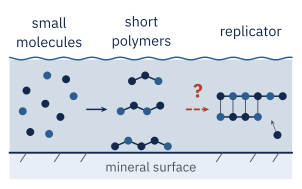
Identify a sequence of chemically and geologically plausible steps, with rates under stated early-Earth conditions (temperature, pH, mineral surfaces, wet-dry cycles), that takes a mixture of small prebiotic molecules to a population of informational polymers that replicate with heritable variation and undergo Darwinian selection. A complete answer specifies each step and demonstrates the chain in the laboratory or in a quantitative model with measured rate constants.
-
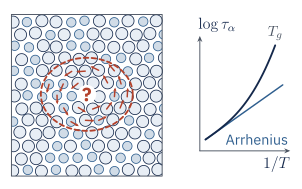
In molecular glass formers the structural relaxation time $\tau_\alpha(T)$ grows from about $10^{-12}\ \mathrm{s}$ in the high-temperature liquid to about $10^{2}\ \mathrm{s}$ at $T_g$, with an effective activation energy that increases on cooling; model liquids (Kob-Andersen Lennard-Jones mixture, polydisperse soft spheres) reproduce the onset of this growth. Competing explanations include random first-order transition theory (entropy-driven cooperative rearrangements), dynamic facilitation (kinetically constrained localized excitations) and elastic or frustration-based models. An answer is a theory that predicts $\tau_\alpha(T)$ and the associated growing length scales from the interaction potential and is singled out against the alternatives by equilibrium simulations near and below the experimental $T_g$. This is the root question of the topic; its working content is split into the sharper problems linked to it.
-
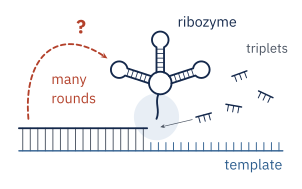
Sustained exponential self-replication by a polymerase ribozyme
Partially resolved 78A polymerase ribozyme of length $L$ must synthesize complete copies of itself and of its complementary strand with per-nucleotide fidelity $q$ satisfying $L(1 - q) < \ln(\sigma)$ (Eigen error threshold; $\sigma$ = selective advantage of the correct sequence), at yields that allow exponential growth over repeated cycles that include strand separation. QT45, a 45-nucleotide ribozyme (Gianni and co-workers, Science 2026), synthesizes its complementary strand from a random triplet pool at $q = 0.941$ and a copy of itself from defined triplet substrates, each at about 0.2% yield in 72 days in eutectic ice. Answer: yes or no, with a demonstrated system showing sustained exponential amplification of both strands over many rounds without defined oligomer feeds.
-

AI-generated illustration
Microscopic basis of Archard's wear law
Partially resolved 73Archard's law $V = K N s / H$ (wear volume V, load N, sliding distance s, hardness H) has an empirical dimensionless coefficient K spanning roughly $10^{-8} \text{ to } 10^{-2}$. Derive K from asperity-scale mechanisms, including the critical junction size $d*$ proportional to $G w / \tau_j^{2}$ (shear modulus G, surface energy w, junction strength $\tau_j$) below which junctions deform plastically instead of shedding debris, and predict wear rates for specified material pairs.
-
Predicting the friction coefficient from multi-asperity contact mechanics
Partially resolved 71For two elastic or elastoplastic surfaces with self-affine roughness (Hurst exponent H, rms slope), derive the static friction $F = \mu_s N$ with $\mu_s$ independent of apparent area and load, combining the real contact area $A_r(N)$ and the shear strength $\tau_j$ of single junctions. An answer predicts $\mu_s$ from bulk and interfacial material parameters within experimental scatter for specified material pairs.
-
How life came to use only one molecular handedness
Contested 70Identify the symmetry-breaking event (a deterministic bias such as weak-interaction parity violation, circularly polarized light, or spin-polarized electrons from magnetic minerals; or spontaneous symmetry breaking) and the amplification mechanism (autocatalysis, crystallization, polymerization selectivity) that took a near-racemic prebiotic pool to enantiomeric excess $\mathrm{ee} > 0.99$ in nucleotides and amino acids. Answer: a demonstrated, prebiotically plausible pathway.
-
For 3D glass formers with short-range interactions in equilibrium, determine whether the configurational entropy $s_{c}(T)$ (total entropy minus the vibrational entropy of the inherent structures) vanishes at a finite Kauzmann temperature $T_{K} > 0$ with a thermodynamic singularity, or remains positive down to $T = 0$. An answer is a proof for a realistic model or finite-size-scaling evidence (configurational entropy, point-to-set length, overlap fluctuations) from equilibrium data below $T_{g}$ that discriminates the two cases.
-
For asexual microbial populations of size $N$ and beneficial mutation rate $U_b$ on an empirically measured fitness landscape, determine the probability that replicate populations follow the same mutational path or reach the same peak, and which landscape statistics (ruggedness, epistasis structure, distribution of fitness effects) control it. Answer: a theory that predicts measured repeatability in replicated evolution experiments.
-
For A-beta42 at neutral pH and $\alpha$-synuclein at mildly acidic pH (about 5 to 6) in vitro, aggregation kinetics fit a master equation in which secondary nucleation on fibril surfaces, at rate $k_{2}$ m^$n_{2}$ M (m = monomer concentration, M = fibril mass concentration), dominates the formation of new aggregates. Determine the microscopic steps (adsorption, conformational conversion on the surface, detachment) and compute $k_{2}$ and the reaction order $n_{2}$ from a molecular model, matching measured values within a factor of 3.
-
Escape from Eigen's paradox for prebiotic genomes
Partially resolved 66With nonenzymatic copying fidelity $q \sim 0.9\ \text{to}\ 0.99$ per nucleotide, $L_{\max} \sim \ln(\sigma)/(1 - q)$ is tens to about a hundred nucleotides; polymerase ribozymes derived from the class I ligase are about 200 nucleotides long, while the 45-nucleotide QT45 ribozyme (Science 2026) copies at $q = 0.941$, giving $L_{\max} \sim 17 \ln(\sigma)$. Find a mechanism (compartments with group selection, hypercycles, template-directed ligation of short oligomers, spatial structure on surfaces) that maintains information content exceeding $L_{\max}$ over many replication rounds, stable against parasitic sequences, for a replicase that copies itself from mononucleotides or mixed-length feedstocks, with parameters measured in prebiotic chemistry.
-
For a given condensate (nucleolus, stress granules, transcriptional condensates), determine whether phase separation itself, as distinct from the underlying molecular binding, changes a measurable cellular output (reaction rate, transcriptional burst frequency, stress survival), using perturbations that shift $c_{sat}$ while preserving binding affinities.
-
For an enhancer-promoter pair at genomic separation $s$, relate contact probability $p_c(s)$ (or contact rate) to transcriptional burst frequency, and identify the mechanism behind the reported nonlinear dependence of expression on $p_c$ (threshold, multi-step activation, or action at a distance through a condensate). Answer: a quantitative model predicting expression across inserted enhancer positions.
-
For the Drosophila wing imaginal disc, identify the mechanism that ends growth at a final size reproducible to a few percent: Dpp morphogen readout, mechanical feedback through compression-dependent proliferation, Hippo pathway signaling, or a combination. A model must predict final size and the timing of growth arrest under perturbations (clonal overgrowth, Dpp mutants, imposed compression).
-
Predict condensate phase diagrams from protein sequence
Partially resolved 64For intrinsically disordered regions of 50 to 500 residues, predict the saturation concentration $c_{\mathrm{sat}}(T,\mathrm{salt})$ and the dense-phase concentration from sequence alone, within a factor of 2 for $c_{\mathrm{sat}}$, across sequence variants with altered aromatic and charge patterning (stickers-and-spacers framework). Answer: a model validated on blind variants and on two-component mixtures.
-
Is the brain poised near a critical point?
Contested 64For cortical networks in vivo, determine whether collective activity is at or near a continuous phase transition (avalanche criticality at an absorbing-to-active boundary, or an edge-of-instability point), as opposed to a non-critical state producing power laws by other means (latent common inputs, subsampling, neutral dynamics), and whether the distance to criticality is regulated by homeostasis. An answer states criteria such as finite-size scaling under an independently varied control parameter.
-
For a single continuous incommensurate crystalline contact (graphite on graphite or on hexagonal boron nitride; not an ensemble of many small superlubric flakes), the friction force scales as $F \sim A^\gamma$ with contact area $A$ and $\gamma < 1$ because of edges, defects and elastic deformation. Determine $\gamma$ and the crossover length above which elastic pinning or defects restore a finite friction per unit area, and whether friction coefficients below $10^{-3}$ can persist for two-dimensional contacts with area above about $10^{-4}\,\mathrm{cm}^2$.
-
A nonlocal constitutive law for slow granular flows
Partially resolved 63The local $\mu(I)$ rheology gives the stress ratio $\mu = \tau / P$ as a function of the inertial number $I = \gamma_{\mathrm{dot}} d / \sqrt{P / \rho_s}$ (shear rate $\gamma_{\mathrm{dot}}$, grain diameter $d$, pressure $P$, grain density $\rho_s$). It fails as $I \to 0$: creep below the yield ratio $\mu_s$, thickness-dependent stopping height $h_{\mathrm{stop}}$ of flowing layers, and flow induced by distant shear. Find a constitutive law (for example a fluidity model with cooperativity length $\xi \sim \mid \mu - \mu_s \mid^{-1/2}$) that predicts all three effects quantitatively for frictional spheres, with parameters derived from grain-scale physics.
-
Homogeneous ice nucleation rate of deeply supercooled water
Partially resolved 62Determine the homogeneous ice nucleation rate $J(T)$ in pure $\mathrm{H_2O}$ between about 230 and 240 K, where measurements by different techniques disagree by several orders of magnitude and simulations (seeding with TIP4P/Ice and similar models) depend on CNT-based extrapolation. Decide whether CNT with a temperature-dependent ice-water interfacial free energy $\gamma(T)$ reproduces $J(T)$, and confirm whether the critical nucleus is stacking-disordered ice.
-
Does real water have a liquid-liquid critical point?
Partially resolved 62Determine whether $\mathrm{H_2O}$ (and $\mathrm{D_2O}$) has a first-order transition between a high-density liquid (HDL) and a low-density liquid (LDL) ending at a liquid-liquid critical point (LLCP), versus the singularity-free scenario, a critical point at negative pressure, or the stability-limit conjecture. The LLCP is established in several classical and machine-learned first-principles water models, and ultrafast heating of amorphous ice with X-ray scattering has reported a discontinuous-to-continuous crossover with critical fluctuations. An answer is an independent confirmation, by a different technique or group, of critical scaling (diverging correlation length with 3D Ising exponents) in metastable bulk water with crystallization excluded.
-
For globular proteins such as lysozyme, colloids with short-range attraction and some small molecules, crystals are reported to nucleate within metastable dense-liquid droplets or amorphous precursors. Determine for which interaction ranges and supersaturations the two-step pathway dominates the rate, and derive a rate expression replacing CNT that predicts measured rates.
-
How predictable is the species composition of an assembling microbial community?
Partially resolved 61Given a pool of S microbial strains and a defined medium with specified carbon sources, predict the relative abundances of the community reached after serial dilution, at family and species level, from measured monoculture traits, pairwise outcomes or metabolic capabilities. Quantify the predictability limit by comparing prediction error with replicate-to-replicate variation. An answer is the minimal data set and model that predict composition to within replicate variation, or a demonstration that species-level composition is intrinsically unpredictable (for example from multistability or historical contingency).
-
How T cells discriminate foreign from self antigens
Contested 61T cells respond to approximately 1 to 10 agonist peptide-MHC ligands among approximately $10^{4}$ to $10^{5}$ self ligands whose receptor-binding lifetimes differ by a factor of order 3 to 10 (approximate). Kinetic proofreading of the McKeithan type trades sensitivity for specificity; identify the signaling mechanism (adaptive sorting, negative feedback, receptor clustering, force-dependent catch bonds) that achieves both, and test its predicted dose-response curves against data.
-
Origin of the logarithmic aging of static friction
Contested 60The static friction coefficient grows as $\mu_{s}(t) = \mu_{0} + \beta \ln(1 + t / t_{c})$ with $\beta$ of order 0.01 for rocks, polymers and metals, the basis of rate-and-state friction laws. Determine whether aging comes from creep growth of real contact area, from interfacial chemical bonding (reported in nanoscale silica contacts), or both, and predict $\beta$ and $t_{c}$ from material properties.
-
For FUS and hnRNPA1 condensates in vitro, viscosity and elastic modulus increase over hours (aging of a Maxwell fluid). Determine whether aging is driven by $\beta$-sheet formation and fibril nucleation inside the dense phase, by glass-like slowing of sticker exchange, or by both, and predict the aging time as a function of sequence and temperature.
-
Determine the mechanism, length scale and critical strain for nucleation of a system-spanning shear band in metallic and model glasses under uniaxial or shear loading: the organization of shear-transformation zones (localized rearrangements of about 10 to 100 atoms) into a band, the role of local softening (free volume or effective temperature), and the resulting dependence of ductility on sample size and annealing.
-
For a community matrix $J$ with $S$ species, connectance $C$, interaction standard deviation $\sigma$ and self-regulation d, random-matrix theory gives stability only if $\sigma \sqrt{S C} < d$, with refinements for correlated pairs (predator-prey or competitive). Given empirical interaction strengths and abundances ($J_{ij} = -N_i^{*} (\delta_{ij} + \alpha_{ij})$ at a feasible equilibrium $N^{*}$), determine which structural property (feasibility filtering during assembly, interaction-strength distribution, pair correlations, trophic coherence, consumer-resource structure) controls the leading eigenvalue of real communities. An answer is an identified property with a quantitative test on measured networks showing it accounts for observed stability at observed $S$ and $\sigma$.
-
Surface-force measurements in aqueous NaCl above $\sim 1\, \mathrm{M}$ and in ionic liquids find an exponentially decaying force with decay length $\lambda_S$ that grows with concentration and reaches several nm, scaling as $\lambda_S/\lambda_D \sim (a/\lambda_D)^n$ with $n \sim 3$, where $\lambda_D$ is the Debye length and a the ion diameter. Liquid-state theory and molecular simulations of bulk electrolytes give $n \sim 1 \text{ to } 1.5$ and much smaller $\lambda_S$. An answer is a bulk or interfacial mechanism that reproduces the measured magnitude and n, or a demonstration that the long decay is an artifact of specific surfaces or measurement conditions.
-
For hard-sphere colloids at volume fractions $\phi$ of roughly $0.50\text{ to }0.53$, simulated nucleation rate densities (umbrella sampling, forward flux, brute-force MD) fall below light-scattering and microscopy measurements by roughly 10 or more orders of magnitude (up to 22 in some estimates), while agreeing at higher $\phi$. Identify the cause (polydispersity, sedimentation, solvent hydrodynamics, errors in mapping experimental to effective volume fraction, simulation method, or a deficiency in the nucleation picture itself) and reconcile simulation and experiment within statistical error.
-
The kinetic fragility $m = d log10(\tau_{\alpha}) / d(T_{g}/T)$ evaluated at $T = T_g$ ranges from about 20 for $\mathrm{SiO_2}$ to above 150 for some polymers. Identify the microscopic determinants of $m$ (softness of the repulsion, network connectivity, vibrational anharmonicity, the heat-capacity jump $\Delta C_p$ at $T_g$) and give a predictive relation for $m$ tested across a set of chemically different liquids.
-
For the light-induced radical pair in avian cryptochrome 4 (flavin radical FAD.- with a tryptophan or another partner radical) in a field $B \sim 0.5\,\mathrm{G}$ at $T \sim 313\,\mathrm{K}$, compute the spin relaxation and decoherence time $T_2$ including hyperfine modulation by protein motion and spin-rotation, and the resulting dependence of the singlet yield on field direction. Simulated $T_2$ for the flavin-tryptophan pair is of order $0.1\,\text{microsecond}$ (approximately, model dependent), while a usable heading signal at $0.5\,\mathrm{G}$ is estimated to need $T_2$ of order $1\,\text{microsecond}$ or longer (approximately). An answer is either a computed and measured $T_2$ and anisotropic yield for the identified pair large enough to support orientation, or the identification of a different radical pair or mechanism that achieves it.