This browser is older than PubPhys supports. Every page can be read, but signing in to contribute, voting and signing need Safari 15.4, Chrome or Edge 99, Firefox 97 or newer. Browsers
All problems
65 problems
Starting order drafted by AI. Votes change it. How ranking works
-
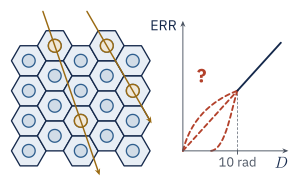
Does risk stay linear below 10 rad?
Contested 83Determine the shape of the dose-response relation for solid-cancer incidence below 10 rad ($1\,\mathrm{rad}=100\,\mathrm{erg}/\mathrm{g}$) of low-linear-energy-transfer radiation: linear without threshold, linear-quadratic, threshold, or non-monotonic. The answer must handle dose-measurement error, confounding and reverse causation at effect sizes of about 5 percent excess relative risk per 10 rad (ERR about 0.5 per 100 rad), falling to about 0.5 percent at 1 rad. An answer is a shape with confidence intervals excluding the alternatives.
-
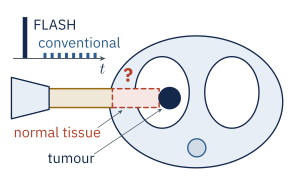
Determine whether single-fraction doses of 800 to 3000 rad delivered at mean dose rates above 4000 rad/s produce measurably lower normal-tissue toxicity in humans than the same dose at conventional dose rates of 1 to 10 rad/s, at matched tumour control, for at least one tissue and endpoint. An answer is yes or no with an estimated dose-modifying factor and confidence interval.
-
AI-generated illustration
Identify the mechanism by which mean dose rates above roughly $4000\ \mathrm{rad}/\mathrm{s}$ ($1\ \mathrm{rad} = 100\ \mathrm{erg}/\mathrm{g}$), delivered in under $200\ \mathrm{ms}$, raise normal-tissue tolerance at fixed total dose (typically $1000\ \text{to}\ 3000\ \mathrm{rad}$ single fraction) without a matching rise in tumour tolerance. Candidate classes: transient radiolytic oxygen depletion, inter-track radical-radical recombination altering peroxidation yields, differential iron and labile metal pools, immune and vascular responses. An answer is a quantitative model reproducing the measured sparing as a function of dose, dose rate, pulse structure and tissue oxygen tension.
-
Millimetre in vivo verification of particle range
Partially resolved 70Achieve in vivo verification of the distal beam range to a standard deviation of 1 mm or better, per treatment field, in soft tissue and across tissue interfaces, at clinical dose levels. Candidate signals: prompt gamma emission at 3 to 7 MeV, positron-emitter activation (C-11, O-15, N-13), ionoacoustic pressure pulses, and charged secondary tracking. An answer is a demonstrated method with measured accuracy and precision in patients.
-
Does absorbed dose predict outcome in radionuclide therapy?
Partially resolved 67Establish whether tumour absorbed dose, computed from quantitative imaging and time-activity integration for Lu-177 labelled agents, predicts response with a slope distinguishable from zero, and whether kidney and marrow absorbed dose predicts toxicity. Typical delivered tumour doses span $10^3$ to $3 \times 10^4\,\mathrm{rad}$ at dose rates of 1 to 100 rad/h. An answer is a dose-response relation with confidence intervals, or a demonstration that dose rate and biological factors dominate.
-
Variable biological effectiveness of proton beams
Contested 66Determine the proton relative biological effectiveness as a function of dose-averaged linear energy transfer $\mathrm{LET}_{d}$ from $1 \text{ to } 15\,\mathrm{keV}/\mathrm{micron}$, dose per fraction from $100 \text{ to } 1000\,\mathrm{rad}$, and tissue $\alpha/\beta$ from $200 \text{ to } 1000\,\mathrm{rad}$, for clinically relevant normal-tissue endpoints. The clinical standard $\mathrm{RBE} = 1.1$ is constant. An answer is a validated RBE model with uncertainty bands usable in treatment planning.
-
How focused ultrasound changes neural activity
Contested 66Identify the mechanism by which focused ultrasound at $0.2\ \text{to}\ 1.5\ \mathrm{MHz}$, spatial-peak pulse-average intensity below about $10^8\ \mathrm{erg}/(\mathrm{s}\ \mathrm{cm}^{2})$ and mechanical index below 1, modulates neuronal firing. Candidates: radiation force and membrane strain, intramembrane cavitation, mechanosensitive ion channel activation, local heating of order $0.1\ \mathrm{K}$, and indirect auditory activation. An answer is a mechanism predicting the sign and magnitude of the effect versus frequency, pulse length and duty cycle.
-
Determine whether a coincidence time resolution of 10 ps full width at half maximum is attainable in a detector of sufficient stopping power for 511 keV photons, which corresponds to a position uncertainty of about 1.5 mm along the line of response. Required chain: photon production statistics and rise time, light transport, photodetector transit-time spread, and electronics jitter. An answer is a demonstrated detector pair or a proof that a chain element forbids it.
-
Circulatory disease risk from radiation below 50 rad
Contested 64Determine whether the excess relative risk of circulatory disease (ischaemic heart disease and cerebrovascular disease), estimated in pooled analyses at about 0.11 per 100 rad, persists for organ doses below 50 rad and at low dose rate, and whether the dose response is linear or has a threshold, after control for smoking, lipids and other confounders. An answer is a dose-response shape with confidence intervals below 50 rad and a mechanism compatible with it.
-
Causal cancer risk from diagnostic CT exposure
Contested 63Establish whether the excess leukaemia, haematological-cancer and brain-tumour incidence observed in paediatric CT cohorts, reported as excess relative risk of about 1 to 2.5 per 10 rad organ dose, is causal after removing reverse causation from scans prompted by the undiagnosed disease and from cancer-predisposition syndromes, and after correcting organ-dose reconstruction errors. An answer is a causal risk coefficient or a demonstration that the association is confounded.
-
Design and demonstrate a delivery scheme giving a conformal dose distribution to a target at 10 to 20 cm depth with mean dose rate above 4000 rad/s over the whole target and delivery under 200 ms. Candidate routes: very-high-energy electrons at 100 to 250 MeV with magnetic scanning or focusing, transmission or Bragg-peak proton beams with ridge filters, and multi-source photon arrays. An answer is a validated design with measured dose rate, conformality and delivery time.
-
Explain the dose-volume effect in which normal tissue tolerates peak doses of several times $10^{4}\,\mathrm{rad}$ in beams of $25\ \text{to}\ 100\,\mathrm{micron}$ width with spacing of $200\ \text{to}\ 400\,\mathrm{micron}$, while tolerating only a few thousand rad in broad fields. Candidate mechanisms: preferential survival and migration of cells from unirradiated valleys, differential microvascular response, bystander signalling range, and immune recruitment. An answer is a mechanism predicting tolerance as a function of beam width, spacing and valley dose.
-
Identify a nanodosimetric quantity, such as the ionization cluster size distribution in a volume of 2 to 10 nm, lineal energy on a 1 micron site, or a DNA-weighted energy-deposition metric, that collapses measured cell-survival and chromosome-aberration data for photons, protons and ions of LET from 0.2 to 200 keV/micron onto a single curve. An answer names the quantity and shows the collapse with residuals.
-
Value of the dose and dose-rate effectiveness factor
Contested 59Determine the dose and dose-rate effectiveness factor, the ratio of risk per unit dose at high acute dose rate to that at protracted low dose rate, for solid cancer and for leukaemia separately. Values in use range from 1 to 2 (the ICRP uses 2, some bodies use 1). An answer is a measured value with uncertainty, per endpoint.
-
Establish the sparing factor as a function of mean dose rate, dose per pulse, pulse width, pulse repetition frequency and total dose, for fixed tissue and endpoint, and locate the thresholds. Current working values of mean dose rate above 4000 rad/s, total delivery under 200 ms and dose per pulse above about 100 rad are empirical. An answer is a parametrized response surface with stated validity ranges.
-
Establish traceable absolute dosimetry for pulses delivering 100 to 1000 rad in 1 to 4 microseconds, with instantaneous dose rates up to $10^9\,\mathrm{rad}/\mathrm{s}$, where ion-chamber general recombination is severe and the Boag formalism (the standard correction for charge recombination in ion chambers) fails. Candidate standards: water and graphite calorimetry, Fricke and alanine chemical dosimeters, scintillator and Cherenkov detectors. An answer is a primary standard plus validated transfer detectors with uncertainty below 2 percent.
-
Identify an assay predicting severe normal-tissue reaction, defined as grade 3 or higher toxicity, before treatment, with sensitivity and specificity sufficient for clinical use. Candidate physical and cellular measures: residual DNA double-strand break foci at 24 h, chromosome aberration yield per 100 rad in lymphocytes, and apoptosis fraction after ex vivo irradiation. An answer names a validated assay with its operating characteristics.
-
Define and validate a cavitation dose quantity, built from the passively detected acoustic emission spectrum (harmonic, subharmonic and broadband components) integrated over the exposure, that predicts both the degree of blood-brain barrier permeability increase and the onset of damage such as microhaemorrhage, across bubble types, concentrations and frequencies of 0.2 to 1.5 MHz. An answer is the quantity with its measured predictive relation.
-
Predict the yield and complexity spectrum of DNA double-strand breaks and clustered lesions per 100 rad per cell, including the indirect chemical channel, from physical track structure plus radiation chemistry and a chromatin geometry model, without fitting to the damage data being predicted. Target accuracy: 20 percent across radiation qualities from Co-60 photons to 100 keV/micron ions. An answer is a predicted yield spectrum with that accuracy.
-
Patient stopping-power accuracy below one percent
Partially resolved 55Determine the stopping power of patient tissues relative to water from imaging to better than 1 percent root-mean-square, including tissue mean excitation energies relative to water and tissue-composition variability. Candidate routes: dual-energy CT, photon-counting spectral CT, proton CT. An answer is a validated conversion with a stated uncertainty budget.
-
Accelerator production routes for therapeutic alpha emitters
Partially resolved 55Determine the optimal production route for Ac-225 and related $\alpha$ emitters by measuring excitation functions and co-produced impurities for proton spallation of thorium-232, photonuclear production from Ra-226, and deuteron or $\alpha$ routes, in the energy ranges used by available accelerators. Key figure of merit: yield per beam hour at required radionuclidic purity, in particular Ac-227 contamination. An answer is cross sections and yields fixing the preferred route.
-
Rank ion species by atomic number Z from 1 to 10 against the combined criteria of lateral and distal penumbra, dose-averaged LET in target versus normal tissue, fragmentation tail dose beyond the Bragg peak, and oxygen enhancement ratio in hypoxic targets. An answer is a classification of tumour and site classes to the preferred ion, with the physics criteria that decide each case.
-
Identify and engineer prompt emission mechanisms with sub-100 ps rise and a useful photon yield at 511 keV: Cherenkov emission in high-refractive-index media, cross-luminescence in barium fluoride, quantum-confined emission in nanocrystals and metamaterial scintillators, and hot intraband luminescence. Required figures of merit: prompt photons per MeV, emission rise time, self-absorption and extraction efficiency. An answer names a material and reports these quantities.
-
Identifiability of white-matter compartment parameters from diffusion data
Partially resolved 52For the two- or three-compartment model of white matter (intra-axonal sticks with a fibre orientation distribution, an anisotropic extra-axonal compartment, free water), with parameters axonal water fraction f, intra-axonal diffusivity $D_a$, and extra-axonal diffusivities D_e_par and D_e_perp, determine the minimal set of acquisitions (diffusion weightings $b\ \text{up to about}\ 10\,\mathrm{ms}/\text{micron}^2$, b-tensor shapes, echo-time variation) that makes the parameters identifiable at clinical signal-to-noise ratio of 20 to 50, and state the residual estimation variance. An answer is the identifiability condition and the attainable precision.
-
Image the B-10 concentration in tissue during neutron irradiation through the 478 keV gamma line from the Li-7 excited state, with 10 percent accuracy in concentration, about 5 mm spatial resolution and a frame time of minutes, against the intense background of 2.2 MeV hydrogen-capture gammas and neutron-induced detector activation. An answer is a demonstrated detector and reconstruction method with these figures in a patient-sized phantom.
-
Determine the absorbed dose at cellular scale from Ac-225 and Ra-223 chains, including recoil-induced release of daughters (Fr-221, Bi-213, Pb-209 for Ac-225) and their redistribution, given alpha ranges of 40 to 100 micron and hit numbers of order a few per cell nucleus. An answer is a microdosimetric specific-energy distribution per organ and tumour, with measured daughter redistribution fractions.
-
Determine elastic, electronic excitation, ionization and dissociative electron attachment cross sections for electrons of 1 to 100 eV in liquid water, to about 10 percent, including the condensed-phase dielectric response and phase effects relative to water vapour. An answer is a consistent cross-section set reproducing measured electron ranges, thermalization distances and radiolysis yields.
-
Extend inhomogeneous radiation chemistry past $1\,\mathrm{microsecond}$ into the homogeneous regime in realistic cellular media, including oxygen, scavengers at millimolar concentration, lipid and protein targets, and track overlap at high dose rate. Required outputs: yields $G$ of hydroxyl radical, hydrated electron, hydroperoxyl, hydrogen peroxide and organic peroxyl species versus time, LET and dose rate. An answer is a validated kinetic scheme over $10^{-12}\ \text{to}\ 10\,\mathrm{s}$.
-
Construct a model converting the absorbed dose components of a neutron capture field (B-10(n,$\alpha$)Li-7 at about 2.3 MeV total kinetic energy, N-14(n,p) protons at 0.58 MeV, fast-neutron recoil protons and photons) into a photon-isoeffective dose that predicts tumour control and normal-tissue complication, replacing fixed compound and relative biological effectiveness factors. The model must include the boron microdistribution relative to the nucleus and dose-rate effects over treatment times of 30 to 60 min. An answer is a validated weighting scheme with stated uncertainty.
-
Predict the threshold and spatial extent of histotripsy bubble-cloud formation from the incident pressure waveform, with peak negative pressures of $10^8\text{ to }3 \times 10^8\,\mathrm{dyn}/\mathrm{cm}^2$ and microsecond pulses, including nucleus distribution in tissue, shock scattering from earlier bubbles, and tissue mechanical properties. An answer is a predictive model giving the treated volume boundary to within $1\,\mathrm{mm}$.