This browser is older than PubPhys supports. Every page can be read, but signing in to contribute, voting and signing need Safari 15.4, Chrome or Edge 99, Firefox 97 or newer. Browsers
All problems
74 problems
Starting order drafted by AI. Votes change it. How ranking works
-
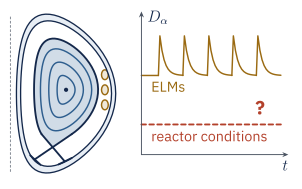
Candidate regimes are QH-mode (edge harmonic oscillation), I-mode, EDA H-mode, small or grassy ELM regimes (quasi-continuous exhaust) and negative-triangularity L-mode edges. Determine whether at least one achieves $H_{98}$ near 1, no type-I ELMs and a detached divertor simultaneously at reactor-relevant $n_{e}/n_{G}$ of about 0.8 or more, low external torque, high separatrix density and pedestal collisionality as low as ITER $Q = 10$. An answer is a demonstrated discharge meeting all conditions on one device, or a validated stability analysis showing that each regime's access window excludes them.
-
AI-generated illustration
In ITER disruptions mitigated by shattered pellet injection (SPI, fragmented $\mathrm{D_2}$ and Ne pellets), a small runaway seed from hot-tail generation, tritium beta decay and Compton scattering of gamma rays from the activated wall is amplified by avalanche multiplication. Compute the final runaway current versus injected D and Ne quantities, including losses through stochastic magnetic fields during the thermal quench and runaway-driven kinetic instabilities, and determine whether any injection scheme keeps the runaway current below the wall-tolerable level.
-
AI-generated illustration
A multi-machine regression gives an inter-ELM heat flux width $\lambda_{q}$ inversely proportional to the outboard-midplane poloidal field, extrapolating to about $0.1\,\mathrm{cm}$ for ITER, while gyrokinetic XGC simulations predict about $0.5\,\mathrm{cm}$. Determine $\lambda_{q}$ for the ITER $Q = 10$ baseline to within 30 percent and identify the mechanism (magnetic drifts versus edge turbulence) that sets it.
-
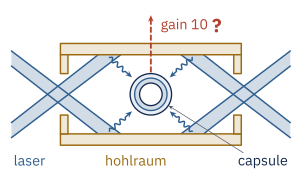
Target gain $G$ $= \text{fusion yield}/\text{laser energy}$ on target exceeded 1 at the National Ignition Facility in December 2022 with about $2.05 \times 10^{13}$ erg of laser energy. Determine whether $G$ of at least 10 is reachable at laser energy of about $2 \times 10^{13}$ to $3 \times 10^{13}$ erg by any design (indirect drive, direct drive, shock ignition, magnetized targets) given measured limits from hydrodynamic instabilities, ablator-fuel mix and drive asymmetry. An answer is an experiment, or a radiation-hydrodynamics design validated against existing ignition shots.
-
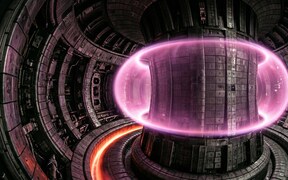
AI-generated illustration
With alpha heating $P_\alpha$ proportional to $n^2 \langle\sigma v\rangle(T)$ and confinement degrading with power, determine whether high-gain ($Q$ of 10 or more) or ignited tokamak operating points are thermally stable and controllable with realistic actuators (fueling, auxiliary heating, impurity seeding), including profile self-organization and coupling to pedestal and density limits. An answer is the stable, controllable operating region from a validated integrated model.
-
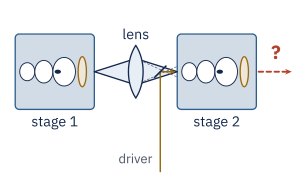
Between stages the strongly focused beam diverges and must be refocused, producing chromatic emittance growth $(\Delta \epsilon/\epsilon)^2 \sim (W \sigma_{\delta})^2$ with chromatic amplitude $W \sim \beta_{\mathrm{lens}}/f$. Demonstrate acceleration through at least two independently driven stages with charge coupling above 90 percent, normalized emittance growth below 10 percent and rms energy spread below 1 percent, or show it is impossible with known optics. An answer is an experiment or a proof of a fundamental limit.
-
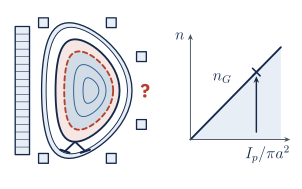
Discharges disrupt or return to L-mode when line-averaged density approaches the Greenwald density $n_G = 10^{14}\,\mathrm{cm}^{-3} x (I_p / 1\,\mathrm{MA}) / (\pi (a / 100\,\mathrm{cm})^2)$, with $I_p$ the plasma current and a the minor radius. Identify the mechanism (edge turbulence transition at critical collisionality or adiabaticity, radiative collapse and MARFE formation, tearing-island growth, plasma-wall self-organization) and derive whether the maximum density scales with heating power and wall conditions. An answer is a predictive criterion validated on several devices, including cases with $n/n_G$ above 1.
-
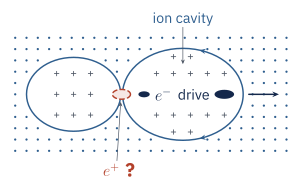
In the nonlinear blowout regime, plasma electrons are expelled and the ion column focuses electrons but defocuses positrons. Find a wake configuration (hollow channel, finite-radius plasma, electron filament, magnetized wake, quasi-linear wake) that simultaneously gives gradient above $10^{7}\,\mathrm{eV}/\mathrm{cm}$, energy-transfer efficiency above 30 percent, rms energy spread below 1 percent and collider-level emittance preservation. An answer is a demonstrated configuration or a proof that the requirements are incompatible.
-
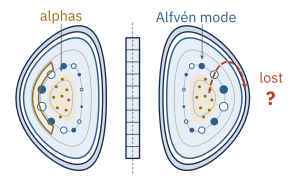
$3.5\,\mathrm{MeV}$ alphas with speeds comparable to the Alfven speed can drive toroidal Alfven eigenmodes and energetic-particle modes. Compute the steady-state alpha redistribution and the fraction of alpha power lost to the wall in the ITER $Q = 10$ scenario, including nonlinear saturation (wave-wave coupling, phase-space structures) and interaction with microturbulence. An answer is the alpha power loss fraction with uncertainty, from models validated on fast-ion transport in present devices.
-
AI-generated illustration
Predicting pedestal pressure height and width in reactor conditions
Partially resolved 72Pedestal models of the EPED type combine the ideal peeling-ballooning stability limit with a kinetic-ballooning-mode constraint on pedestal width (width ~ beta_pol,ped^0.5) to predict the pedestal pressure $p_{\mathrm{ped}}$. Determine what additional physics (separatrix density and neutral fueling, microtearing or electron-temperature-gradient transport, resistive and diamagnetic effects) is needed to predict $p_{\mathrm{ped}}$ to within 20 percent at high separatrix density, high gas fueling and metal walls, and give the prediction for ITER $Q = 10$. An answer is a model validated on at least three devices including a metal-wall one.
-
In diverted tokamaks, identify the mechanism that suppresses edge turbulence at the L-H transition within about $10^{-4}$ s: turbulence-driven zonal flows, the ion-diamagnetic radial electric field well, X-point ion orbit loss, or their combination. An answer is a flux-driven first-principles model (gyrokinetic or two-fluid, realistic diverted geometry) that reproduces the measured threshold power and its dependences on density, toroidal field direction, isotope and divertor geometry.
-
Quantify the trade-off between quasisymmetry error and coil engineering metrics: minimum coil-plasma distance relative to minor radius, maximum coil curvature, number of coils and allowed fabrication tolerance. For example, determine whether planar or other simple coil sets can achieve quasisymmetry error below $10^{-2}$ at reactor aspect ratio and coil-plasma spacing. An answer is a Pareto frontier from global optimization.
-
In W7-X, ion-temperature-gradient turbulence clamps the ion temperature near 1.5 keV in electron-heated plasmas unless the density profile is peaked. Determine the minimum nonlinear gyrokinetic ion heat flux at fixed normalized gradients achievable by 3D shaping, using nonlinear gyrokinetics inside the optimization loop, and validate the predicted reduction experimentally. An answer is the attainable reduction factor relative to W7-X at fixed gradients.
-
Steady burn requires the ratio $\rho = \tau_{\mathrm{He}}*/\tau_E$ of effective helium particle confinement time to energy confinement time below about 5 to 10. Predict $\rho$ for ITER and a reactor from core helium transport, edge and divertor helium enrichment and pumping. An answer is $\rho$ with uncertainty from validated core-edge-divertor modeling.
-
Data-driven and physics-based predictors reach detection rates near 90 percent or better with warning times of order 0.01 to 0.1 s on single devices. Determine whether a predictor trained on existing devices plus a small number of discharges from a new, larger device meets reactor requirements (e.g. above 95 percent detection, below 5 percent false alarms, warning time longer than the mitigation response time) on that device. An answer is a demonstrated cross-device transfer with these metrics.
-
For a current sheet of length $L$ and thickness a forming under external driving in resistive or Hall MHD at Lundquist number $S = L v_A/\eta$ of $10^{12}$ to $10^{14}$ (solar corona), determine the aspect ratio $a/L$ and the time at which tearing growth outpaces sheet thinning and fast (plasmoid-mediated or collisionless) reconnection begins; the ideal-tearing proposal gives $a/L \sim S^{-1/3}$. Determine how the criterion depends on the thinning rate and on the approach to kinetic scales ($a \sim d_i$), and predict the stored magnetic energy at onset. An answer is a criterion confirmed by driven-sheet simulations over a range of $S$ and consistent with flare-onset observations.
-
At ignition-scale direct drive (intensity about $10^{22}\,\mathrm{erg}\,\mathrm{s}^{-1}\,\mathrm{cm}^{-2}$), cross-beam energy transfer, two-plasmon decay and stimulated Raman scattering reduce absorption and produce hot electrons that preheat the fuel. Determine the absorbed fraction and the hot-electron preheat energy at full scale, and whether broadband or multi-color laser light suppresses them enough to allow $G$ above 10. An answer is a validated kinetic plus hydrodynamic prediction tested at intermediate scale.
-
Scaling of benign runaway beam termination to ITER
Partially resolved 64In JET, DIII-D and TCV, low-$Z$ ($\mathrm{D_2}$) injection into a runaway plateau purges high-$Z$ impurities, lowers resistivity and triggers a large MHD instability that deposits the beam energy over a wide wetted area with little avalanche regeneration. Determine whether this benign termination survives at ITER beam current and energy, where regeneration and the instability's wetted area differ. An answer is yes or no for the ITER reference runaway plateau, with the predicted peak wall energy deposition.
-
Precise quasisymmetry together with MHD stability at reactor pressure
Partially resolved 64Quasisymmetry ($\left|B\right|$ depending on flux-surface angles only through one fixed linear combination) was achieved in vacuum with symmetry-breaking amplitude about $5 \times 10^{-5}$ of the field strength (about $0.5\,\mathrm{G}$ in a $10^{4}\,\mathrm{G}$ field; Landreman and Paul, 2022). Determine whether equilibria exist with quasisymmetry error below $10^{-3}$, volume-averaged $\beta$ of at least $5\%$, ideal-MHD ballooning and kink stability, and nested flux surfaces, and map the trade-off frontier between these quantities. An answer is explicit configurations or a demonstrated frontier.
-
Resonant magnetic perturbations (RMPs, applied nonaxisymmetric fields with toroidal mode number $n=1\ \text{to}\ 4$) suppress type-I ELMs in DIII-D, KSTAR, EAST and ASDEX Upgrade in narrow windows of edge safety factor $q_{95}$ and at low pedestal collisionality, apparently when the field penetrates as an island near the pedestal top. Determine, with validated two-fluid nonlinear MHD, whether the ITER coil set achieves penetration and suppression in the $Q=10$ baseline at ITER pedestal collisionality and rotation. An answer is yes or no with predicted $q_{95}$ windows and required coil current.
-
Fundamental trade-off between efficiency and beam-breakup instability
Partially resolved 63Strong beam loading raises wake-to-witness energy-transfer efficiency but also strengthens the transverse wakefield that drives the hosing (beam-breakup) instability. Determine the maximum efficiency compatible with a given tolerable emittance growth and driver-witness misalignment, including damping by energy spread, ion motion and plasma-density tailoring. An answer is an upper bound on efficiency versus tolerance, validated by simulation.
-
In magnetized liner inertial fusion (MagLIF: axial seed field of order $10^{5}\ \mathrm{G}$, laser-preheated D or DT fuel, liner imploded by a current pulse of about $20\ \mathrm{MA}$ on the Z machine), magnetic insulation lowers the required fuel areal density. Determine whether integrated designs reach ignition and gain $G\ \text{above}\ 10$ at drive currents of $40\ \text{to}\ 70\ \mathrm{MA}$, given measured limits from magneto-Rayleigh-Taylor growth, preheat-induced mix and magnetized electron heat transport (Nernst advection). An answer is a radiation-MHD design validated on Z data at $20\ \mathrm{MA}$, or a demonstrated scaling showing it fails.
-
Why the collisionless reconnection rate is close to 0.1
Partially resolved 61In collisionless electron-ion reconnection (realistic $m_i/m_e$, guide field $B_g/B_0$ from 0 to above 1, plasma $\beta\ 0.01\ \text{to}\ 1$, symmetric and asymmetric inflows), the normalized rate $E_{\mathrm{rec}} c/(B_0 v_A)$ is about 0.1 in kinetic simulations and MMS data, nearly independent of the dissipation mechanism. Derive from first principles the mechanism that selects this value and its dependence on $B_g/B_0,\beta$ and inflow asymmetry in 2D and 3D. An answer is a derived formula that matches fully kinetic simulations to within 20 percent across these parameters.
-
Identify what sets the thermal quench duration (about $10^{-3}$ s or less in large tokamaks): magnetic stochastization by global MHD modes, radiative collapse, and parallel heat transport in stochastic fields. Predict the quench time, the radiated versus conducted energy fraction and the wall heat-load distribution for ITER. An answer is 3D nonlinear MHD with validated kinetic heat-flux closures reproducing measured quench times across devices.
-
For alpha pressure up to about 10 percent of the total, determine the sign and size of the change in thermal ion and electron turbulent transport caused by alphas (fuel dilution, electromagnetic stabilization of ion-temperature-gradient modes, zonal-flow drive, alpha-driven modes), and the resulting change in predicted $\tau_E$ for ITER and an ARC-class reactor. An answer is a converged nonlinear gyrokinetic result reproducing JET D-T observations.
-
Why heavier hydrogen isotopes confine better than theory predicts
Partially resolved 60Local gyro-Bohm scaling predicts energy confinement time $\tau_E$ proportional to A^-0.5 ($A=\text{ion mass number}$), while experiments find tau_E increasing with A, more strongly in H-mode. Identify the mechanism (E x B shear, collisional electron dynamics, pedestal dependence, zonal flows) and predict the D-T to D confinement ratio for ITER to within 15 percent.
-
Neoclassical theory predicts inward impurity convection in the ion-root regime (negative radial electric field) of non-quasisymmetric stellarators, while W7-X and LHD find impurity flushing or an impurity hole in some regimes. Determine whether an optimized reactor stellarator can keep core impurity concentration below the radiative limit, via turbulent transport, temperature screening or quasisymmetry. An answer is a validated neoclassical plus turbulent impurity transport prediction for reactor conditions.
-
For a current sheet with lobe field $B_0$, small normal field $B_n$ ($B_n/B_0$ about 0.01 to 0.1) and half-thickness $L$ thinned by external driving toward the ion inertial length $d_i$ or below, determine the condition on $L/d_i$, $B_n/B_0$, magnetic flux accumulation at the sheet end and driving rate under which the sheet becomes unstable to collisionless tearing or a related mode (electron tearing, which magnetized electrons are predicted to stabilize; ion tearing; ballooning-interchange modes), and the resulting growth time. An answer is an onset criterion and onset time that agree with fully kinetic simulations at realistic $m_i/m_e$ and with substorm growth-phase observations.
-
Ion-to-electron heating ratio in collisionless turbulence
Partially resolved 57For Alfvenic turbulence cascading to kinetic scales, determine the ion-to-electron heating ratio $Q_{i}/Q_{e}$ as a function of ion $\beta_{i}$, $T_{i}/T_{e}$ and the ratio of compressive to Alfvenic energy injection. An answer is a validated fit $Q_{i}/Q_{e}(\beta_{i}, T_{i}/T_{e})$ consistent with Parker Solar Probe and Solar Orbiter radial temperature profiles.
-
Cosmic-ray-current-driven instabilities (notably the nonresonant Bell instability) amplify the upstream field of fast shocks. Determine the saturated amplitude $deltaB/B_{0}$ and its coherence length as functions of shock speed $v_{\mathrm{sh}}$ and cosmic-ray acceleration efficiency, including the saturation mechanism (expansion of current-driven cavities, back-reaction on the cosmic rays, nonlinear damping). An answer is $deltaB/B_{0}(v_{sh}, efficiency)$ from kinetic or hybrid simulations converged over many growth times, with an analytic saturation model from which the maximum proton energy at young supernova remnants follows.