This browser is older than PubPhys supports. Every page can be read, but signing in to contribute, voting and signing need Safari 15.4, Chrome or Edge 99, Firefox 97 or newer. Browsers
All problems
64 problems
Starting order drafted by AI. Votes change it. How ranking works
-
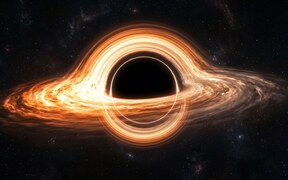
AI-generated illustration
For a named candidate completion of $3+1$ gravity coupled to the Standard Model (string theory, asymptotic safety, loop quantum gravity, causal dynamical triangulations, Horava gravity or another), derive a low-energy observable, at energies far below $E_P=\sqrt{\hbar c^5/G}$, approximately $1.2 \times 10^{19}$ GeV ($2 \times 10^{16}$ erg), whose predicted deviation from general relativity plus the Standard Model is computed with stated uncertainty and is within reach of current or planned measurements. An answer is a falsifiable prediction with a stated magnitude that distinguishes the candidate from the alternatives.
-
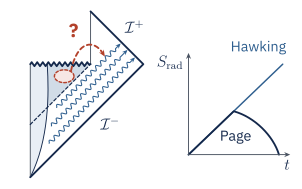
Microscopic mechanism that makes Hawking radiation carry information out
Partially resolved 78For a black hole formed by collapse in a UV-complete theory, the fine-grained entropy $S_{\mathrm{rad}}(t)$ of the radiation follows the Page curve, which the island formula $S = \min \operatorname{ext} [A(X) c^{3}/(4 G \hbar) + S_{\mathrm{bulk}}]$ reproduces semiclassically via replica wormholes. Identify the Lorentzian, microscopic mechanism (which degrees of freedom, which couplings) that transfers information into the outgoing quanta, and show how the Euclidean replica-wormhole saddles follow from it. An answer is a dynamical model or derivation in which the late radiation state is computed and its correlations with the early radiation are traced to specific interactions.
-
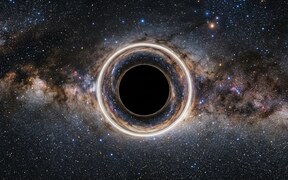
AI-generated illustration
Within a UV-complete theory, identify the sector of the Hilbert space that describes a 4D Schwarzschild black hole of mass $M$ and compute the logarithm of its dimension, reproducing $S = 4 \pi G M^2/(\hbar c)$ (entropy in units of $k_B$). An answer is a controlled microscopic count valid away from supersymmetry and extremality.
-
For a black hole past the Page time (when half the initial Bekenstein-Hawking entropy has been radiated), determine whether a freely falling observer crossing the horizon finds the local vacuum (mode occupation near zero for wavelengths much shorter than $r_s = 2GM/c^{2}$) or high-energy quanta up to the cutoff (a firewall). An answer specifies which assumption of the Almheiri-Marolf-Polchinski-Sully argument fails (unitary evaporation, local effective field theory outside the stretched horizon, a black hole that a distant observer describes as a quantum system with $\exp(S_{\mathrm{BH}})$ states, or a smooth horizon for an infalling observer), in a framework where the computation is controlled.
-
In a UV-complete framework, for example AdS/CFT for large AdS-Schwarzschild black holes, identify observables sensitive to the $r = 0$ spacelike singularity (such as the light-cone singularity of boundary correlators on a secondary sheet found by Fidkowski, Hubeny, Kleban and Shenker in 2004) and determine how finite-$N$ and finite-coupling effects modify them. An answer is an exact or controlled computation of such an observable showing whether the singularity is smoothed, replaced by a bounce, or remains an endpoint of semiclassical time.
-
Do remnant black hole ringdown tones match Kerr at percent precision?
Partially resolved 67For merger remnants, measure the complex frequencies of at least two independent quasinormal modes, for example $(l,m,n) = (2,2,0)$ together with $(2,2,1)$, $(3,3,0)$ or $(4,4,0)$, and constrain the fractional deviations $\delta f$ and $\delta \tau$ from Kerr values for a common mass and spin. The target is $\mid\delta f\mid, \mid\delta \tau\mid$ below 0.01. An answer is the measured deviations with uncertainties from a catalog of events.
-
For generic asymptotically flat initial data for the 3+1 vacuum Einstein equations (or Einstein equations with physically reasonable matter), prove that the maximal globally hyperbolic development has a complete future null infinity. An answer is a proof, or a counterexample that persists under an open set of perturbations of the data.
-
For the renormalization group flow of 4D gravity coupled to Standard Model matter, determine whether a non-Gaussian fixed point exists with finitely many UV-relevant directions, beyond truncations of the effective action, in Lorentzian signature and without ghosts in the full graviton propagator. An answer is a controlled demonstration (for example convergence across systematically enlarged truncations, or a lattice continuum limit) or a no-go result.
-
For a Schwarzschild black hole evaporating from $M \gg m_P=\sqrt{\hbar c/G}$, approximately $2.2 \times 10^{-5}\,\mathrm{g}$, determine the final state at $M \sim m_P$: complete evaporation with a pure final radiation state, a stable or long-lived remnant, a black-to-white-hole transition, or topology change. An answer is a classification derived in a UV-complete or otherwise controlled framework, giving the remnant mass and lifetime if any and the entropy carried by the final burst.
-
For massless minimally coupled scalars and perturbative gravitons on de Sitter space with Hubble rate H, loop corrections to correlators and to $\langle T_{ab}\rangle$ grow secularly as powers of H t or $\ln a$, with a the scale factor (Tsamis and Woodard; Polyakov 2012). Determine whether, after infrared resummation and in terms of gauge-invariant observables, back-reaction changes the local expansion rate or produces an instability, or whether the secular terms are gauge or resummation artifacts. An answer is a gauge-invariant computation of a local expansion observable with controlled infrared resummation and its late-time limit.
-
Consider a 4D asymptotically flat Schwarzschild black hole evaporating to null infinity, with dynamical massless gravity everywhere and no non-gravitating bath. Does the prescription S(R) = min ext_I [A(boundary of I) c^3/(4 G hbar) + S_bulk(R u I)] with a nontrivial island I give a well-defined, gauge-invariant entropy for a radiation region R that follows the Page curve? Answer yes with a construction of R and I compatible with the gravitational Gauss law, or no with a proof that islands require a massive graviton or a non-gravitating region.
-
How does a single unitary theory avoid wormhole-induced ensemble averaging?
Partially resolved 59In AdS/CFT, two decoupled boundary theories have a factorized partition function $Z(J1, J2) = Z(J1) Z(J2)$, while the bulk path integral includes connected wormhole saddles that do not factorize. Determine the bulk mechanism that restores factorization for a fixed (non-averaged) dual, such as $N=4$ super-Yang-Mills at large $N$, and its effect on the replica-wormhole derivation of the Page curve. An answer is a bulk computation, in a model with a single fixed dual, showing which contributions cancel the wormhole correlations and at what order in $\exp(-S)$.
-
For generic asymptotically flat vacuum (or reasonable matter) initial data in 3+1 dimensions, prove that the maximal development is asymptotically a finite collection of boosted Kerr black holes plus radiation, possibly with a dispersing part. An answer is a proof or a counterexample.
-
For Kerr the mass quadrupole moment is $Q=-J^{2}/(M c^{2})$ (in g cm^2). Using extreme mass-ratio inspirals (a stellar-mass body orbiting a supermassive black hole) observed by LISA over about $10^{5}$ orbital cycles, measure M, J and Q independently and test this relation; Barack and Cutler (2007) estimated fractional precision of about $10^{-4}\ \text{to}\ 10^{-2}$. An answer is the measured deviation of $Q$ from $-J^{2}/(M c^{2})$ with its uncertainty.
-
Are scalar-Gauss-Bonnet and higher-curvature theories well-posed in black hole mergers?
Partially resolved 57For Einstein-scalar-Gauss-Bonnet gravity, L = R/(16 pi G) - (1/2)(grad phi)^2 + alpha f(phi) $G_{\mathrm{GB}}$ with G_GB the Gauss-Bonnet invariant, and for general Horndeski theories, strong hyperbolicity holds in modified harmonic gauge at weak coupling (Kovacs and Reall 2020). Determine the maximal coupling $\alpha/M^2$ for which binary black hole evolutions stay strongly hyperbolic through merger, and whether effective-field-theory fixing of the equations converges to a unique answer as the fixing is removed. An answer is a theorem or convergent numerical evidence with the coupling threshold.
-
Compute the UV behavior of the four-graviton amplitude of $N=8$ supergravity at $L$ loops. At five loops the first divergence appears in critical dimension $D_{c}=24/5>4$ (Bern et al. 2018). Determine whether a divergence appears in $D=4$ at seven loops, where a counterterm compatible with the $E7(7)$ symmetry first exists, or at any higher loop; an answer is the coefficient of the first potential $D=4$ divergence or an all-loop finiteness proof.
-
Nonlinear stability of Kerr for all spins below extremal
Partially resolved 55Prove that the maximal development of asymptotically flat vacuum data close to subextremal $\operatorname{Kerr}(a_0, M_0), \mid a_0\mid < M_0$, has complete future null infinity and a domain of outer communication converging to a nearby $\operatorname{Kerr}(a_f, M_f)$. Residual question: confirm the 2026 proofs and close the gap between their data classes (structured data with polyhomogeneous expansions plus an O(r^-3-eps) remainder in one, structureless O(r^-3/2-delta) decay in the other).
-
For $3+1$ general relativity (vacuum or with a scalar field) quantized canonically, construct a physical inner product on solutions of the Hamiltonian and momentum constraints $H \Psi = 0, H_{i} \Psi = 0$, with a complete set of Dirac observables represented as self-adjoint operators, beyond minisuperspace truncations. An answer is a rigorous construction (for example group averaging with proven convergence) or a proof that none exists for a stated operator ordering and regularization.
-
For generic 3+1 vacuum solutions with a spacelike singularity, prove that spatial derivatives become negligible near the singularity, so that each spatial point evolves as an independent homogeneous Bianchi IX (mixmaster) cosmology with infinitely many Kasner epochs. An answer is a proof of these asymptotics for an open set of data, or a counterexample.
-
The Kerr/CFT correspondence reproduces $S = 2\pi J/\hbar$ for extremal Kerr via the Cardy formula with central charge $c_L = 12 J/\hbar$, and hidden conformal symmetry of low-frequency wave equations (2010) extends the Cardy match to non-extremal Kerr. Determine whether a unitary 2D CFT, or another quantum system, with these central charges exists whose states are the microstates of generic Kerr with $0 < a < M$. An answer is a construction or an obstruction (for example inconsistency of the boundary conditions or of modular invariance).
-
In Lorentz-invariant quantum field theory on a collapse Schwarzschild geometry of mass M, an outgoing mode of frequency $\omega \sim T_H$ at time t after collapse had, near the horizon and as measured in a frame falling freely across it, frequency $\sim \omega \exp(\kappa t)$ with $\kappa = c/(2 r_s)$, exceeding the Planck frequency after $t \sim (2 r_s/c) \ln(r_s/\ell_P)$, $\ell_P = (\hbar G/c^{3})^{1/2} \sim 1.6 \times 10^{-33}\,\mathrm{cm}$. Identify the mechanism that supplies these modes (dispersion in a preferred frame, mode creation in a growing lattice, Lorentz-invariant nonlocality, or a full quantum gravity calculation) consistent with present bounds on Lorentz violation, and determine whether it yields $T_H = \hbar c^{3}/(8 \pi G M)$ with corrections suppressed by powers of $\ell_P/r_s$. Formulating the question within a specified ultraviolet completion is part of the problem; an answer is the mechanism plus the leading correction to $T_H$.
-
For ghost-free (de Rham-Gabadadze-Tolley) massive gravity and bigravity with $m_g \sim \hbar H_0/c^2$, approximately $10^{-33}\,\mathrm{eV}/c^2$, the strong-coupling scale $\Lambda_3 = (m_g^2 M_P)^{(1/3)}$ corresponds to a length of roughly $10^3\,\mathrm{km}$. Determine whether the theory admits a Lorentz-invariant, unitary, causal UV completion compatible with S-matrix positivity bounds. An answer is an explicit completion or a no-go theorem.
-
Parametrize photon propagation as v(E) = c [1 - s ((n+1)/2) (E/E_QG,n)^n] with $s = +1$ (subluminal) or $-1$ (superluminal). Measure or bound E_QG,1 and E_QG,2 for both signs, and determine whether any candidate UV completion predicts a nonzero linear term consistent with these bounds. An answer is a detection of an energy-dependent arrival delay, or a demonstration that a given completion forbids linear Lorentz violation.
-
The averaged null energy condition, integral of $\langle T_{ab}\rangle k^{a} k^{b} d\lambda \ge 0$ along complete null geodesics with tangent $k^{a}$ and affine parameter $\lambda$, is proved for quantum field theory in Minkowski space (Faulkner, Leigh, Parrikar, Wang 2016) but fails on some curved backgrounds. Prove or refute the self-consistent achronal version (Graham and Olum 2007): for every achronal complete null geodesic in a solution of semiclassical gravity, the integral is non-negative. An answer is a proof for a stated class of field theories and spacetimes, or a counterexample that solves the semiclassical equations.
-
For the D1-D5-P black hole with $S = 2 \pi \sqrt{N1 N5 N_P}$, determine whether typical microstates are described by horizonless smooth or stringy geometries that differ from the black hole at the horizon scale. Known supergravity families (superstrata) have entropy growing parametrically slower than $S$. An answer is a count showing whether horizonless solutions, including string-scale ones, saturate $S$, or a proof that typical states are indistinguishable from the black hole outside a Planck-scale or string-scale neighborhood of the horizon.
-
Does quantum back-reaction forbid the formation of time machines?
Partially resolved 50For a spacetime that develops a compactly generated Cauchy horizon (chronology horizon) from regular initial data, the renormalized $\langle T_{ab}\rangle$ of a linear quantum field is not a well-defined distribution at certain base points of the horizon (Kay, Radzikowski, Wald 1997). Determine whether semiclassical or quantum gravitational dynamics generically prevents closed timelike curves from forming, given that the breakdown occurs within a Planck distance of the horizon where the semiclassical approximation itself fails. An answer is a theorem in a controlled approximation, or a model spacetime in which closed timelike curves form with bounded $\langle T_{ab}\rangle$ and curvature below the Planck scale.
-
For a nonspinning remnant of mass $M$ with a partially reflecting surface at areal radius $r_s+\delta$, echoes repeat with delay Delta t ~ (4 G M/c^3) |ln(delta/r_s)|; a surface one Planck length $l_P=\sqrt{G\hbar/c^3}$, approximately $1.6 \times 10^{-33}$ cm, of proper distance outside the horizon has $\delta\sim l_P^2/r_s$, so Delta t ~ (8 G M/c^3) ln(r_s/l_P). Determine whether data contain such echoes and bound the surface reflectivity $R$ as a function of the proper distance of the surface from the horizon, down to $l_P$. An answer is a detection or upper limits on R.
-
The $n = 1$ and $n = 2$ photon subrings of M87* produce universal interferometric signatures at long baselines (Johnson et al. 2020) and closely follow the Kerr critical curve, whose diameter stays within a few percent of $2\sqrt{27}\,G M/c^{2}$ for all spins and inclinations. Measure the $n = 1$ ring diameter and azimuthal shape to percent accuracy and test them against the Kerr critical curve. An answer is a measurement with baselines beyond about 20 G-lambda (space VLBI) and a stated consistency level.
-
Semiclassical gravity sets $G_{ab} = (8\pi G/c^4) \langle T_{ab}\rangle_{\omega}$ for a Hadamard state $\omega$. Determine conditions on $\omega$ and the spacetime (for example bounds on the fluctuation $\langle T_{ab} T_{cd}\rangle - \langle T_{ab}\rangle\langle T_{cd}\rangle$ relative to $\langle T_{ab}\rangle^2$, smeared over curvature-scale regions) under which solutions approximate the full quantum theory to leading order in $\hbar$, and give a well-posed initial value formulation that excludes higher-derivative runaway solutions. An answer is a theorem or a large-$N$ derivation with stated error bounds.
-
Chandrasekaran, Longo, Penington and Witten (2022) showed that adding an observer with a clock Hamiltonian to the de Sitter static patch yields a type $\mathrm{II}_1$ von Neumann algebra of gravitationally dressed observables as $G \to 0$, with a maximal-entropy state matching the Gibbons-Hawking entropy. Determine whether a consistent algebra with a trace (finite entropy) exists at higher orders in $G\hbar/c^{3}$, and whether the observer must be treated as a dynamical subsystem. An answer is a construction at second order or a demonstration of breakdown.