This browser is older than PubPhys supports. Every page can be read, but signing in to contribute, voting and signing need Safari 15.4, Chrome or Edge 99, Firefox 97 or newer. Browsers
All problems
1,762 problems
Starting order drafted by AI. Votes change it. How ranking works
-
AI-generated illustration
The physical parameter $\theta_{\mathrm{bar}} = \theta - \arg \det(M_{q})$ induces $d_{n} \sim 10^{-16}\ \theta_{\mathrm{bar}}\ e\ \mathrm{cm}$; the PSI bound $\mid d_{n}\mid < 1.8 \times 10^{-26}\ e\ \mathrm{cm}$ (90 percent CL, 2020) gives $\mid\theta_{\mathrm{bar}}\mid < \sim 10^{-10}$. An answer is a mechanism (Peccei-Quinn axion, massless up quark, spontaneous CP or P violation such as Nelson-Barr) consistent with lattice QCD and flavor data.
-
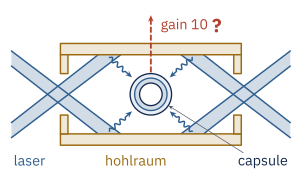
Target gain $G$ $= \text{fusion yield}/\text{laser energy}$ on target exceeded 1 at the National Ignition Facility in December 2022 with about $2.05 \times 10^{13}$ erg of laser energy. Determine whether $G$ of at least 10 is reachable at laser energy of about $2 \times 10^{13}$ to $3 \times 10^{13}$ erg by any design (indirect drive, direct drive, shock ignition, magnetized targets) given measured limits from hydrodynamic instabilities, ablator-fuel mix and drive asymmetry. An answer is an experiment, or a radiation-hydrodynamics design validated against existing ignition shots.
-
AI-generated illustration
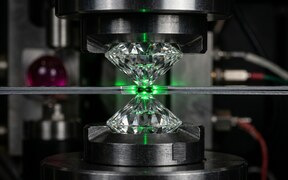
Determine whether any thermodynamically stable or long-lived metastable hydride has $T_c > 77\ \mathrm{K}$ at ambient pressure. An answer is a synthesized compound with zero resistance and diamagnetic shielding above 77 K at 1 bar, or a computational search with stated completeness showing none exists among a defined class.
-
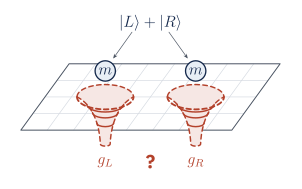
Determine whether the low-energy gravitational field of laboratory masses can exist in superpositions of distinct configurations and carry quantum information, or is a classical field coupled to quantum matter (mean-field semiclassical, stochastic classical-quantum, or collapse-based). An answer is an experimental result that excludes one class under stated assumptions, such as locality of the mediator.
-
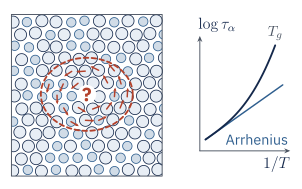
In molecular glass formers the structural relaxation time $\tau_\alpha(T)$ grows from about $10^{-12}\ \mathrm{s}$ in the high-temperature liquid to about $10^{2}\ \mathrm{s}$ at $T_g$, with an effective activation energy that increases on cooling; model liquids (Kob-Andersen Lennard-Jones mixture, polydisperse soft spheres) reproduce the onset of this growth. Competing explanations include random first-order transition theory (entropy-driven cooperative rearrangements), dynamic facilitation (kinetically constrained localized excitations) and elastic or frustration-based models. An answer is a theory that predicts $\tau_\alpha(T)$ and the associated growing length scales from the interaction potential and is singled out against the alternatives by equilibrium simulations near and below the experimental $T_g$. This is the root question of the topic; its working content is split into the sharper problems linked to it.
-
AI-generated illustration
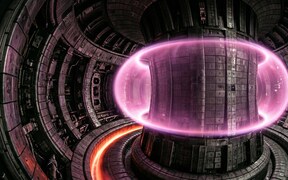
With alpha heating $P_\alpha$ proportional to $n^2 \langle\sigma v\rangle(T)$ and confinement degrading with power, determine whether high-gain ($Q$ of 10 or more) or ignited tokamak operating points are thermally stable and controllable with realistic actuators (fueling, auxiliary heating, impurity seeding), including profile self-organization and coupling to pedestal and density limits. An answer is the stable, controllable operating region from a validated integrated model.
-
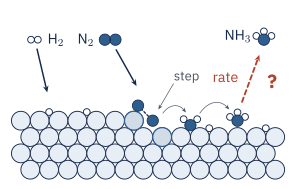
For benchmark heterogeneous reactions ($\mathrm{NH_3}$ synthesis on Ru(0001) step sites, CO oxidation on Pt(111), methanol synthesis on Cu/ZnO), predict the absolute turnover frequency under specified temperature and pressure within a factor of 10 from first-principles energetics and kinetic modeling with no fitted parameters. An answer is a protocol (electronic structure accuracy, treatment of coverage, entropy and site heterogeneity) meeting this target on several reactions.
-

AI-generated illustration
In Al/AlOx/Al Josephson junctions and in Nb, Ta and Al surface oxides, individual two-level defects resonant at 4-8 GHz couple to qubits through electric dipoles of order 1 e Angstrom and shift under applied strain and electric field. Identify the dominant atomic configuration (hydrogen or hydroxyl tunneling, oxygen vacancies, dangling bonds, trapped electrons) and predict its density, dipole moment, strain coupling and isotope dependence.
-
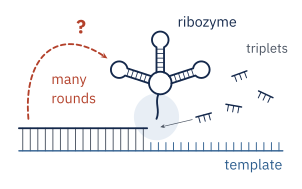
Sustained exponential self-replication by a polymerase ribozyme
Partially resolved 78A polymerase ribozyme of length $L$ must synthesize complete copies of itself and of its complementary strand with per-nucleotide fidelity $q$ satisfying $L(1 - q) < \ln(\sigma)$ (Eigen error threshold; $\sigma$ = selective advantage of the correct sequence), at yields that allow exponential growth over repeated cycles that include strand separation. QT45, a 45-nucleotide ribozyme (Gianni and co-workers, Science 2026), synthesizes its complementary strand from a random triplet pool at $q = 0.941$ and a copy of itself from defined triplet substrates, each at about 0.2% yield in 72 days in eutectic ice. Answer: yes or no, with a demonstrated system showing sustained exponential amplification of both strands over many rounds without defined oligomer feeds.
-
AI-generated illustration
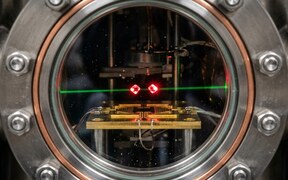
Two masses $m \sim 10^{-11}\,\mathrm{g}$, each in a spatial superposition of size $\Delta x \sim 2.5 \times 10^{-2}\,\mathrm{cm}$ at separation $d \sim 4.5 \times 10^{-2}\,\mathrm{cm}$, acquire branch-dependent phases $\phi = G m^{2} t / (\hbar d)$ over $t \sim 2.5\,\mathrm{s}$ (illustrative parameters of Bose et al. 2017, approximate). Demonstrate a positive entanglement witness (e.g. embedded-spin correlations) with Casimir-Polder and electromagnetic couplings suppressed below the gravitational one and decoherence rates below $1/t$.
-
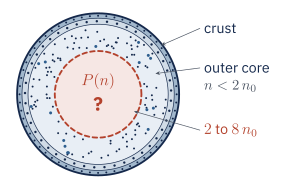
Pressure of neutron-star matter between two and eight times nuclear density
Partially resolved 78Determine the pressure $P(n)$ of cold beta-equilibrated matter for baryon density n between $2\,n_0$ and $8\,n_0$ ($n_0 = 0.16\,\mathrm{fm}^{-3}$) with 10 percent uncertainty, combining chiral EFT below about $2\,n_0$, perturbative QCD above about $40\,n_0$, pulsar masses, NICER (X-ray timing telescope) radii and gravitational-wave tidal deformabilities. Answer: a $P(n)$ band with stated priors.
-
AI-generated illustration
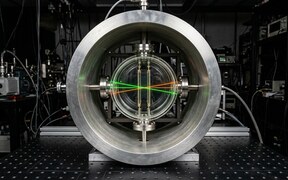
Current bound $\mid d_{e}\mid < 4.1 \times 10^{-30}\,e\,\mathrm{cm}$ (90% CL, JILA HfF+, 2023), with the Standard Model contribution many orders smaller. Determine whether $d_{e}$ (or the equivalent electron-nucleon coupling $C_{\mathrm{S}}$) is nonzero at the $10^{-31}\,e\,\mathrm{cm}$ level using polar molecules (ThO, ThF+, YbOH, BaF or others).
-
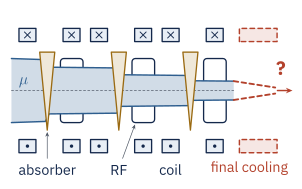
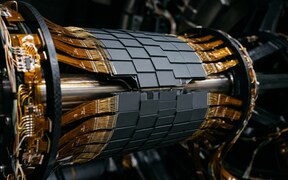
Transverse ionization cooling of muons through a single absorber was demonstrated by MICE (published 2020). Determine whether a realistic 6D cooling channel plus final cooling stage can reach normalized transverse emittance of approximately $2.5 \times 10^{-3}$ cm and longitudinal emittance of approximately $7\,\mathrm{cm}$ with overall muon transmission above $\sim 10$ percent, including RF limits in solenoid fields, absorber heating, space charge and muon decay.
-
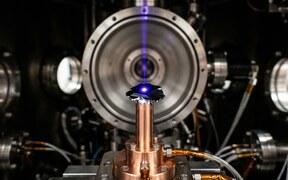
AI-generated illustration
What is the pseudogap state of underdoped cuprates?
Contested 78Identify the state below $T*(p)$ in hole-doped cuprates for $p < p* \sim 0.19$: a broken-symmetry phase (intra-unit-cell loop currents, nematic order, pair density wave, fluctuating antiferromagnet), a fractionalized metal with small Fermi pockets ($\mathrm{FL}*$), or a crossover. An answer specifies the order parameter or topological character and accounts for the Fermi arcs, the Knight-shift suppression, and the drop of Hall carrier density from $1+p$ to p near $p*$.
-
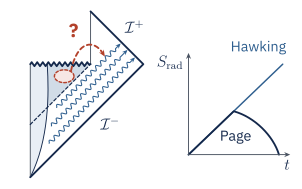
Microscopic mechanism that makes Hawking radiation carry information out
Partially resolved 78For a black hole formed by collapse in a UV-complete theory, the fine-grained entropy $S_{\mathrm{rad}}(t)$ of the radiation follows the Page curve, which the island formula $S = \min \operatorname{ext} [A(X) c^{3}/(4 G \hbar) + S_{\mathrm{bulk}}]$ reproduces semiclassically via replica wormholes. Identify the Lorentzian, microscopic mechanism (which degrees of freedom, which couplings) that transfers information into the outgoing quanta, and show how the Euclidean replica-wormhole saddles follow from it. An answer is a dynamical model or derivation in which the late radiation state is computed and its correlations with the early radiation are traced to specific interactions.
-
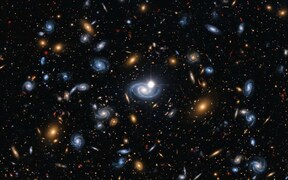
AI-generated illustration
Find a quantum system whose observables compute those of quantum gravity in asymptotically de Sitter space, for example a Euclidean CFT at future infinity (dS/CFT, Strominger 2001), a static-patch or horizon dual, or double-scaled SYK, reproducing at least the Gibbons-Hawking entropy and the tree-level wavefunction of the universe.
-
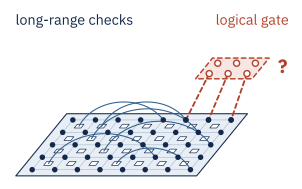
Low-overhead universal logical gates on constant-rate qLDPC codes
Partially resolved 78For a constant-rate qLDPC family with distance d, give a fault-tolerant implementation of a universal logical gate set (all logical Clifford gates plus one non-Clifford gate on any chosen logical qubits) that uses O(n) ancilla qubits, has space-time cost per logical gate O(d polylog d), and has a threshold under circuit-level noise. Candidate ingredients include code surgery, code automorphisms and codes with transversal CCZ.
-

AI-generated illustration
Compute the pressure $P(T,\mu_{B})$ and the chiral transition line of $2+1$-flavor QCD at physical quark masses for $\mu_{B}/T$ between 3 and 6 with controlled continuum extrapolation, despite the complex fermion determinant. Answer: $P$ and $T_{\mathrm{pc}}(\mu_{B})$ with percent-level uncertainty, by any method (reweighting, Taylor expansion, imaginary $\mu_{B}$, complex Langevin, Lefschetz thimbles) validated against established results at $\mu_{B}/T<2$.
-
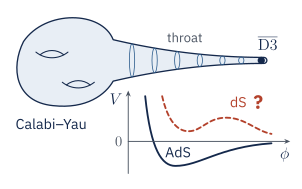
Determine whether there exist solutions of string theory, with $\alpha'$ and $g_s$ corrections under control, whose 4D effective potential has a local minimum with $V > 0$ and lifetime longer than the Hubble time, such as KKLT or Large Volume Scenario constructions in type IIB orientifolds with anti-D3-brane uplift.
-
AI-generated illustration
Is dark matter the QCD axion?
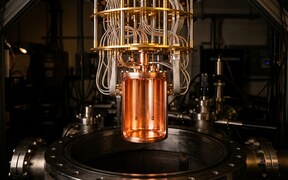
Open 77Does a QCD axion with mass $m_a$ in roughly $10^{-6} \text{ to } 10^{-3}\, \mathrm{eV}$ and photon coupling $g_a-\gamma$ on the KSVZ or DFSZ model bands constitute $\Omega_c$? An answer is a haloscope or helioscope detection at a fixed frequency $\nu = m_a c^2 / h$ with the predicted coupling, or exclusion of the DFSZ band over the mass range favored by post-inflationary production.
-
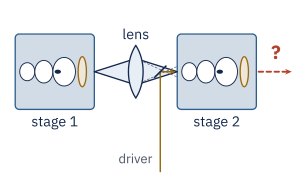
Between stages the strongly focused beam diverges and must be refocused, producing chromatic emittance growth $(\Delta \epsilon/\epsilon)^2 \sim (W \sigma_{\delta})^2$ with chromatic amplitude $W \sim \beta_{\mathrm{lens}}/f$. Demonstrate acceleration through at least two independently driven stages with charge coupling above 90 percent, normalized emittance growth below 10 percent and rms energy spread below 1 percent, or show it is impossible with known optics. An answer is an experiment or a proof of a fundamental limit.
-
AI-generated illustration
The SM Yukawa couplings span $y_e \sim 3 \times 10^{-6}$ to $y_t \sim 1$, CKM angles are small ($\theta_C \sim 0.23$, $\mid V_{ub}\mid$ $\sim 4 \times 10^{-3}$) while PMNS angles are large ($\theta_{12} \sim 34\,\mathrm{deg}$, $\theta_{23} \sim 45\,\mathrm{deg}$). An answer is a mechanism (Froggatt-Nielsen charges, modular or discrete flavor symmetries, extra-dimensional localization, partial compositeness) that predicts these values with fewer parameters than it explains.
-
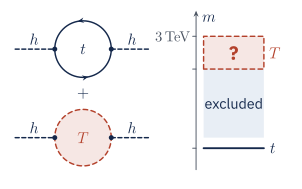
Determine whether colored states that cancel the top-loop contribution to $m_h^2$ (scalar stops in supersymmetry, vector-like fermionic top partners in composite-Higgs models) exist with mass $m_T < \sim 3\ \mathrm{TeV}$. Current LHC 13 TeV limits exclude stops up to about 1.2 to 1.3 TeV for a light neutralino and vector-like top partners up to roughly 1.5 TeV (approximate, model dependent).
-
AI-generated illustration
Is the AMOC already weakening toward collapse today?
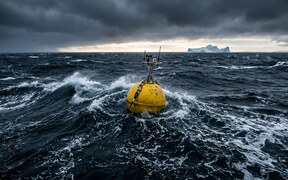
Contested 76Using the RAPID array (since 2004), other transport arrays and proxy reconstructions (sea-surface temperature fingerprints, sediment grain size), determine whether the AMOC has declined since the mid-20th century beyond natural variability and whether early-warning indicators (rising variance and autocorrelation, freshwater-transport sign at 34 S) are physically valid for this system. An answer is a detected or rejected trend and stability-loss signal with stated confidence.
-
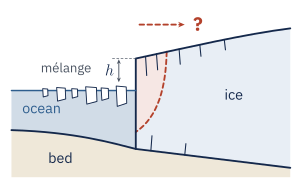
Determine whether ice cliffs with subaerial height above about 100 m fail faster than ice flow can replace them, producing self-sustained retreat into deepening basins, and whether this marine ice-cliff instability (MICI) is required to explain past sea-level highstands. An answer is a validated calving law for tall cliffs, including brittle and viscous failure and buttressing by melange (a mix of icebergs and sea ice), applied to Thwaites-type geometries.
-
AI-generated illustration
Identify the mechanism by which mean dose rates above roughly $4000\ \mathrm{rad}/\mathrm{s}$ ($1\ \mathrm{rad} = 100\ \mathrm{erg}/\mathrm{g}$), delivered in under $200\ \mathrm{ms}$, raise normal-tissue tolerance at fixed total dose (typically $1000\ \text{to}\ 3000\ \mathrm{rad}$ single fraction) without a matching rise in tumour tolerance. Candidate classes: transient radiolytic oxygen depletion, inter-track radical-radical recombination altering peroxidation yields, differential iron and labile metal pools, immune and vascular responses. An answer is a quantitative model reproducing the measured sparing as a function of dose, dose rate, pulse structure and tissue oxygen tension.
-
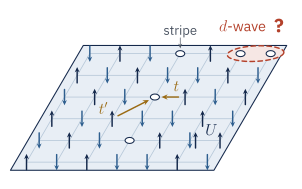
For the square-lattice $t-t'-U$ Hubbard model with $t'/t \sim -0.2\ \text{to}\ -0.3$ and $U/t = 8$, determine the ground-state phase diagram versus hole and electron doping in the thermodynamic limit: presence, magnitude and symmetry of the superconducting order parameter and its coexistence with partially filled stripes or Neel order. An answer is a phase diagram with extrapolated order parameters and an estimate of $T_c/t$.
-
AI-generated illustration
For graphite and lithium-metal anodes in carbonate electrolytes (for example 1 mol/L $\mathrm{LiPF_6}$ in ethylene carbonate and ethyl methyl carbonate), determine the nanoscale arrangement of inorganic (LiF, $\mathrm{Li_2CO_3}$, $\mathrm{Li_2O}$) and organic phases in the solid-electrolyte interphase (SEI), the transport process that sustains its growth (electron tunneling, neutral lithium interstitial diffusion, solvent diffusion through pores), and the resulting thickness law $L(t)$, often reported near $t^{1/2}$. An answer is a model with first-principles rate parameters that predicts $L(t)$ and the measured calendar-aging capacity loss.
-
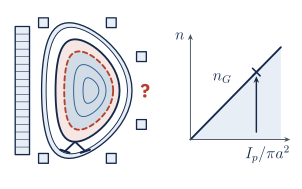
Discharges disrupt or return to L-mode when line-averaged density approaches the Greenwald density $n_G = 10^{14}\,\mathrm{cm}^{-3} x (I_p / 1\,\mathrm{MA}) / (\pi (a / 100\,\mathrm{cm})^2)$, with $I_p$ the plasma current and a the minor radius. Identify the mechanism (edge turbulence transition at critical collisionality or adiabaticity, radiative collapse and MARFE formation, tearing-island growth, plasma-wall self-organization) and derive whether the maximum density scales with heating power and wall conditions. An answer is a predictive criterion validated on several devices, including cases with $n/n_G$ above 1.
-
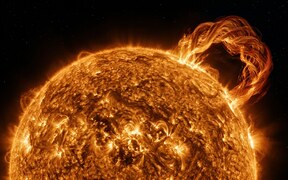
AI-generated illustration
Predict the time series of the north-south interplanetary magnetic field component $B_z$ inside a CME at $1\,\mathrm{au}$ from observations at or near the Sun (photospheric magnetograms, coronagraph images), including rotation, deflection and erosion during propagation. An answer is a forecast method that achieves skill above climatology in $B_z$ sign and magnitude with lead time of a day or more.