This browser is older than PubPhys supports. Every page can be read, but signing in to contribute, voting and signing need Safari 15.4, Chrome or Edge 99, Firefox 97 or newer. Browsers
All problems
1,762 problems
Starting order drafted by AI. Votes change it. How ranking works
-
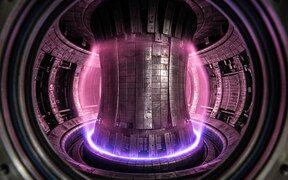
AI-generated illustration
Predicting pedestal pressure height and width in reactor conditions
Partially resolved 72Pedestal models of the EPED type combine the ideal peeling-ballooning stability limit with a kinetic-ballooning-mode constraint on pedestal width (width ~ beta_pol,ped^0.5) to predict the pedestal pressure $p_{\mathrm{ped}}$. Determine what additional physics (separatrix density and neutral fueling, microtearing or electron-temperature-gradient transport, resistive and diamagnetic effects) is needed to predict $p_{\mathrm{ped}}$ to within 20 percent at high separatrix density, high gas fueling and metal walls, and give the prediction for ITER $Q = 10$. An answer is a model validated on at least three devices including a metal-wall one.
-
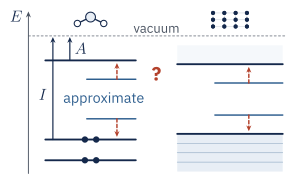
Find a generalized Kohn-Sham functional with no system-specific tuning that gives the fundamental gap $I - A$ ($I = \text{ionization energy}, A = \text{electron affinity}$) of molecules (the GW100 set of ionization potentials and electron affinities and similar sets) and the band gap of semiconductors and insulators (Si to LiF) with mean absolute error below $0.2\,\mathrm{eV}$. An answer is such a functional or an argument that tuning-free accuracy at this level requires orbital-dependent nonlocal terms of a specified type.
-
AI-generated illustration
Measure the PMNS phase $\delta_{\mathrm{CP}}$ and determine whether $\sin(\delta_{\mathrm{CP}}) \ne 0$ at $\ge 5\sigma$ using $\nu_{\mu} \to \nu_e$ versus $\mathrm{anti}-\nu_{\mu} \to \mathrm{anti}-\nu_{e}$ appearance. Answer: $\delta_{\mathrm{CP}}$ with uncertainty $\sim 10\text{ to }20\ \mathrm{deg}$ and the yes-no CP verdict.
-
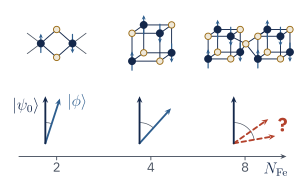
For strongly correlated molecules and clusters (e.g. iron-sulfur clusters with $N_{\mathrm{Fe}}$ iron atoms), determine how the maximal overlap $\mid\langle \phi \mid \psi_0\rangle\mid^2$ between the ground state $\psi_0$ and states $\phi$ preparable classically in poly time (bounded-bond-dimension MPS, broken-symmetry determinants and short sums of them) scales with system size; exponential decay would remove the exponential advantage of phase estimation.
-

AI-generated illustration
Rate-and-state friction predicts a quasi-static nucleation zone of size $L_c \sim G D_c/(\sigma (b - a))$ before dynamic rupture. Determine whether earthquakes with $M \ge 7$ are systematically preceded by aseismic slip or foreshock sequences distinguishable from ETAS background clustering (ETAS: a statistical model in which every earthquake can trigger later ones) at amplitudes above present geodetic and seismic detection thresholds. An answer is a statistically significant catalog-wide test.
-
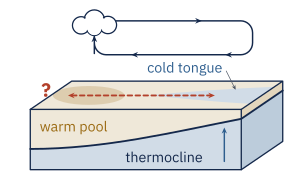
Determine the sign and magnitude of change in ENSO amplitude, frequency and spatial pattern under greenhouse warming, and resolve why the observed 1980 to 2020 eastern equatorial Pacific cooling trend and strengthened zonal SST gradient differ from the warming in most CMIP models. An answer is a projected change with mechanisms (thermocline, zonal advective and Ekman feedbacks) constrained by observations and paleo records.
-

AI-generated illustration
Predicting neural scaling-law exponents from properties of the data
Partially resolved 72For a deep network trained in the feature-learning regime on natural data, the test loss follows $L($$N$, $D$$) = L_{\infty} + A N^{-\beta_N} + B D^{-\beta_D}$ over several decades, with N parameters and D training examples or tokens. Derive $\beta_N, \beta_D$ and the compute-optimal allocation exponent from measurable statistics of the data distribution (for example the power-law decay exponent of the data covariance spectrum or of the target function's spectral decomposition). An answer is a theory that predicts measured exponents on a held-out dataset and architecture within quoted errors, or a proof that no data statistic of this kind fixes them.
-
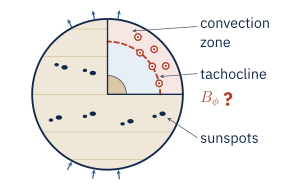
Determine whether the solar cycle is a Babcock-Leighton flux-transport dynamo with toroidal (east-west) field generated and stored in the tachocline ($r \sim 0.7\,R_{\mathrm{sun}}$) or a distributed dynamo in the convection zone. Answer: a model reproducing the butterfly diagram, the 22-year magnetic cycle period, polar-field reversal and helioseismic flows.
-
Two-dimensional square-lattice Fermi-Hubbard model, $U/t = 6\ \text{to}\ 8$, hole doping $\delta = 0.1\ \text{to}\ 0.2$, nearest-neighbour hopping $t$ and optional next-nearest hopping $t'$. Measure the d-wave pair correlation $P_d(r) = \langle \Delta_d^{\mathrm{dag}}(r) \Delta_d(0)\rangle$, with $\Delta_d(r)$ the d-wave singlet pair operator on the four bonds of site r, by quantum gas microscopy or pair-transport protocols at the lowest achievable $T/t$. True long-range order is excluded at $T > 0$ in 2D, so the answer is whether $P_d(r)$ decays algebraically below a Kosterlitz-Thouless temperature $T_{\mathrm{KT}}$, or at least has a correlation length above 10 lattice sites, together with the temperature and entropy at which this appears.
-
For every compact simple gauge group $G$ ($SU(2)$ is the minimal case), construct a quantum Yang-Mills theory on $R^4$ satisfying the Osterwalder-Schrader or Wightman axioms, and prove a mass gap: the Hamiltonian $H$ has spectrum contained in $\{0\}\cup[\Delta, \infty)$ for some $\Delta > 0$. Answer: a proof of both statements (Jaffe-Witten formulation for the Clay Mathematics Institute).
-
For Ta- or Nb-based transmons with $T_{1}$ from $\sim 0.3\,\mathrm{ms}$ to above $1\,\mathrm{ms}$ at $\sim 4-5\,\mathrm{GHz}$ on sapphire or high-resistivity Si, determine the loss tangents $\tan \delta_{i}$ and participation ratios $p_{i}$ of the metal-air, metal-substrate, substrate-air, substrate bulk and junction regions, and identify which term dominates $1/Q = \sum_{i} p_{i}\tan \delta_{i}$ plus non-dielectric channels.
-
In fusion-based quantum computation with linear optics, entangled resource states of bounded size are joined by probabilistic two-photon fusion measurements (success probability $1/2$ without ancilla boosting), and each photon is lost with probability $\eta_L$. Determine the supremum of $\eta_L$ for which a fault-tolerance threshold exists, as a function of resource-state size and fusion boosting, and decide whether loss tolerance well above the $10.4\%$ loss per fusion reported for a ballistic scheme by Bartolucci et al. (arXiv:2101.09310, 2021) is reachable with bounded-size resource states.
-
Measure $\kappa_{\lambda} = \lambda_3/\lambda_3^{\mathrm{SM}}$, where the SM gives $\lambda_3 = m_h^2/(2 v^2) \sim 0.13$ for the cubic term $\lambda_3 v h^3$. An answer is $\kappa_{\lambda}$ with total uncertainty below about 0.3 (30 percent), sufficient to distinguish the SM from models with a strongly first-order phase transition.
-
The quiet corona requires an energy flux of $\sim 3 \times 10^{5}\ \mathrm{erg}\ \mathrm{cm}^{-2}\ \mathrm{s}^{-1}$ and active regions $\sim 10^{7}\ \mathrm{erg}\ \mathrm{cm}^{-2}\ \mathrm{s}^{-1}$. Determine the dominant dissipation mechanism: Alfven-wave turbulence, resonant absorption and phase mixing of waves, or nanoflares (small reconnection events) in braided fields. Answer: mechanisms with energy fluxes matching these requirements, by region type.
-
Predicting the friction coefficient from multi-asperity contact mechanics
Partially resolved 71For two elastic or elastoplastic surfaces with self-affine roughness (Hurst exponent H, rms slope), derive the static friction $F = \mu_s N$ with $\mu_s$ independent of apparent area and load, combining the real contact area $A_r(N)$ and the shear strength $\tau_j$ of single junctions. An answer predicts $\mu_s$ from bulk and interfacial material parameters within experimental scatter for specified material pairs.
-
Measure the subhalo and line-of-sight halo mass function $dn/dM$ over $M = 10^{6}\text{ to }10^{9}\ M_{\mathrm{sun}}$. CDM predicts dn/dM ~ M^-1.9 with no cutoff above $\sim 10^{-6}\ M_{\mathrm{sun}}$; warm, fuzzy or interacting dark matter predict suppression below a half-mode mass $M_{\mathrm{hm}}$. An answer is a measured amplitude and slope or a bound on $M_{\mathrm{hm}}$ from strong-lens flux ratios, gravitational imaging and stellar-stream gaps, with the density profiles of detected clumps.
-
Give a protocol using $\operatorname{poly}(N)$ measurements and $\operatorname{poly}(N)$ classical post-processing (for example Hamiltonian learning, time-reversal echoes, cross-platform comparison of randomized measurements) that bounds the error of local observables of the prepared state relative to the ideal Hamiltonian, for $N > 100$ in a regime where classical simulation is believed hard. Answer: protocol with a proof of soundness and an experimental demonstration.
-
In Si/SiGe and Si-MOS quantum-dot qubits, charge noise with $S_E(1\,\mathrm{Hz})^{1/2}$ of order $0.1-1\,\text{micro-eV}/\mathrm{Hz}^{1/2}$ and spectral exponent near 1 limits dephasing and two-qubit gate fidelity, with temperature and frequency dependence that vary between devices. Identify the fluctuator ensemble (defects in gate oxides, in the SiGe barrier, or at interfaces) and its location, using noise correlations between neighboring dots and dependence on the gate stack.
-
Microscopic origin of 1/f flux noise in SQUIDs and qubits
Partially resolved 71Low-frequency flux noise $S_{\Phi}(1\,\mathrm{Hz})^{1/2} \sim 1-10\,\mathrm{micro}-\Phi_0/\mathrm{Hz}^{1/2}$ ($\Phi_0=hc/2e$), weakly dependent on loop area, is attributed to surface spins of density $\sim 5 \times 10^{13}\,\mathrm{cm}^{-2}$ (Koch, DiVincenzo and Clarke 2007). Identify the spin species (adsorbed $\mathrm{O_2}$, hydrogen, dangling bonds) and the dynamics producing $1/f$ (spin clusters, spin-glass dynamics, spin diffusion), consistent with the measured temperature dependence and the correlation between flux noise and inductance noise.
-
For lattice models with purely repulsive interactions (Hubbard-type, bandwidth $W=8t$ on the square lattice), determine the maximum $T_c/t$ over interaction strength, filling and lattice geometry, and whether it exceeds the cuprate value $T_c/t\sim 0.03$. An answer is controlled numerical $T_c$ values with error bars, or a bound.
-
For controlled-Z gates between alkali or alkaline-earth atoms in optical tweezers using the Rydberg blockade, the error has contributions from radiative and blackbody-induced decay of the Rydberg state (lifetime $\tau_R$ of order $10^{-4}\,\mathrm{s}$ at 300 K for principal quantum number $n \sim 50-70$, approximate), finite blockade shift $B$ relative to the Rabi frequency, laser phase and intensity noise, and atomic motion. Determine the lowest achievable two-qubit error once all intrinsic contributions are minimized jointly over pulse shape and gate time, and decide whether errors $\le 10^{-4}$ are reachable at room temperature or require cryogenic environments or conversion of errors into detectable erasures.
-
LEP Z-width data give $N_\nu = 2.9963 \pm 0.0074$ light neutrino species after the 2020 luminosity correction (Janot and Jadach), and Higgs production rates exclude a fourth sequential chiral generation. An answer is a principle (anomaly cancellation in an extended gauge group, string compactification topology, or a symmetry argument) that requires $N_{\mathrm{g}} = 3$ and makes a further testable prediction.
-
Do first-principles 3D models reproduce observed supernova energies?
Partially resolved 71In $3\mathrm{D}$ neutrino-radiation hydrodynamics with general relativity and energy-dependent neutrino transport, determine whether the delayed neutrino-heating mechanism reaches asymptotic explosion energies $\sim 10^{51}\,\mathrm{erg}$ and Ni-56 masses $\sim 0.01\ \text{to}\ 0.1\,M_{\mathrm{sun}}$ (median $\sim 0.03\,M_{\mathrm{sun}}$) for progenitors of $9\ \text{to}\ 25\,M_{\mathrm{sun}}$, as observed in Type II-P supernovae. Answer: converged energies and Ni-56 masses versus progenitor, with dependence on resolution and transport method quantified.
-
$H = \sum_i J S_i . S_{i+1} + h_i S^{z}_i$ with $h_i$ independent and uniform in $[-W, W]$. Does a $W_c < \infty$ exist such that for $W > W_c$ infinite-temperature eigenstates obey an area law and local memory of the initial state persists as $t \to \infty$, in the limit $L \to \infty$? Answer yes or no, with an estimate or bound on $W_c$.
-
What stabilizes ferroelectricity and wake-up in thin-film $\mathrm{HfO_2}$?
Partially resolved 70Doped (Si, Zr, La, Y) $\mathrm{HfO_2}$ films of thickness about $5 \times 10^{-7}$ to $2 \times 10^{-6}$ cm show remanent polarization of order $3 \times 10^{4} \text{ to } 9 \times 10^{4}\,\mathrm{statC}/\mathrm{cm}^{2}$, attributed mainly to the metastable orthorhombic $\mathrm{Pca2}_{1}$ phase. Determine which factors stabilize it (surface and grain-boundary energy, dopants, oxygen vacancies, stress, electrodes), whether other polar phases contribute, and the mechanism of wake-up and fatigue (oxygen-vacancy redistribution versus field-induced transformation from tetragonal or monoclinic grains). An answer is a phase-stability and switching model predicting remanent polarization versus thickness, dopant and cycle number.
-
How life came to use only one molecular handedness
Contested 70Identify the symmetry-breaking event (a deterministic bias such as weak-interaction parity violation, circularly polarized light, or spin-polarized electrons from magnetic minerals; or spontaneous symmetry breaking) and the amplification mechanism (autocatalysis, crystallization, polymerization selectivity) that took a near-racemic prebiotic pool to enantiomeric excess $\mathrm{ee} > 0.99$ in nucleotides and amino acids. Answer: a demonstrated, prebiotically plausible pathway.
-
Derive and validate a parameterization of basal melt rate m as a function of far-field temperature, salinity and current speed under ice shelves, covering shear-driven and convective, double-diffusive regimes of the ice-ocean boundary layer and the effect of basal channels and crevasses. An answer is a melt law tested against direct under-ice observations to within a factor of order unity across regimes.
-
Find a task executable by circuits of depth $O(\operatorname{polylog} n)$ on $n \le 10^{3}$ qubits with two-qubit gate error $\sim 10^{-3}$ and no error correction such that (i) a classical verifier checks the output in $\operatorname{poly}(n)$ time, (ii) the task is classically hard under a standard assumption such as learning with errors, and (iii) soundness holds at the output fidelity actually achievable. Answer: a protocol with all three properties, or a no-go result relating verifiability, noise rate and depth.
-
Measure the local bispectrum amplitude $f_{\mathrm{NL}}^{\mathrm{local}}$; Planck 2018 gives $f_{\mathrm{NL}}^{\mathrm{local}} = -0.9 \pm 5.1$. Single-field inflation predicts $\left|f_{\mathrm{NL}}^{\mathrm{local}}\right| \ll 1$ in the squeezed limit; many multi-field models give $\left|f_{\mathrm{NL}}^{\mathrm{local}}\right| \ge 1$. An answer is $f_{\mathrm{NL}}^{\mathrm{local}}$ with $\sigma$ below 0.5 from scale-dependent galaxy bias and CMB.
-
For a machine-learned exchange-correlation functional trained only on main-group molecular data, determine its errors on out-of-distribution sets: 3d transition-metal reaction energies and spin gaps, lattice constants and cohesive energies of metals, and band gaps of solids, relative to the best conventional hybrid. An answer is a quantitative transfer test, or a training principle (exact constraints, data types) shown to guarantee transfer.