This browser is older than PubPhys supports. Every page can be read, but signing in to contribute, voting and signing need Safari 15.4, Chrome or Edge 99, Firefox 97 or newer. Browsers
All problems
322 problems
Starting order drafted by AI. Votes change it. How ranking works
-
AI-generated illustration
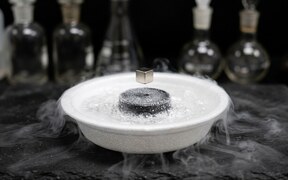
Determine whether any thermodynamically stable or long-lived metastable material has $T_c \ge 300\ \mathrm{K}$ at ambient pressure. The ambient-pressure record is 151 K in pressure-quenched HgBa2Ca2Cu3O8+d (2026). An answer is a reproduced zero-resistance and Meissner measurement above 300 K at 1 bar, or a proof that a defined class of realistic materials cannot exceed a stated $T_c$ below 300 K.
-
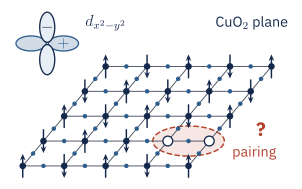
Identify the dominant pairing interaction behind $d_{(x^{2}-y^{2})}$ superconductivity in hole-doped $\mathrm{CuO_2}$ planes (candidates: antiferromagnetic superexchange $J \sim 0.13\ \mathrm{eV}$ and spin fluctuations, charge-transfer fluctuations, phonons, or a combination). An answer is a microscopic mechanism that predicts $T_c(p)$ and the gap magnitude across cuprate families within a factor of order one and passes material-specific tests (isotope effect, pressure dependence, family dependence of $T_c,\mathrm{max}$).
-
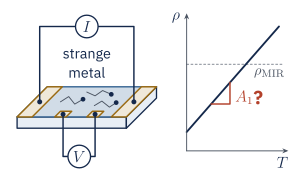
Explain $\rho(T) = \rho_0 + A_1 T$ persisting from T well below the Fermi temperature up to and beyond the Mott-Ioffe-Regel limit without saturation, near quantum critical points in cuprates ($p \sim p*$), $\mathrm{YbRh_2Si_2}$ and other materials. An answer is a controlled theory of a metal without long-lived quasiparticles in two or three dimensions that yields T-linear resistivity with the measured slope $A_1$ and its doping or field dependence.
-
AI-generated illustration
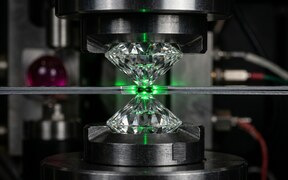
Determine whether any thermodynamically stable or long-lived metastable hydride has $T_c > 77\ \mathrm{K}$ at ambient pressure. An answer is a synthesized compound with zero resistance and diamagnetic shielding above 77 K at 1 bar, or a computational search with stated completeness showing none exists among a defined class.
-
AI-generated illustration
In Al/AlOx/Al Josephson junctions and in Nb, Ta and Al surface oxides, individual two-level defects resonant at 4-8 GHz couple to qubits through electric dipoles of order 1 e Angstrom and shift under applied strain and electric field. Identify the dominant atomic configuration (hydrogen or hydroxyl tunneling, oxygen vacancies, dangling bonds, trapped electrons) and predict its density, dipole moment, strain coupling and isotope dependence.
-
AI-generated illustration
What is the pseudogap state of underdoped cuprates?
Contested 78Identify the state below $T*(p)$ in hole-doped cuprates for $p < p* \sim 0.19$: a broken-symmetry phase (intra-unit-cell loop currents, nematic order, pair density wave, fluctuating antiferromagnet), a fractionalized metal with small Fermi pockets ($\mathrm{FL}*$), or a crossover. An answer specifies the order parameter or topological character and accounts for the Fermi arcs, the Knight-shift suppression, and the drop of Hall carrier density from $1+p$ to p near $p*$.
-
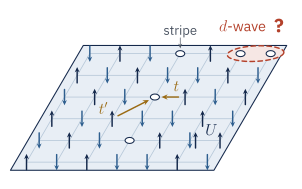
For the square-lattice $t-t'-U$ Hubbard model with $t'/t \sim -0.2\ \text{to}\ -0.3$ and $U/t = 8$, determine the ground-state phase diagram versus hole and electron doping in the thermodynamic limit: presence, magnitude and symmetry of the superconducting order parameter and its coexistence with partially filled stripes or Neel order. An answer is a phase diagram with extrapolated order parameters and an estimate of $T_c/t$.
-

AI-generated illustration
In FCC single crystals (Cu, Al, Ni) the stage II hardening rate $\theta_{II} = d \tau / d \gamma$ is of order $\mu/200$ to $\mu/300$ ($\mu$ the shear modulus), nearly independent of material and temperature, and dislocation cells obey the similitude relation $\Lambda = K \mu b / \tau$ with $K$ of order 10 ($b$ the Burgers vector). Derive $\theta_{II}$ and the emergence and wavelength of cell structures from discrete or continuum dislocation dynamics without fitted hardening parameters. An answer is computed $\theta_{II}/\mu$ and $K$ within 20 percent of experiment.
-
AI-generated illustration
Determine the dominant mobile species (halide vacancies, halide interstitials, organic cations) in MAPbI3 and FAPbI3 under operation, their densities and activation energies (reported values span approximately 0.1 to 0.6 eV), and the mechanism of light-enhanced ionic conductivity. Measurements must separate ionic from electronic signals (e.g. impedance with tracer diffusion) and be matched to first-principles migration barriers. An answer is the identified species with activation energies and the photo-enhancement mechanism.
-
AI-generated illustration
In a Fabry-Perot interferometer at $\nu = 5/2$ (GaAs) or at even-denominator states in bilayer graphene, demonstrate the even-odd effect: Aharonov-Bohm oscillations of $e/4$ quasiparticles vanish when the enclosed number of $e/4$ quasiparticles is odd and reappear, with phase shifts given by Ising braiding, when it is even. An answer is reproducible data in independent devices that exclude Coulomb-dominated and Abelian explanations.
-
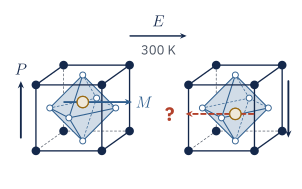
Identify a single-phase compound with ferroelectric polarization above about $3 \times 10^{3}\ \mathrm{statC}/\mathrm{cm}^{2}$ and net magnetization above $10\ \mathrm{emu}/\mathrm{cm}^{3}$ at $T = 300\ \mathrm{K}$, in which an electric field deterministically reverses (or rotates by $90\ \text{degrees}$) the magnetization. An answer is a material with measured $P$, $M$ and demonstrated electric-field reversal of $M$ at $300\ \mathrm{K}$ without a ferromagnetic overlayer.
-
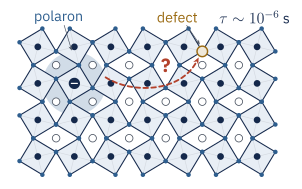
In MAPbI3, FAPbI3 and $\mathrm{CsPbBr_3}$, nonradiative lifetimes reach about $10^{-6}$ s at trap densities of order $10^{15}\ \text{to}\ 10^{16}\,\mathrm{cm}^{-3}$ despite modest mobilities. Determine which mechanism dominates the suppression of Shockley-Read-Hall (defect-mediated) recombination: shallow intrinsic defect levels from antibonding valence-band character, large-polaron screening of capture, dynamic disorder reducing capture cross sections, or spin-split (Rashba) band edges. An answer is a ranking of mechanisms with first-principles nonadiabatic capture rates matching measured lifetimes versus $T$ and composition.
-
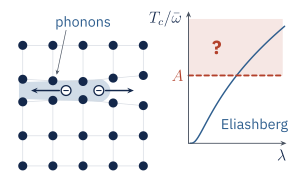
Within Migdal-Eliashberg theory and beyond it, determine whether $k_B T_c \le A \hbar \omega_{\mathrm{bar}}$ holds with a universal constant A ($A \sim 0.1$ argued from the breakdown of Migdal theory at strong coupling), and combine it with bounds on the highest phonon frequency in terms of the electron mass, charge and Planck constant to give a material-independent $T_c$ ceiling. An answer is a theorem with stated assumptions, or a model counterexample with controlled $T_c$ above the bound.
-
For Ta- or Nb-based transmons with $T_{1}$ from $\sim 0.3\,\mathrm{ms}$ to above $1\,\mathrm{ms}$ at $\sim 4-5\,\mathrm{GHz}$ on sapphire or high-resistivity Si, determine the loss tangents $\tan \delta_{i}$ and participation ratios $p_{i}$ of the metal-air, metal-substrate, substrate-air, substrate bulk and junction regions, and identify which term dominates $1/Q = \sum_{i} p_{i}\tan \delta_{i}$ plus non-dielectric channels.
-
In Si/SiGe and Si-MOS quantum-dot qubits, charge noise with $S_E(1\,\mathrm{Hz})^{1/2}$ of order $0.1-1\,\text{micro-eV}/\mathrm{Hz}^{1/2}$ and spectral exponent near 1 limits dephasing and two-qubit gate fidelity, with temperature and frequency dependence that vary between devices. Identify the fluctuator ensemble (defects in gate oxides, in the SiGe barrier, or at interfaces) and its location, using noise correlations between neighboring dots and dependence on the gate stack.
-
Microscopic origin of 1/f flux noise in SQUIDs and qubits
Partially resolved 71Low-frequency flux noise $S_{\Phi}(1\,\mathrm{Hz})^{1/2} \sim 1-10\,\mathrm{micro}-\Phi_0/\mathrm{Hz}^{1/2}$ ($\Phi_0=hc/2e$), weakly dependent on loop area, is attributed to surface spins of density $\sim 5 \times 10^{13}\,\mathrm{cm}^{-2}$ (Koch, DiVincenzo and Clarke 2007). Identify the spin species (adsorbed $\mathrm{O_2}$, hydrogen, dangling bonds) and the dynamics producing $1/f$ (spin clusters, spin-glass dynamics, spin diffusion), consistent with the measured temperature dependence and the correlation between flux noise and inductance noise.
-
For lattice models with purely repulsive interactions (Hubbard-type, bandwidth $W=8t$ on the square lattice), determine the maximum $T_c/t$ over interaction strength, filling and lattice geometry, and whether it exceeds the cuprate value $T_c/t\sim 0.03$. An answer is controlled numerical $T_c$ values with error bars, or a bound.
-
$H = \sum_i J S_i . S_{i+1} + h_i S^{z}_i$ with $h_i$ independent and uniform in $[-W, W]$. Does a $W_c < \infty$ exist such that for $W > W_c$ infinite-temperature eigenstates obey an area law and local memory of the initial state persists as $t \to \infty$, in the limit $L \to \infty$? Answer yes or no, with an estimate or bound on $W_c$.
-
What stabilizes ferroelectricity and wake-up in thin-film $\mathrm{HfO_2}$?
Partially resolved 70Doped (Si, Zr, La, Y) $\mathrm{HfO_2}$ films of thickness about $5 \times 10^{-7}$ to $2 \times 10^{-6}$ cm show remanent polarization of order $3 \times 10^{4} \text{ to } 9 \times 10^{4}\,\mathrm{statC}/\mathrm{cm}^{2}$, attributed mainly to the metastable orthorhombic $\mathrm{Pca2}_{1}$ phase. Determine which factors stabilize it (surface and grain-boundary energy, dopants, oxygen vacancies, stress, electrodes), whether other polar phases contribute, and the mechanism of wake-up and fatigue (oxygen-vacancy redistribution versus field-induced transformation from tetragonal or monoclinic grains). An answer is a phase-stability and switching model predicting remanent polarization versus thickness, dopant and cycle number.
-
For 3D Edwards-Anderson instances with $N$ up to about 5000 spins, compare the scaling with $N$ and with the target residual energy per spin $\epsilon$ of the time to solution of coherent quantum annealing against named classical baselines: simulated annealing, parallel tempering, and tensor-network and variational Monte Carlo emulation of the annealing dynamics. An answer is a pair of measured scaling exponents with uncertainties for each baseline on fixed instance families with matched resources.
-
Numerics predict Moore-Read-type non-Abelian order at half filling of a higher moire Chern band of twisted $\mathrm{MoTe_2}$ near $\theta \sim 2\ \mathrm{deg}$, a band whose wavefunctions resemble the first excited Landau level. Determine whether any zero-field moire Chern band hosts a gapped even-denominator state with non-Abelian order. An answer is a quantized even-denominator $\sigma_{xy}$ with $R_{xx} \to 0$ at $B = 0$, plus a half-integer chiral central charge from thermal Hall or $e/4$ quasiparticle charge.
-
Can first-principles Eliashberg theory predict hydride $T_{c}$ within ten percent?
Partially resolved 68Determine whether Migdal-Eliashberg theory with first-principles electron-phonon coupling, including quantum anharmonic lattice dynamics and zero-point motion and with $\mu*$ computed or fixed in advance, predicts $T_{c}$ of compressed hydrides ($\mathrm{H_3S}$, $\mathrm{LaH_{10}}$, $\mathrm{CaH_6}$, $\mathrm{YH_6}$) within 10 percent and their isotope coefficients. An answer is a blind prediction later confirmed or refuted by experiment.
-
With $\hbar/\tau = \alpha k_B T$ extracted from the T-linear resistivity slope and the independently measured effective mass and carrier density, test whether $\alpha = 1$ within error across strange metals and whether any metal sustains $\alpha >> 1$. An answer is a proof of a bound on the transport scattering rate within a defined class of models, or a material with reliably measured $\alpha$ well above 1.
-
For $\nu = 5/2$ in high-mobility GaAs quantum wells, determine the topological order. The thermal Hall conductance $\kappa_{xy} = c \kappa_0$, $\kappa_0 = \pi^2 k_B^2 T/(3h)$, distinguishes Pfaffian ($c = 7/2$), PH-Pfaffian ($c = 5/2$) and anti-Pfaffian ($c = 3/2$); the measured value is $5/2$ (Banerjee et al., 2018), while numerics with Landau-level mixing favour anti-Pfaffian or Pfaffian. An answer is an identification consistent with thermal Hall, upstream neutral modes, tunnelling exponents and numerics.
-
Polynomial-cost real-time simulation of interacting fermion lattices
Partially resolved 67Real-time diagrammatic and path-integral Monte Carlo for nonequilibrium Green's functions have variance growing as $\exp(c t)$. Inchworm Monte Carlo (Cohen et al. 2015) and related methods reach polynomial scaling in t for Anderson impurity models. Determine whether a classical algorithm computes local real-time correlators of the infinite 2D Hubbard model at $U/t \sim 4$, starting from a thermal state at $T \sim t$, up to time $t_{\max}$ with error $\epsilon$ at cost polynomial in $t_{\mathrm{max}}$ and $1/\epsilon$, or prove that this is hard (e.g. by a complexity reduction). An answer is an algorithm with proven scaling or a hardness proof.
-
Twisted bilayer graphene at $\theta \sim 1.05-1.15\,\mathrm{deg}$ superconducts with $T_c$ up to $\sim 3\,\mathrm{K}$ near filling $\nu = -2 - \delta$ ($\nu$ = electrons per moire cell measured from charge neutrality). Determine the dominant pairing interaction (intervalley K-point optical phonons, other phonons, spin or valley fluctuations, Coulomb-driven Kohn-Luttinger pairing, or a combination) and the order-parameter symmetry. An answer is a microscopic model that reproduces the measured $T_c(\nu, \theta)$, tunnelling gap spectrum and superfluid stiffness without retuned parameters.
-
Source of residual nonequilibrium quasiparticles in superconducting qubits
Partially resolved 66In Al-based qubits at $T \sim 20\,\mathrm{mK}$, the thermal quasiparticle fraction $x_{qp} \sim \sqrt{2 \pi T/\Delta}\,\exp(-\Delta/T)$ is below $10^{-40}$, while measured $x_{qp}$ ranges from $\sim 10^{-11}$ to $10^{-5}$. Known sources are stray infrared photons, ionizing radiation (gamma rays, cosmic-ray muons) and phonon bursts from stress relaxation (Mannila et al. 2022). With infrared shielding, radiation shielding and gap engineering in place, determine the residual $x_{qp}$ and charge-parity switching rate and identify the remaining generation mechanism.
-
For amorphous $\mathrm{SiO_2}$ (and a-Si, a-Al2O3), identify the atomic configurations that form tunneling two-level systems with energies below $\sim 10^{-4}\,\mathrm{eV}$ ($\sim 1\,\mathrm{K}$), and reproduce their measured density of states $P$, deformation potential $\gamma \sim 0.5-1\,\mathrm{eV}$, electric dipole moments and isotope dependence.
-
Does the pure square-lattice Hubbard model superconduct at moderate doping?
Partially resolved 65For the square-lattice Hubbard model with $t' = 0$, $U/t = 6\ \text{to}\ 8$ and hole doping $\delta = 1/8$, determine whether the ground state in the thermodynamic limit has long-range d-wave superconducting order or a stripe state whose pair correlations decay to zero. An answer is a controlled extrapolation of the pairing order parameter from at least two independent methods (DMRG, AFQMC, iPEPS, DMET) with consistent error bars.
-
For heavy-fermion quantum critical points (CeCu6-xAux, $\mathrm{YbRh_2Si_2}$, $\mathrm{CeRhIn_5}$ under pressure, $\mathrm{CeCoIn_5}$), determine whether criticality is of Hertz-Millis-Moriya spin-density-wave type with Kondo screening intact, or of local (Kondo breakdown) type in which the f electrons leave the Fermi volume at the critical point. An answer classifies the known materials using $\omega/T$ scaling of the dynamical spin susceptibility, the Fermi-volume change, and the exponents of $C/T$ and $\rho(T)$.