This browser is older than PubPhys supports. Every page can be read, but signing in to contribute, voting and signing need Safari 15.4, Chrome or Edge 99, Firefox 97 or newer. Browsers
All problems
105 problems
Starting order drafted by AI. Votes change it. How ranking works
-
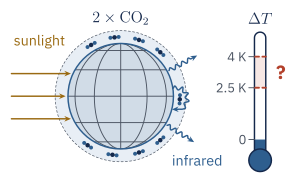
What is Earth's equilibrium climate sensitivity?
Partially resolved 88Equilibrium climate sensitivity (ECS) is the equilibrium global-mean surface air temperature change for doubled $\mathrm{CO_2}$ (forcing about $4\mathrm{e}3\,\mathrm{erg}/(\mathrm{s}\,\mathrm{cm}^{2})$). The 2020 multi-evidence assessment gives a 66 percent range of about $2.6\ \text{to}\ 3.9\,\mathrm{K}$ and the 2021 IPCC assessment a likely range of $2.5\ \text{to}\ 4\,\mathrm{K}$. An answer is a 66 percent range narrower than $1\,\mathrm{K}$ consistent with process, historical and paleoclimate evidence.
-
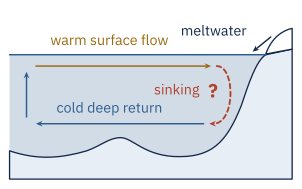
Determine whether the present AMOC (about $17\,\mathrm{Sv}$ at $26.5\,\mathrm{N}$, $1\,\mathrm{Sv} = 10^{12}\,\mathrm{cm}^3/\mathrm{s}$) is bistable and, if so, the critical North Atlantic freshwater flux or global warming level at which the strong state disappears, including the timescale of the transition. An answer is a threshold value with uncertainty from models whose salt-advection feedback and mean salinity biases are constrained by observations.
-
AI-generated illustration
Is West Antarctic retreat already irreversible?
Contested 84For the Amundsen Sea sector (Thwaites and Pine Island glaciers), determine whether grounding lines have passed a marine ice-sheet instability threshold such that retreat continues under present or even reduced ocean forcing, accounting for bedrock uplift, ice-shelf buttressing and basal friction laws. An answer is a yes or no with the committed sea-level contribution (Amundsen Sea sector potential about 120 cm, whole West Antarctic ice sheet about 330 cm) and its timescale.
-
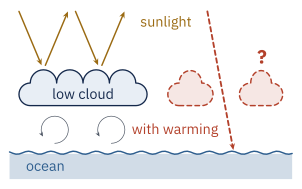
How strongly do low marine clouds amplify warming?
Partially resolved 83Determine the global low-cloud feedback parameter (stratocumulus and trade cumulus over the subtropical oceans) in $\mathrm{erg}/(\mathrm{s}\,\mathrm{cm}^{2}\,\mathrm{K})$; current assessments center near $+2 \times 10^{2}\,\mathrm{erg}/(\mathrm{s}\,\mathrm{cm}^{2}\,\mathrm{K})$ with large uncertainty. An answer is a value with uncertainty below about $10^{2}\,\mathrm{erg}/(\mathrm{s}\,\mathrm{cm}^{2}\,\mathrm{K})$ supported by large-eddy simulations and observed cloud-controlling-factor relations.
-
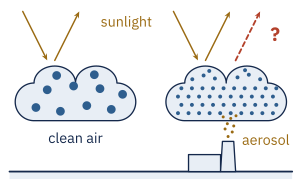
The industrial-era total aerosol effective radiative forcing has a 68 percent range of about $-1.6 \times 10^{3} \text{ to } -0.65 \times 10^{3}\,\mathrm{erg}/(\mathrm{s}\,\mathrm{cm}^2)$ (Bellouin and coauthors, Reviews of Geophysics 2020, https://doi.org/10.1029/2019RG000660), dominated by aerosol-cloud interactions (droplet number, liquid-water-path and cloud-fraction adjustments). Determine this forcing with a 68 percent range narrower than about $4 \times 10^{2}\,\mathrm{erg}/(\mathrm{s}\,\mathrm{cm}^2)$. An answer is a value supported by process-level observations of cloud adjustments and consistent with the historical and interhemispheric temperature record.
-
AI-generated illustration
Is the AMOC already weakening toward collapse today?
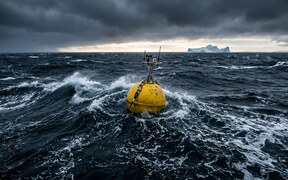
Contested 76Using the RAPID array (since 2004), other transport arrays and proxy reconstructions (sea-surface temperature fingerprints, sediment grain size), determine whether the AMOC has declined since the mid-20th century beyond natural variability and whether early-warning indicators (rising variance and autocorrelation, freshwater-transport sign at 34 S) are physically valid for this system. An answer is a detected or rejected trend and stability-loss signal with stated confidence.
-
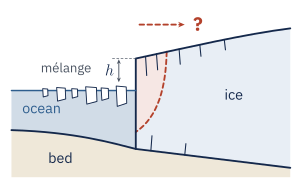
Determine whether ice cliffs with subaerial height above about 100 m fail faster than ice flow can replace them, producing self-sustained retreat into deepening basins, and whether this marine ice-cliff instability (MICI) is required to explain past sea-level highstands. An answer is a validated calving law for tall cliffs, including brittle and viscous failure and buttressing by melange (a mix of icebergs and sea ice), applied to Thwaites-type geometries.
-
AI-generated illustration
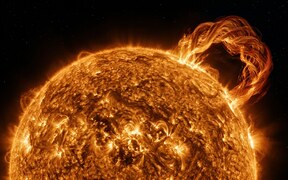
Predict the time series of the north-south interplanetary magnetic field component $B_z$ inside a CME at $1\,\mathrm{au}$ from observations at or near the Sun (photospheric magnetograms, coronagraph images), including rotation, deflection and erosion during propagation. An answer is a forecast method that achieves skill above climatology in $B_z$ sign and magnitude with lead time of a day or more.
-
AI-generated illustration
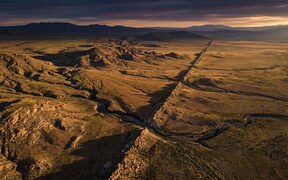
Quantify the maximum probability gain over ETAS achievable for $M \ge 6$ earthquakes in windows of about 30 days and 100 km, using any combination of seismic, geodetic, hydrological or electromagnetic data. An answer is either a prospectively tested forecast with gain significantly above 1 in a CSEP-type experiment (CSEP: a community testing framework for earthquake forecasts), or an information-theoretic bound showing gains are limited.
-
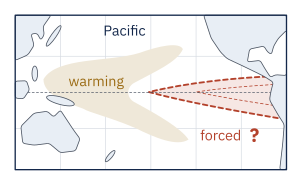
Over roughly 1980 to 2020 the eastern equatorial Pacific and Southern Ocean warmed less than in coupled models, making the effective historical feedback more negative than the long-term feedback. Determine whether this sea surface temperature pattern is forced (and will persist) or internal variability (and will reverse), and the resulting correction to ECS inferred from historical warming. An answer is an attribution of the pattern with uncertainty and the implied pattern-effect correction.
-
AI-generated illustration
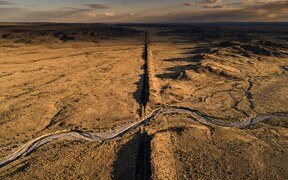
Rate-and-state friction predicts a quasi-static nucleation zone of size $L_c \sim G D_c/(\sigma (b - a))$ before dynamic rupture. Determine whether earthquakes with $M \ge 7$ are systematically preceded by aseismic slip or foreshock sequences distinguishable from ETAS background clustering (ETAS: a statistical model in which every earthquake can trigger later ones) at amplitudes above present geodetic and seismic detection thresholds. An answer is a statistically significant catalog-wide test.
-
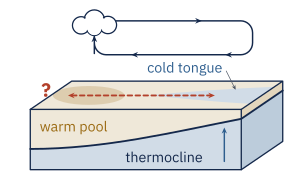
Determine the sign and magnitude of change in ENSO amplitude, frequency and spatial pattern under greenhouse warming, and resolve why the observed 1980 to 2020 eastern equatorial Pacific cooling trend and strengthened zonal SST gradient differ from the warming in most CMIP models. An answer is a projected change with mechanisms (thermocline, zonal advective and Ekman feedbacks) constrained by observations and paleo records.
-
Derive and validate a parameterization of basal melt rate m as a function of far-field temperature, salinity and current speed under ice shelves, covering shear-driven and convective, double-diffusive regimes of the ice-ocean boundary layer and the effect of basal channels and crevasses. An answer is a melt law tested against direct under-ice observations to within a factor of order unity across regimes.
-
Identify the physical processes that stall magma intrusions during unrest (solidification of dikes, stress barriers, volatile loss, insufficient overpressure) and derive measurable discriminants between unrest that culminates in eruption and unrest that does not. An answer is a criterion based on geodetic, seismic and gas data with demonstrated skill on a global catalogue of unrest episodes.
-
For a given magma composition and volatile content, determine the conditions (ascent rate, conduit permeability and outgassing, crystallization, conduit geometry) that select explosive versus effusive eruption, and identify the observable precursors that discriminate them. An answer is a predictive model of eruption style verified against eruptions with known ascent conditions.
-
Quantify the contributions of ocean temperature and solubility, Southern Ocean sea-ice capping and stratification, iron fertilization of the biological pump, carbonate compensation and terrestrial carbon to the roughly $90\,\mathrm{ppm}$ glacial-interglacial $p\mathrm{CO}2$ change, with a budget that closes within proxy uncertainty. An answer is a quantitative carbon budget consistent with deep-ocean carbon-14 ages, $\delta-13\mathrm{C}$ and carbonate-ion proxies at the Last Glacial Maximum.
-
The tropical anvil cloud area feedback was assessed at about $-2 \times 10^{2} \pm 2 \times 10^{2}\,\mathrm{erg}/(\mathrm{s}\,\mathrm{cm}^2\,\mathrm{K})$ (Sherwood and coauthors 2020), while the iris hypothesis (Lindzen and coauthors 2001) argued for a much more negative value. Determine the global anvil-area feedback and its mechanism (stability iris, changes in convective aggregation, anvil lifetime and microphysics) with uncertainty below about $10^{2}\,\mathrm{erg}/(\mathrm{s}\,\mathrm{cm}^2\,\mathrm{K})$.
-
Using global catalogs of source time functions, determine whether the moment-rate function in the first few seconds statistically predicts the final moment magnitude $M_w$ for large events (weak or strong determinism), or whether growth is universal until arrest. An answer is a statistically significant discrimination of final $M_w$ from early moment rate, with stated scatter, or proof of indistinguishability.
-
Derive the global annual tropical cyclone frequency (about 85 per year) from the large-scale state, specifying whether genesis is limited by the rate of seed disturbances or by environmental conditions, and predict its sign and magnitude of change under $\mathrm{CO_2}$ doubling. An answer is a theory or validated genesis index that reproduces present climatology and agrees with convection-permitting simulations across climates.
-
For the Greenland interstadial onsets of the last glacial period (about 115 to 12 kyr ago), determine whether the abrupt warmings are noise-induced transitions between AMOC states, self-sustained oscillations involving sea-ice and ocean stratification in the Nordic Seas, or forced by ice-sheet changes, and what sets their irregular spacing. An answer is a mechanism reproduced in a comprehensive model under glacial boundary conditions with the observed amplitude, rise time of decades, and Antarctic bipolar seesaw lag.
-
Determine the thermal conductivity $k$ of the outer-core Fe-Ni-light-element liquid at $P \sim 1.36 \times 10^{12}\,\mathrm{dyn}/\mathrm{cm}^2$ and $T \sim 4000\,\mathrm{K}$. Ab initio calculations give $k$ of order $10^{7}\ \text{to}\ 2.5 \times 10^{7}\,\mathrm{erg}/(\mathrm{s}\,\mathrm{cm}\,\mathrm{K})$ while some laser-heated diamond-anvil measurements give values near $3 \times 10^{6}\,\mathrm{erg}/(\mathrm{s}\,\mathrm{cm}\,\mathrm{K})$. An answer is $k$ with about 20 percent uncertainty including light-element and electron-electron scattering contributions.
-
Slow slip events and tectonic tremor at subduction zones move at slip rates of order $10^{-6} \text{ to } 10^{-5}\,\mathrm{cm/s}$, roughly $10 \text{ to } 100$ times the plate rate and about $10^{7} \text{ to } 10^{8}$ times slower than earthquake slip (near $10^{2}\,\mathrm{cm/s}$). Identify the physical control: near-neutral rate-and-state frictional stability ($a - b \text{ near } 0$) with high pore-fluid pressure, dilatancy strengthening, mixed frictional-viscous rheology, or fault-zone heterogeneity, and whether and when slow slip triggers large earthquakes. An answer is a constitutive model, tested against laboratory data, that reproduces the observed moment-duration scaling, recurrence and tremor of slow slip (review: Burgmann, EPSL 2018, https://doi.org/10.1016/j.epsl.2018.04.062).
-
Explain the planetary-scale (zonal wavenumber 1 to 3), intraseasonal (30 to 90 day), eastward-propagating (about 500 cm/s) convective envelope over the Indo-Pacific warm pool, distinguishing moisture-mode theories, skeleton and gravity-wave theories, and radiative-convective feedback mechanisms. An answer is a theory predicting the scale selection, propagation speed and growth rate, verified against observations and convection-permitting simulations.
-
Convection with strongly temperature-dependent viscosity generically produces a stagnant lid. Identify the lithospheric weakening mechanism (water, grain-size reduction and damage, pore fluids) and the planetary parameters (surface temperature, water content, mass, interior temperature) that place Earth in the mobile-lid regime and Venus outside it. An answer is a regime diagram from a rheology calibrated on experiments that places both planets correctly.
-
Which dynamic weakening mechanism controls friction during earthquake slip?
Partially resolved 58At slip rates near $10^{2}\,\mathrm{cm}/\mathrm{s}$, laboratory friction falls to coefficients of about 0.1 to 0.3. Identify which mechanism (flash heating at asperity contacts, thermal pressurization of pore fluid, melt lubrication, nanopowder or silica-gel lubrication) controls coseismic shear stress at seismogenic depths on natural faults, and its dependence on slip and slip rate. An answer is a constitutive law validated against natural fault-zone observations.
-
Predict the time-dependent neutral mass density at 200 to 600 km altitude during storms from solar-wind driving, including Joule heating distribution, nitric-oxide radiative cooling and the composition response. An answer is a model reproducing observed storm-time density enhancements (for example the May 2024 storm) to within tens of percent in amplitude and hours in timing.
-
Where did Earth's water come from?
Contested 58Earth's ocean $\mathrm{D}/\mathrm{H}$ is about $1.5 \times 10^{-4}$, similar to CI and CM carbonaceous chondrites and to enstatite chondrites, while nebular hydrogen has $\mathrm{D}/\mathrm{H}$ near $2 \times 10^{-5}$. Determine the fractional contributions of carbonaceous material, inner-disk (enstatite-like) material, nebular ingassing and comets to bulk Earth hydrogen, and whether delivery preceded or followed the Moon-forming impact. An answer is a mixing solution consistent with H, N, noble gas and nucleosynthetic isotope data.
-
Satellite radiation budgets show a record-low planetary albedo in 2023 driven by reduced low cloud cover, contributing roughly 0.2 K to the global temperature anomaly (Goessling and coauthors, 2024). Separate the contributions of reduced sulfate aerosol (including 2020 shipping fuel rules), internal variability and a low-cloud feedback. An answer is a quantitative attribution with uncertainties.
-
Determine whether the spontaneous aggregation of convection found in radiative-convective equilibrium simulations (driven by longwave radiative, surface-flux and moisture feedbacks) operates in the observed tropics, and quantify its effect on outgoing longwave radiation, mean humidity and climate sensitivity. An answer is an observational metric of aggregation with a measured dependence on sea-surface temperature and a quantified radiative effect.
-
The outer core is roughly 10 percent less dense than Fe-Ni at the same P and T, the inner core a few percent, and the density jump at the inner-core boundary is about $0.5\ \text{to}\ 0.9\ \mathrm{g}/\mathrm{cm}^{3}$ depending on the normal-mode analysis. Determine the concentrations of Si, O, S, C and H in outer and inner core that reproduce density, compressional velocity and the boundary density jump, with solid-liquid partitioning from experiment or ab initio calculation and consistency with core-formation conditions. An answer is a composition with uncertainty of about 1 weight percent per element.